How to Volunteer Abroad: A Step-by-Step Guide for 2026
Learn how to volunteer abroad in 2026: choose a responsible project, check requirements, budget the real costs, prepare well and travel with confidence.
You've got a window in your calendar, money set aside and eleven browser tabs open: a sea turtle hatchery, a classroom in Sri Lanka, a clinic in the Philippines. Every page looks convincing. Almost none of them tells you who supervises you on a Tuesday morning, what the fee covers, or what happens if you get sick in week two. That gap is where disappointing trips start.
The order of your decisions matters more than the destination. Settle the daily work first. Then vet who runs the project, confirm the requirements, price the whole trip, and book last. Do it the other way round, by falling for a country and a photograph, and you'll spend your first week abroad negotiating basics you should have nailed down at home.
Table of Contents
How to Volunteer Abroad Step by Step at a Glance
Volunteering abroad means joining work that already exists in a community, in a defined role, with local people setting the priorities. You aren't arriving to invent a project. You're slotting into one, and the value you add depends on how well you fit the task in front of you.
The scale puts it in perspective. United Nations sources estimate that about 2.1 billion people, roughly 34.5% of the world's working-age population, volunteer each month, whether through organisations or informal mutual aid, according to the UN's overview of volunteerism. That figure counts neighbours helping neighbours as well as formally arranged service, so it isn't a count of people who travel. The cross-border slice is still substantial: in 2024, 3,175 United Nations Volunteers served internationally outside their countries of origin, per UNV's 2024 annual report.
The sequence below is the one I'd walk any first-time volunteer through. Each step is a gate, and if one fails you pause before spending money on the next.
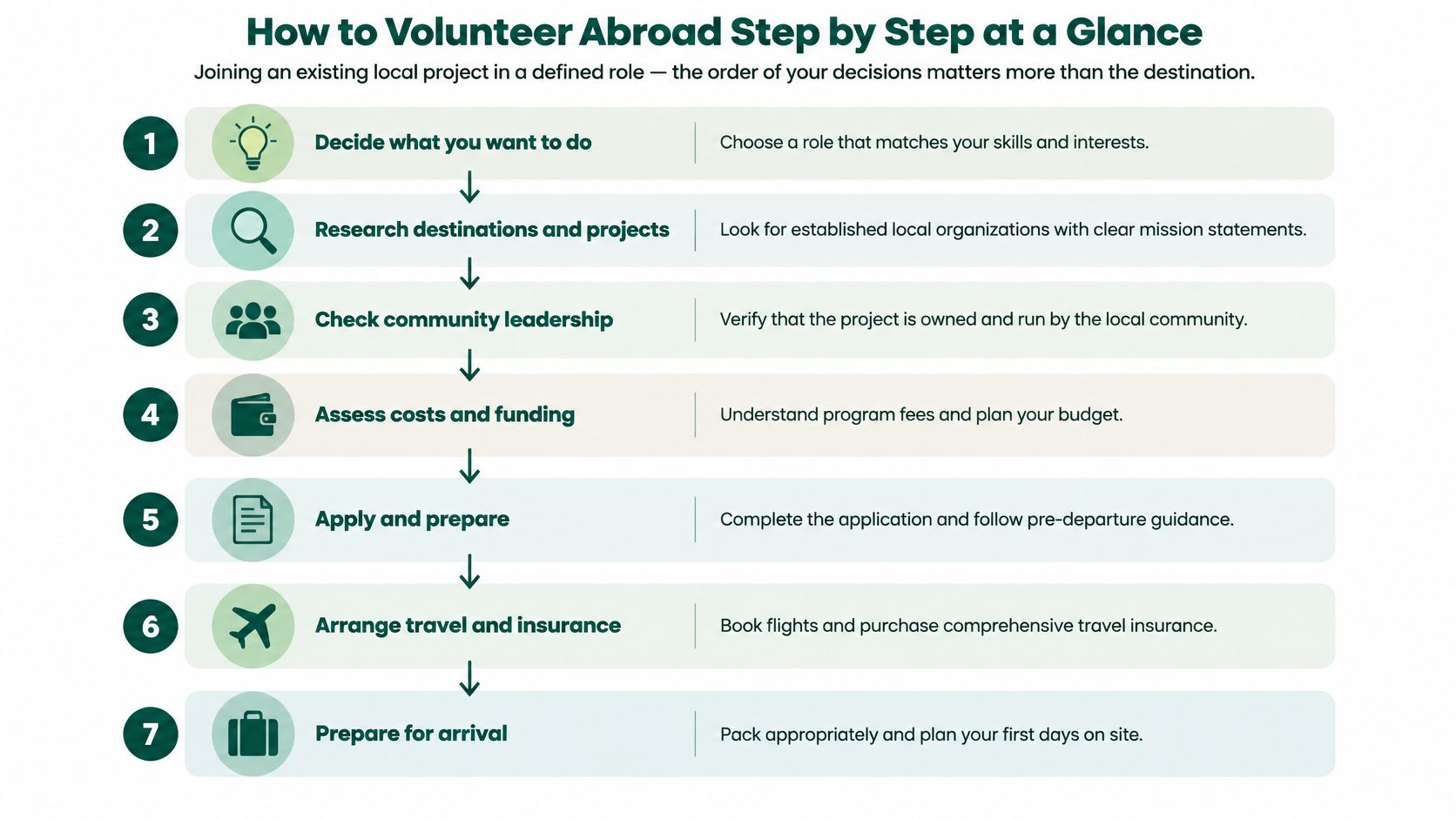
Decide the daily work and the weeks. Name the activity you want to be doing at 9am and the number of weeks you can commit, holidays included.
Shortlist places where the constraints fit. Dates, working language, physical demands, minimum stay and project requirements all have to line up at once.
Vet the organisation and the project. Look for local ownership, a named supervisor, a written role and safeguarding rules that match the people you'll be around.
Confirm eligibility. Age, language level, relevant studies, criminal-record self-declaration, and parental consent if you're under 18.
Price the whole trip. Programme fee, flights, visa, insurance, vaccinations, local transport and a contingency.
Book, then prepare. Documents, health appointments, arrival logistics and a packing list built around the actual work.
Arrive and work under local coordination. Attend orientation, meet your coordinator, agree check-in times and follow local rules on photos and consent.
Allow several months from first idea to departure, and longer where a visa or a healthcare credential is involved. Everything below follows that order, because skipping a gate is how people end up paying for a placement that can't explain its own supervision.
Choose Your Daily Role Before You Pick a Country
Start with the question that decides everything else: what do you want to be doing during the day, and how many weeks can you give? Two placements can cost the same and look equally photogenic while offering completely different work. One has you planning lessons with a teacher; the other has you counting turtle eggs at 5am.
A weekday in each kind of placement
Education is the oldest version of this work. When the Peace Corps sent its first group to Accra in 1961, the 51 volunteers known as Ghana I arrived to work as teachers, according to the Peace Corps milestones factsheet. A school placement today has the same shape: classroom support, games, reading and homework help, with a local teacher deciding what you're allowed to run.
Conservation is physical and starts early, with beach patrols, hatchery shifts, habitat work and data collection before the heat builds. Healthcare roles are clinic observation, preparation and health education, and they usually ask for relevant studies or skills. Community and women's strengthening placements are conversation-heavy: workshops, skills sharing, outreach and the admin that keeps a small organisation running.
Volunteer placement types compared by daily activities
| Placement type | A normal day includes | Suits | Typical requirements | Common minimum stay | |---|---|---|---|---| | Education and teaching | Classroom support, games, stories, homework help | Patient, social travellers, teachers, students | Basic English; some roles want teaching experience | 1-2 weeks | | Childcare | Play, daily routines and early-learning activities | Energetic, hands-on volunteers | Supervised contact and safeguarding rules | 1-2 weeks | | Conservation and wildlife | Beach patrols, hatchery care, habitat work, data collection | Outdoorsy travellers fit for heat and early starts | Physical fitness; experience rarely required | 1-2 weeks | | Medical and healthcare | Clinic observation, preparation, health education | Health students and professionals | Relevant studies or skills usually required | 2+ weeks | | Community and women's empowerment | Workshops, skills sharing, admin and outreach support | Communicators and self-starters | Working language and cultural sensitivity | 2+ weeks |
The shortlisting rule that saves the most time
Keep only placements where dates, working language, physical demands, minimum stay and project requirements all fit. Everything else goes on a maybe list, however good the photos.
The two-placement test: ask what a normal Tuesday looks like in each, and exactly what the fee includes. If either answer is vague, you've found your answer.
The classic trap is fixing a date or a dream destination before you understand the daily role, the travel time to site and the full cost. Placements cluster where host organisations are. In 2024, 2,380 young people completed a weltwärts volunteer service in countries of the Global South, with 45% in Latin America, 36% in Africa and 18% in Asia, according to the German weltwärts programme. Your shortlist should follow that logic, not a bucket list.
We run projects in 15 destinations: Cambodia, Cape Verde, Colombia, Costa Rica, India, Indonesia, Japan, Kenya, Nepal, the Philippines, South Korea, Sri Lanka, Tanzania, Thailand and Vietnam. Usually, no prior volunteering experience is needed to join a project, which means the daily activity matters more than your CV. If teaching is the draw, volunteer teaching in Nosy Be is a school-based role where you prepare lessons, games and creative activities with local teachers while children and teenagers practise English.
Check That the Project Is Community Led
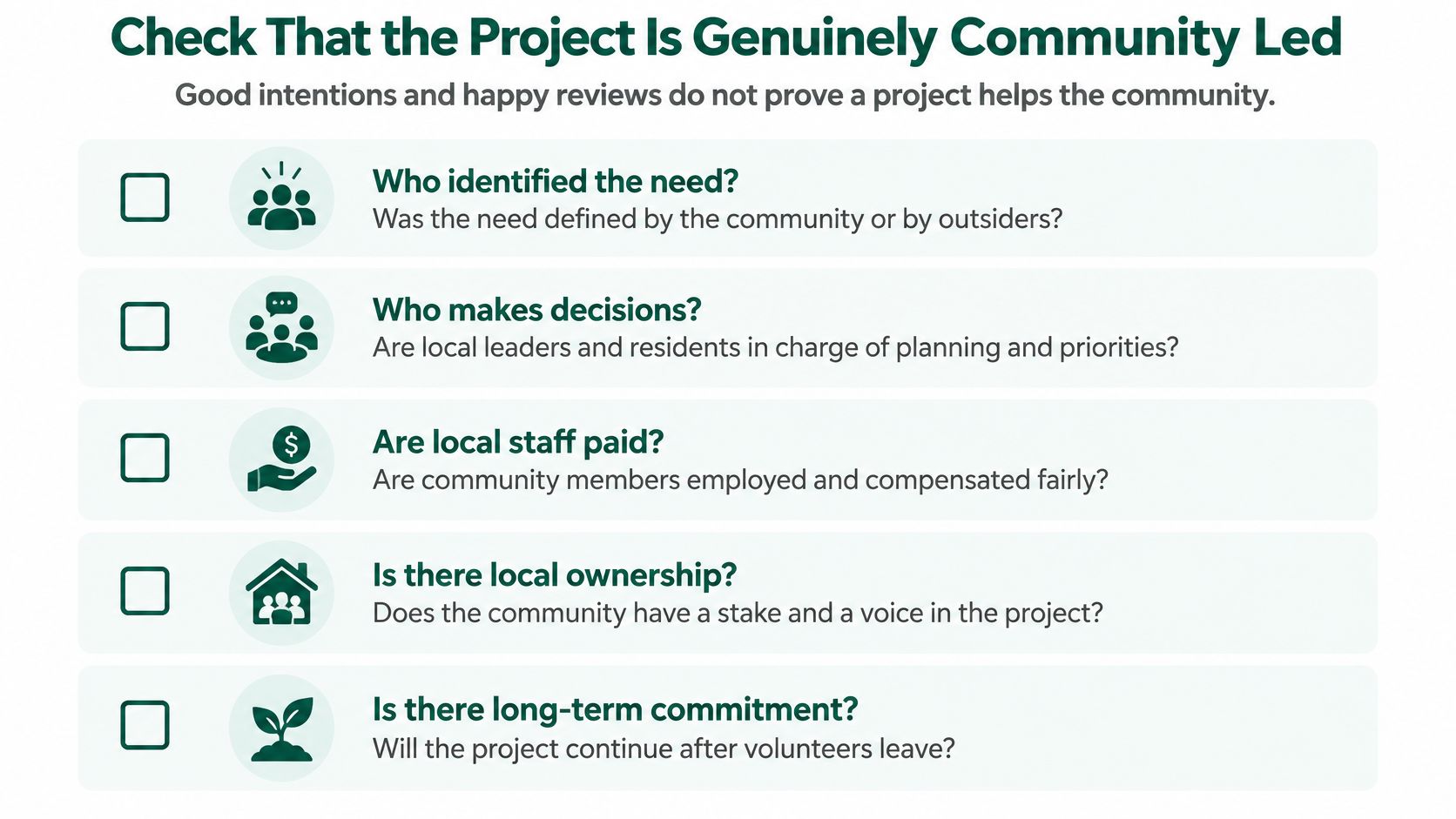
A project can be warm, well reviewed and still not need you. Happy volunteers prove the volunteer enjoyed the week. They don't prove the community gained anything, and confusing the two is the most expensive mistake in this whole process.
A 2025 interview study of 48 volunteers in Social Problems found that participants often used organizational, material or "suspending" justifications to preserve a sense of moral legitimacy despite criticism of the model. In plain terms, people who liked their trip found reasons to stop asking hard questions. Ask them anyway, before you pay.
The ownership questions
Who identified the need? A local organisation, a school head or a clinic manager, or an overseas marketing team?
Who makes decisions? Names matter. If nobody local sets priorities, the project isn't locally led.
Are local staff paid and leading? Volunteers should support qualified local people and leave skilled local jobs to local staff.
What outcomes existed before you arrived? Look for work that was already running and will run after you leave.
What happens between cohorts? Handovers, continuity and a plan for the months when nobody is visiting.
Then check the mechanics of your own placement: a written role description, a named supervisor, a route for reporting problems and a complaints channel. On a community-led project you join activities that already exist and help where your skills are useful, alongside people who live and work in the destination. If a provider can't explain who supervises volunteers or how incidents are handled, walk away before payment.
Make safeguarding the deciding screen
For child- and health-facing work, treat this as the deciding factor. Expert guidance published by the Better Care Network recommends that volunteers around vulnerable children be appropriately skilled, support local professionals rather than substitute for them, and never be unscreened or left alone with children. The same paper cites evidence linking repeated volunteer turnover with emotional harm, attachment disruption, abuse risk and reinforcement of institutional care.
That's why I'd steer you toward community-based education, family support, conservation or capacity-building projects with stable local staff, and away from residential or orphanage-style placements. Ask any provider what they screen for and listen for specifics. On our side, staff and in-house volunteers complete a written application, a full CV, at least two verified references before any placement, a values-based interview and verified identity. Participants declare criminal records, and a parent or guardian is involved for anyone under 18.
Our projects are community-led and in some cases include contact with children and adults at risk, which is exactly why how we select projects is published rather than implied. If your provider can't explain their selection process, ask why not.
Questions that show who really leads the project
| Question to ask | Green flag | Red flag | |---|---|---| | Who runs the project day to day? | A named local organisation with paid local staff | No local names, overseas-only ownership | | What do volunteers do day to day? | A written role supporting ongoing work | Vague duties or "any help welcome" | | How are children protected? | Supervised contact, training, no one-to-one access | Unsupervised access or orphanage-style settings | | Do volunteers replace local workers? | Volunteers assist qualified local staff | Volunteers perform skilled local jobs for free | | What happens between cohorts? | Handover plans and continuity under local leadership | Constant turnover with no handover | | How transparent is the fee? | Written inclusions, exclusions and support | Vague pricing or pressure to pay quickly |
Budget the Full Cost Before You Book Anything
The programme fee is one line in a longer list. Canada's official travel guidance warns that volunteers may have to pay organisation fees, plane tickets, lodging and other placement expenses, and advises checking whether the destination requires a special volunteer or missionary visa, according to the Government of Canada's volunteering abroad guidance. The same page tells travellers to buy travel medical insurance and not to leave home without private medical coverage if they can't afford it.
Build the budget line by line, with the payment timing attached to each one. That way nothing lands as a surprise in the final fortnight.
Volunteer abroad budget checklist with payment timing
| Budget line | What it covers | When you pay it | Where to verify | |---|---|---|---| | Programme fee | Accommodation, meals, coordination and local support, varying by destination | At booking | Project page or provider team | | Flights | International return ticket | Once dates and inclusions are confirmed | Airlines and fare alerts | | Visa or volunteer permit | Legal right to enter and volunteer | Before departure, per official deadlines | Destination embassy or official portal | | Travel medical insurance | Illness, injury and medical evacuation | Before departure | Insurer policy documents | | Vaccinations and health prep | Vaccines, malaria tablets, travel-health advice | Before departure, per clinic advice | Travel clinic | | Local transport and SIM | Daily commute, arrival extras, mobile data | On arrival | Local coordinator | | Spending money and contingency | Personal costs plus a 10-15% buffer | Ongoing | Your own budget sheet |
Two mistakes that blow up budgets
The first is comparing providers on headline fee instead of inclusions. A cheaper programme that excludes meals, airport pickup and local transport can cost more by the end of week two. Read what's covered, then compare totals.
The second is forgetting arrival-day costs: the taxi from the airport, the first meals before a kitchen routine exists, a SIM card, and enough local cash to cover the gap before you find an ATM. Carry a small buffer in cash and keep the rest card-accessible.
UK government guidance on safer volunteering overseas recommends checking the organisation's registration, track record, local partners, project-monitoring arrangements, travel plan, accommodation, insurance coverage and the support available if you must return home early, as set out in the UK's safer adventure travel and volunteering guidance. That last item belongs in your budget, not just your risk plan.
Fee inclusions differ by destination, because each local organisation hosts volunteers according to its own resources and the project's needs. That's not evasion; it's how community-run hosting works. Still, you should be able to read the project page and know what's in and what isn't. Our explanation of why volunteering abroad costs money covers where the fee goes. Total cost first, then book.
Confirm Requirements and Book in the Right Order
Requirements are where travellers assume, then lose a deposit. Before you pay anything, check the live offer for minimum age, working language, exact dates, minimum stay, physical demands and role-specific qualifications.
Keep two checks separate. Professional requirements apply to healthcare and some teaching roles, where relevant studies or experience make you useful and safe rather than a liability. Parental consent applies to anyone under 18: a parent or guardian takes part in the decision and the paperwork. One is competence, the other is permission, and neither substitutes for the other.
Most placements ask for no previous volunteering experience. You can join from the age of 16 with a basic level of English, enough to manage everyday conversations and understand instructions, though some activities call for a higher level. Where a project involves contact with children or adults at risk, expect to declare any criminal record as part of your application and to read the project's safeguarding rules before you travel.
Thresholds elsewhere can be far stricter, which is worth knowing before you assume every programme works the same way. Under the UN's Work4UN guidance on UN Volunteers, an international UN assignment typically runs 3 to 12 months with extensions up to four years and asks for a degree or higher technical diploma, two years of relevant experience and working English, French or Spanish; UN Youth Volunteers are aged 18 to 29 and serve 6 months to 2 years, while UN University Volunteers serve 3 to 6 months on terms set per assignment and confirmed on the offer before applying. Those are career-track postings, a useful contrast rather than a template for a two-week placement.
The booking sequence
Complete the questionnaire. Give your rough date window, length of stay, budget, interests, experience, who is travelling and what accommodation suits you. The answers are what the matching runs on, so vague answers get you a vague shortlist.
Discuss matching projects with the team. Ask what a normal weekday looks like and who supervises it.
Check the live offer. Exact dates, inclusions, exclusions, optional extras and any role requirements specific to that placement.
Confirm the placement. Only now is the project real enough to plan around.
Read the departure information pack. Visas, vaccinations, packing and arrival instructions all live here.
Book flights and confirm airport pickup. Send your arrival details so someone is expecting you.
Attend orientation on arrival. Meet your coordinator, learn the area and save the emergency numbers.
The order matters because each step depends on the last: flights bought before step 4 are a gamble, not a plan. If you have a healthcare background, medical volunteering in San José is the kind of placement where we talk through your studies, experience and the activities that suit your role before you confirm, because a mismatch there wastes everyone's time.
Prepare, Travel and Settle In Safely
Preparation is a countdown, not a checklist you attack the night before. The U.S. Department of State recommends reviewing the destination's travel advisory, ensuring passports and visas are current, checking CDC health information, obtaining insurance that covers medical evacuation, and identifying both a trip contact and an emergency contact, according to the State Department's volunteering abroad safety guidance. It also lists the organisational safeguards worth confirming in writing: pre-departure security briefings, country and safety training, first-aid-qualified staff, emergency evacuation plans and 24-hour office support.
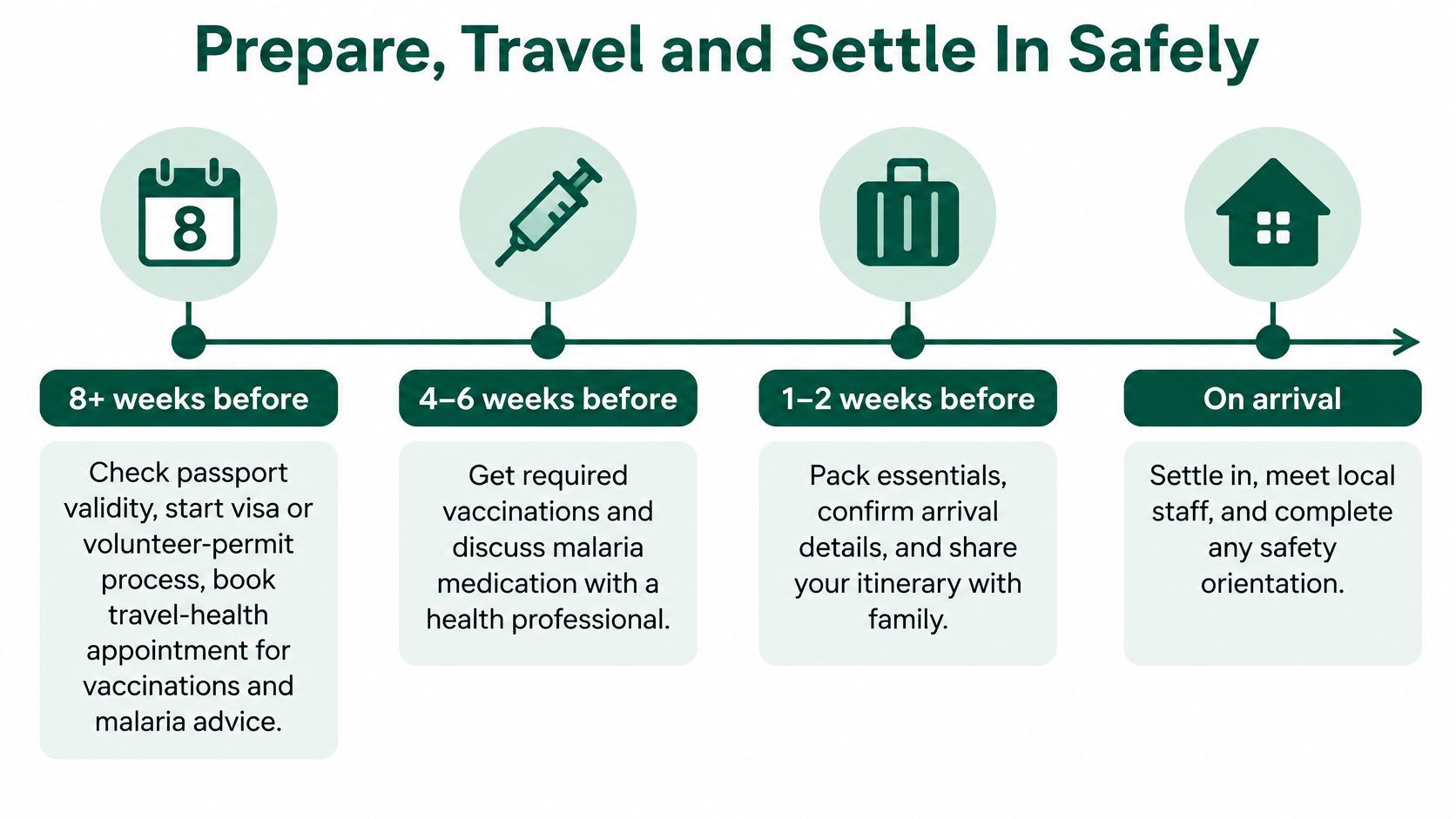
The countdown that works
Eight weeks or more out: check passport validity against the destination's entry rules, start the visa or volunteer-permit process, book a travel-health appointment for vaccinations and malaria advice, and buy insurance that includes medical evacuation.
Four weeks out: read the travel advisory properly, pack for the climate and the actual role rather than the brochure, and learn a handful of local phrases including the ones you'd need in an emergency.
One week out: share your itinerary with a trip contact and an emergency contact, reconfirm airport pickup, and carry paper and digital copies of your passport, insurance policy and project confirmation.
On arrival: attend orientation, meet your local coordinator, save the emergency numbers in your phone and agree how often you'll check in.
Practical rule: if you can't name the person who supervises you and the number you'd call at 2am, you're not prepared yet.
Why the first days feel off
Expect culture shock, a slower rhythm than you planned and questions nobody can answer yet. That's normal, not a sign you chose badly. Your local coordinator looks after volunteers while they're on project, so treat them as the first point of contact for anything from a task you don't understand to a fever. Report early rather than managing on your own.
Insurance deserves the same scrutiny as the placement itself. HearSmart's travel insurance comparison sets policies side by side, which is useful when you're checking evacuation cover and whether a curtailment claim would pay out. Our guide to volunteer abroad insurance covers the clauses that matter for this kind of trip.
Ask in writing what support exists if you have to return home early, and confirm your policy covers that cost. Also settle the small rules that cause real friction: when you may photograph children, who owns the images, and what consent is required. Respect local answers even when you disagree.
Start Your Volunteer Plan This Week
Your next step is a conversation about matching, before any payment. Run the sequence in order: settle the daily role, check that local people lead the work and safeguarding is written down, confirm requirements, budget the full cost, then book.
This week, write down five things: a rough date window, length of stay, budget, interests and experience. Add your working language, who is travelling with you and the accommodation that suits you. Use the 'Find my project' tool to shortlist two placements, then ask what a normal weekday looks like in each and which inclusions change by destination.
Keep the fee questions you already priced, and spend new energy on fit: who supervises you, which activities already exist, and where your help is useful. Organised volunteering is not free, so judge value by support, local ownership and clarity rather than promises.
HeyLocals runs volunteer placements with local organisations across Asia, Africa and Latin America and supports volunteers before, during and after the trip. If you know the daily work you want and the weeks you can give, bring those answers to HeyLocals and start matching before you book a flight.
In this article
- Table of Contents
- How to Volunteer Abroad Step by Step at a Glance
- Choose Your Daily Role Before You Pick a Country
- Check That the Project Is Community Led
- Budget the Full Cost Before You Book Anything
- Confirm Requirements and Book in the Right Order
- Prepare, Travel and Settle In Safely
- Start Your Volunteer Plan This Week