Nurse Volunteering Abroad: Roles, Limits and How to Choose
Nurse volunteering abroad explained: which roles nurses can take, what licences and supervision mean, and how to vet a placement before you commit.
You've got leave pencilled into your rota, a few overseas projects open in your browser and a nursing qualification you'd like to put to good use. The difficult part isn't choosing a destination. It's working out whether the placement offers clinical practice, supervised learning or practical support, and whether you're authorised and insured to do what it describes.
For nurse volunteering abroad, start with the role the local team approves, not the duties you perform at home. That distinction helps you choose a trip with realistic expectations and arrive ready to contribute on the host team's terms.
Table of Contents
Which Nurse Volunteer Roles Exist Abroad
A nurse arrives expecting clinical work, then learns at the first briefing that the host has approved an education and observation role. In this hypothetical situation, the problem isn't necessarily the placement. It's that the nurse booked before establishing what the role involved.
Your suitable role rests on your credentials, the specific site and the host's written approval. A project title such as medical support doesn't settle those questions. Nor does another volunteer's account establish what you'll be allowed to do.
Find the background that matches yours
Typical volunteer roles by nursing background
| Background | Typically approved scope | What to confirm first | |---|---|---| | Qualified registered nurse | Scope set by the host after a credential check; independent clinical work only if the host authorises it and local requirements permit it | Written confirmation of approved scope and supervisor | | Nursing student | Observation and supervised support under the local team | Student status, placement letter from school and supervisor name | | Observer or health educator | Shadowing community healthcare and approved education sessions | Language level needed for briefings | | Non-clinical support | Logistics, admin and community awareness tasks agreed in advance | Task list agreed in writing with the local coordinator |
Use these categories to describe yourself accurately. If you're a student, don't apply under a qualified-nurse category because you've completed clinical placements. If you're registered but seeking observation, say so, rather than allowing the team to assume you're requesting a clinical assignment.
A host may approve different activities for people with the same qualification because their recent experience or the available supervision differs. Send a concise account of your current work, relevant education and learning goals. A long CV alone doesn't tell the coordinator what you're prepared to contribute.
Understand why local priorities come first
The World Health Organization's first State of the World's Nursing report, published in 2020, estimated a global shortfall of 5.9 million nurses in 2018, with approximately 89% of that shortage in low- and lower-middle-income countries. That context matters, but a workforce shortage isn't permission for visitors to fill any available clinical gap.
Local teams need support that fits their services without creating extra responsibilities they can't sustain. Preparing approved educational materials or helping with an existing administrative task may fit better than the clinical experience a visitor hoped to gain.
Practical rule: Choose the work the team needs and can supervise, not the work that sounds most impressive on your CV.
Our overview of healthcare volunteer opportunities can help you distinguish placement types. At HeyLocals, volunteers can join from age 16, with basic English sufficient for everyday conversations and understanding instructions. That general participation threshold doesn't establish eligibility for every healthcare activity.
Check the specific live offer for age limits, dates, minimum duration, role, language level and inclusions. Some healthcare projects expect relevant studies or skills, and everyday English may not be sufficient for a particular briefing or task. Find your row in the table, then obtain written confirmation of your role before booking.
Why a Nursing Licence Does Not Travel Automatically
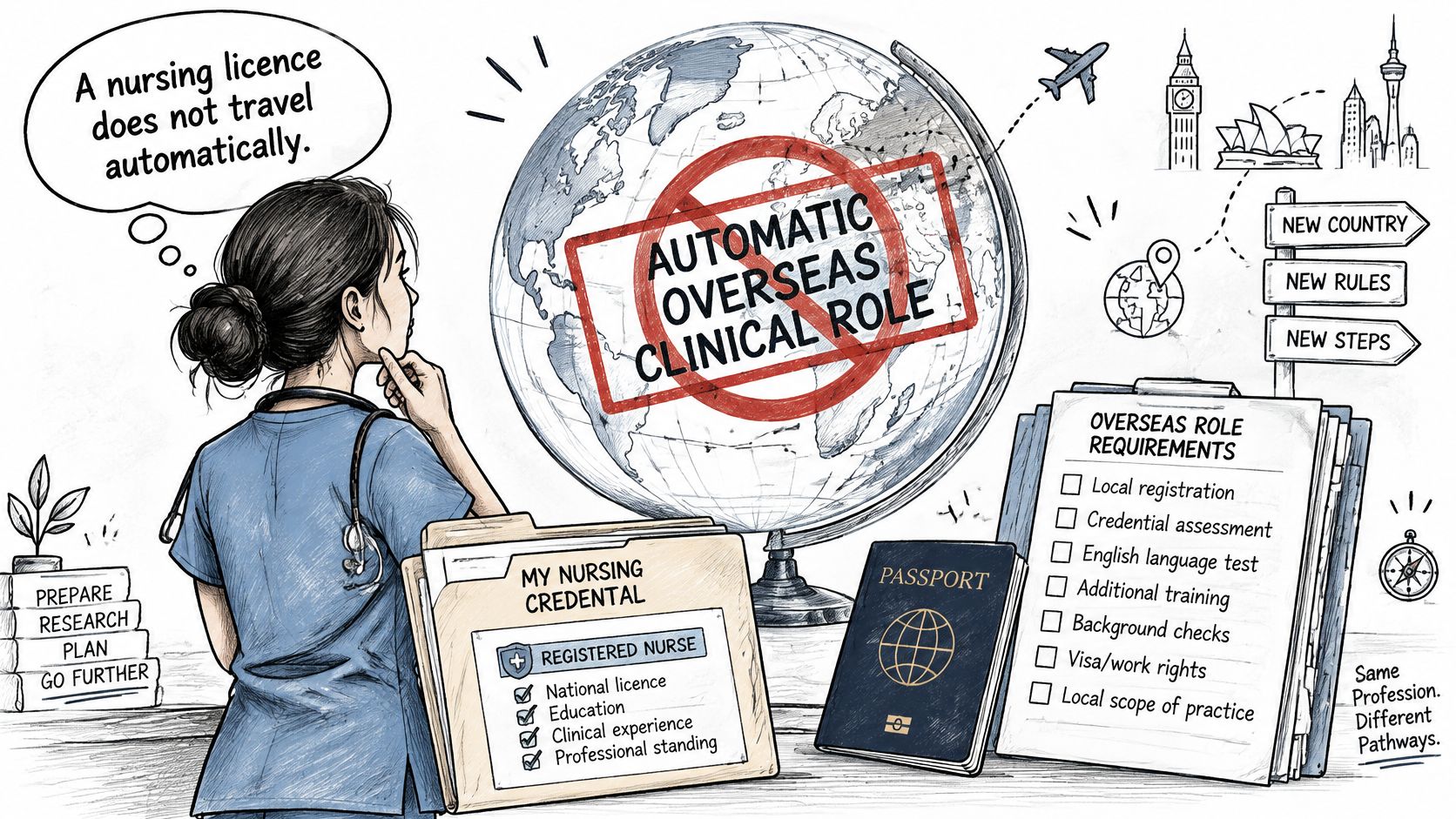
The misconception to correct is that a nursing qualification automatically becomes an independent clinical role overseas. Your qualification demonstrates education and professional standing, but it doesn't, by itself, authorise practice in another jurisdiction.
The American Nurses Association's ethical guidance on global volunteerism calls for nurses to work within their scope, obtain local professionals' consent and supervision, and follow host-country licensing and practice rules. The host partner should also define the programme, rather than letting visiting professionals set their own clinical agenda.
Separate competence from authorisation
You may be competent to perform a task at home yet lack permission to perform it at the host site. The organisation must consider your education, professional experience, local registration status and supervision arrangements. Host approval must sit within applicable law, not replace it.
International short-term health guidance also identifies inadequate credentialing, visitors performing procedures without sufficient training and weak supervision of students as recurring risks. Enthusiasm and previous experience don't remove those safeguards.
Hypothetical illustration: You're a qualified nurse, but the local team approves only education support and observation. You help prepare a community health session, then observe routine community healthcare with the appropriate permission. You don't undertake independent care.
That can be a complete, worthwhile placement. You can learn how the team explains information, coordinates community activities and works within its own referral arrangements without taking over its responsibilities.
Keep the placement category clear
For the rural medical-support listing in Palawan, no verified roster of former volunteers' registrations or authorised duties is available for publication. You therefore shouldn't assume that any particular clinical procedure is a standard volunteer task.
If your longer-term interest is an overseas medical degree rather than a volunteer placement, Medical School Programs' 2026 guide to studying medicine overseas is a separate resource to consult. Admission to study, recognition of qualifications and permission to practise are distinct decisions.
A volunteer placement isn't a shortcut to professional authorisation.
Short-term volunteering doesn't replace professional care. Participants never act as substitute parents, primary teachers or sole care-givers, either. Before agreeing to a role, ask: What may I do at this site with my credentials, under whose supervision, and what must I leave to the local team?
What a Week Looks Like at a Rural Medical-Support Site
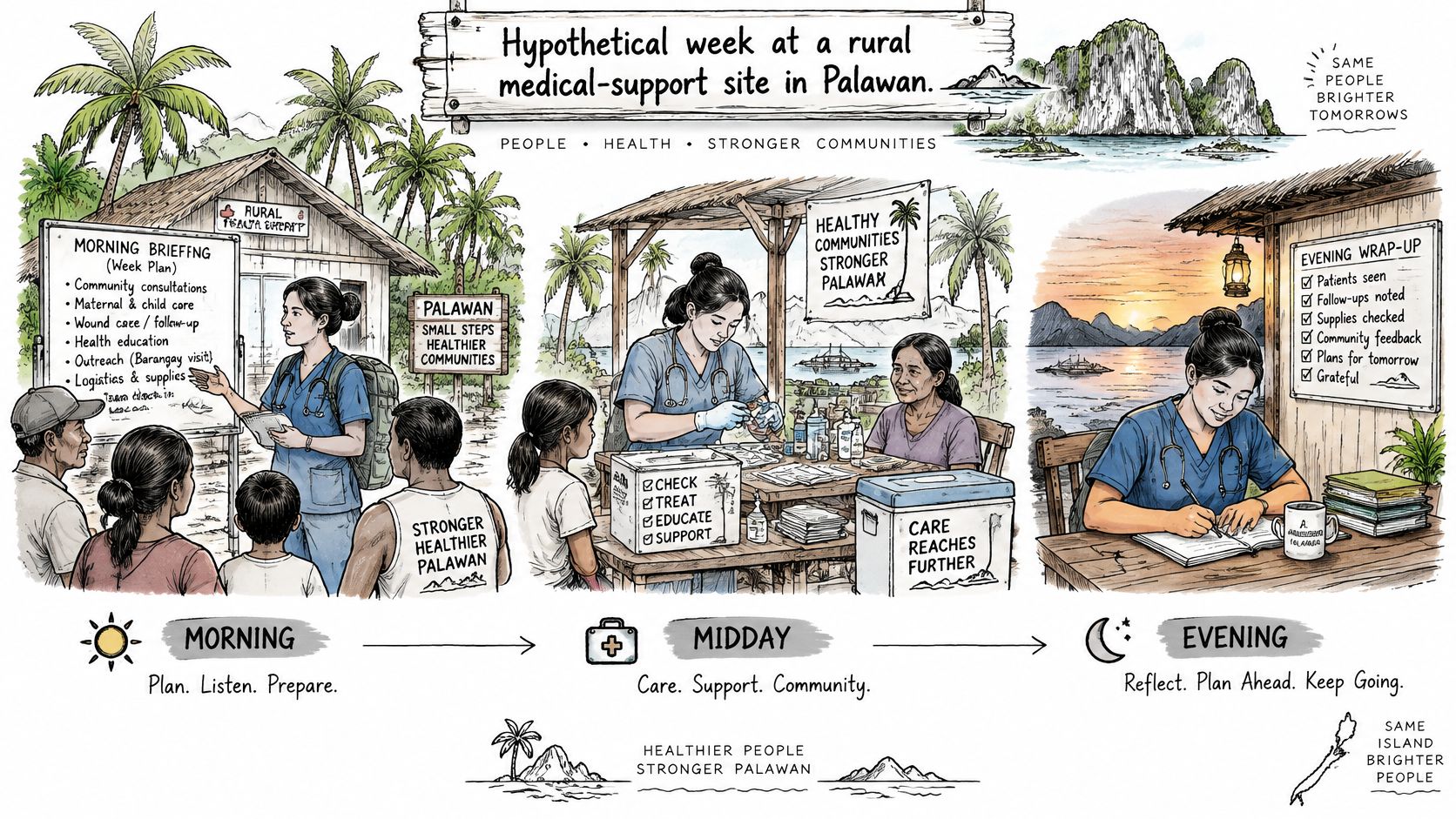
Hypothetical scenario: A registered nurse joins a rural medical-support placement in Palawan, with an agreed role limited to non-clinical support and observation. This is an illustration of how a week might be organised, not an account of a former volunteer or a promised itinerary.
The medical support in villages in Palawan listing is the offer to check for current arrangements. The activities below would still require the local team's agreement.
Morning preparation and midday observation
At the morning briefing, conducted in the agreed language, the local team identifies community health education as its priority for the week. The nurse helps prepare the room, organises the queue as directed and uses the attendance sheets the team already maintains. Before handling those sheets, the nurse checks where they belong and who may access them.
The nurse doesn't introduce a new form just because it resembles the system used at home. Instead, they ask what information the team needs and follow the existing process. The coordinator checks that the volunteer understands the instructions before the session begins.
At midday, the nurse shadows a local nurse during routine community healthcare, where observation is permitted and consent is in place. Questions wait for the agreed debrief rather than interrupting someone's interaction with the team. Learning notes concern working methods, not identifiable people.
Afternoon review and adjustments
The afternoon debrief gives the coordinator space to assess the support:
Useful work: Did the room preparation and queue support match what staff needed?
Boundaries: Did anything arise that fell outside the agreed role?
Next session: Should the nurse repeat the task, change it or leave it with the team?
Across the week, the nurse learns how local staff set priorities, how supervision works in practice and how they handle consent in community settings. Observing differences offers a reason to ask thoughtful questions, not to assume the home system is better.
No patient details, reconstructed quotes or measurable health outcomes are presented in this example. No clinical procedures are assumed. If the initial task doesn't fit, the nurse and coordinator can agree a different non-clinical contribution, such as organising existing session materials. Adjusting the plan together is a normal part of a well-run placement.
Ethical Practice Checks for Healthcare Volunteering
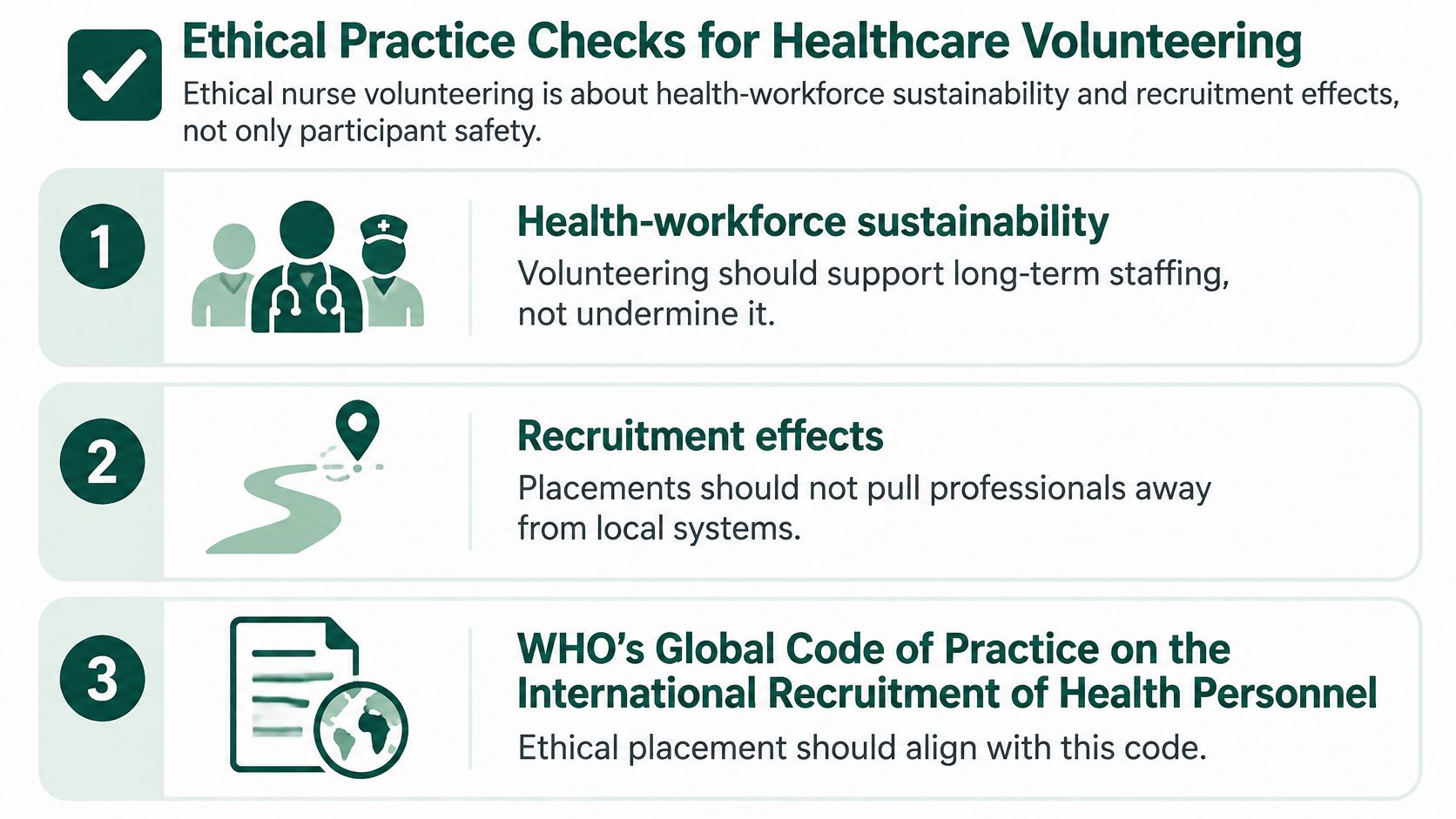
Ethical nurse volunteering is about health-workforce sustainability and recruitment effects, not only participant safety. A trip can feel well organised for the visitor while still placing unreasonable demands on the local team.
The WHO Global Code of Practice on the International Recruitment of Health Personnel provides a reference point for protecting health workers and supporting equitable, sustainable systems; WHO also projects that about 70% of the remaining nursing shortage in 2030 will be concentrated in the African and Eastern Mediterranean Regions. Locally requested, supervised roles matter particularly where staff capacity is already stretched.
Ask what the local service must carry
Short-term volunteers aren't necessarily recruited employees, but their presence still affects staffing. Someone must organise induction, explain procedures, supervise activities and manage handover. That time should be acknowledged when the host agrees to receive visitors.
Repeated inflows of foreign clinicians can create unequal access to procedures or raise expectations that the service can't maintain after departure. Placements also shouldn't pull professionals away from local responsibilities to deliver a visitor experience.
At HeyLocals, volunteers join activities that already exist and help where it's useful, with what they can offer. Our approach to ethical volunteering abroad starts with that relationship to ongoing local work.
Put continuity into questions
Use these questions to test whether the proposed activity belongs to the service rather than to the visitor:
Who is my named local counterpart? Identify the person who directs the activity and receives the handover. A general assurance that staff will be around isn't enough.
What baseline has the team documented? Ask what already happens, what materials exist and what the team wants support with.
What output have we agreed? An output might be education sessions completed, staff training delivered or protocols implemented, but only where the host has requested it and the volunteer is authorised and competent.
How will follow-up happen after I leave? Establish who retains materials, reviews unfinished work and answers subsequent questions.
An output isn't the same as a health outcome. Completing an agreed session can be documented without claiming that it changed anyone's health.
A useful test: Can the local team explain why it wants this activity and what it will keep using after your departure?
Personal and clinical safeguards also need written confirmation, including registration, cover and consent arrangements. Reject a placement that advertises unsupervised clinical exposure or uses visitors instead of paid nurses. The opportunity to do more isn't automatically evidence of a better placement.
Credentials and Paperwork to Confirm Before Departure
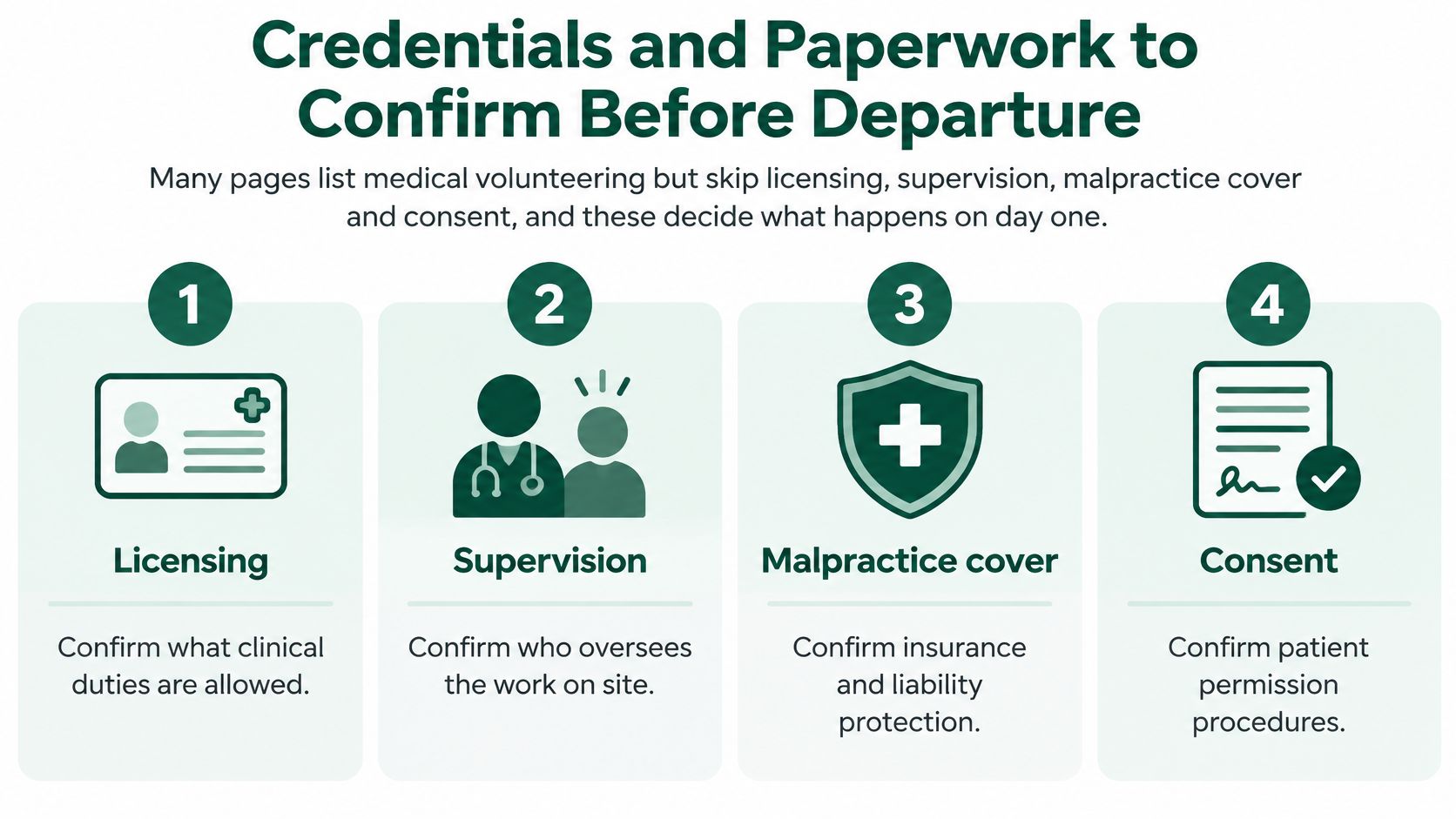
Medical volunteering descriptions can make the setting clear while leaving licensing, supervision, malpractice cover and consent unresolved. Those details decide what happens when you arrive, so collect answers before committing to travel.
The WHO nursing workforce report identifies international migration, unequal distribution and workforce well-being as major challenges. For your own preparation, turn broad assurances into documents that match your actual assignment.
Collect confirmations from the right people
Written scope, confirmed by the host coordinator. Obtain the local facility's approval of your task list, limits and supervisor. Include your credential status so the approval clearly applies to you.
Insurance, checked by you and your insurer. Submit the agreed activities when checking professional indemnity and travel insurance. Request written confirmation of cover and exclusions rather than assuming that a general volunteering policy covers clinical work.
Prescribing and records, clarified by the local supervisor. Establish who may prescribe, authorise medication-related decisions or sign records. Don't infer permission from access to a form or workspace.
Translation, arranged with the local coordinator. Confirm the language used in briefings and documents, and who translates when necessary. Being able to socialise in a language isn't the same as understanding safety instructions.
Incidents and emergencies, explained by the local coordinator. Save the emergency contact and learn how to report an error, exposure, safeguarding concern or request beyond your role.
Equipment, confirmed by the host. Ask what you must bring and what's provided. Don't pack clinical equipment or donations on the assumption that the team wants them.
Privacy and consent, explained by the local team. Confirm permission procedures for observation, information handling and contact with community members. Keep photographs and personal devices out of activities unless explicitly authorised under the host's rules.
Immunisation and occupational health, checked by you against the host's list. Seek appropriate travel-health advice and clarify any exposure-response arrangements relevant to your approved activities.
Keep preparation separate from permission
For background reading, the VirusFAQ infection control training guide from VirusFAQ.com is a resource to consult alongside your preparation. It doesn't replace site induction, occupational-health advice or the host's infection-control procedures.
Helping in a clinic can mean health education or regulated clinical care. Write down which applies. Verify current professional requirements with the competent authorities in the host and home countries, and check entry requirements with the relevant immigration authority.
Parental consent for an under-18 participant answers a different question from professional qualification. Keep those documents separate: neither parental permission nor acceptance onto a trip authorises nursing practice.
How to Assess a Placement and Confirm the Role Before You Book
You've narrowed your options to a shortlist. Compare the offers using the same questions, rather than choosing the one with the most clinical-sounding description. A vague answer is useful information when you're deciding whether to commit.
Placement assessment questions and answers
| Question to ask | Good answer | Warning sign | |---|---|---| | Who supervises me day to day? | A named local clinician or coordinator, confirmed in writing | No supervisor named, or supervision only by phone | | What is my exact role? | A specific task the host has approved for my credential | Role described as help wherever needed | | Did the local team request this work? | Yes, linked to an existing service and its priorities | Project created for visitors' convenience | | Does insurance cover the agreed activities? | Written confirmation of cover and exclusions | Vague statement or no document | | Which language is used in briefings? | A language I understand, with translation where needed | Briefings only in a language I cannot follow | | What remains after I leave? | An agreed output and a follow-up contact | No baseline, no output and no follow-up |
Read the supervision and role answers together
For nurses, day-to-day supervision and the exact role deserve the closest attention. A named coordinator can organise your visit, but you must also establish whether any proposed clinical activity requires a designated clinical supervisor. A contact number alone doesn't explain who checks your work on site.
Look for a task description you could use during a morning briefing. Preparing host-approved session materials is specific. Helping wherever needed leaves both you and the team to negotiate boundaries after you arrive.
You can apply these questions to the rural Palawan medical-support offer without assuming its title establishes clinical permission. For a separate comparison, Medical volunteering in San José allows people with a healthcare background to get to know a local facility and support its staff. Before confirmation, we discuss your studies, experience and activities suited to your role.
Check the live arrangements before committing
Read the current offer rather than relying on a saved screenshot or an older review. Confirm:
Eligibility and timing: Age, available dates and minimum duration. Some listed trips start from one week, but check the specific offer.
Activities and communication: The role offered, relevant study or skill expectations and the language level needed.
Fee inclusions: What's included and what you must arrange separately. Arrangements differ by destination because local organisations host volunteers according to their resources and project needs.
Participant checks: For HeyLocals, complete the self-declaration in your personal area yourself. Treat parental consent and professional credentials as separate matters.
We support volunteers before, during and after their trip, and local coordinators look after volunteers while they're on their project. Use that preparation process to resolve practical questions, while verifying professional requirements with the competent authorities rather than relying solely on a placement description.
Before payment: You should be able to explain your approved activities, your limits and who supervises you without filling in any gaps yourself.
Ask the local coordinator today to put your role in writing, including the site, approved tasks, exclusions and supervision arrangements. Don't pay until you have that confirmation in hand.
HeyLocals helps you choose an international volunteering placement, prepare for it and access support before, during and after your trip. Visit HeyLocals to discuss your nursing background and request a host-approved role description before you book.
In this article
- Table of Contents
- Which Nurse Volunteer Roles Exist Abroad
- Why a Nursing Licence Does Not Travel Automatically
- What a Week Looks Like at a Rural Medical-Support Site
- Ethical Practice Checks for Healthcare Volunteering
- Credentials and Paperwork to Confirm Before Departure
- How to Assess a Placement and Confirm the Role Before You Book