Rescuing Sea Turtles: What Volunteers Really Do
Rescuing sea turtles usually means supporting trained teams. Learn what volunteers really do, which tasks need specialists, and how to choose a project.
The popular idea that helping a turtle means picking it up and carrying it to safety is often the wrong starting point. For someone volunteering abroad, the more useful contribution may be cleaning a tank, preparing feed or reporting an animal's condition without approaching it. Rescuing sea turtles starts with understanding which jobs are yours and which belong to trained specialists.
Table of Contents
What Rescuing Sea Turtles Actually Covers
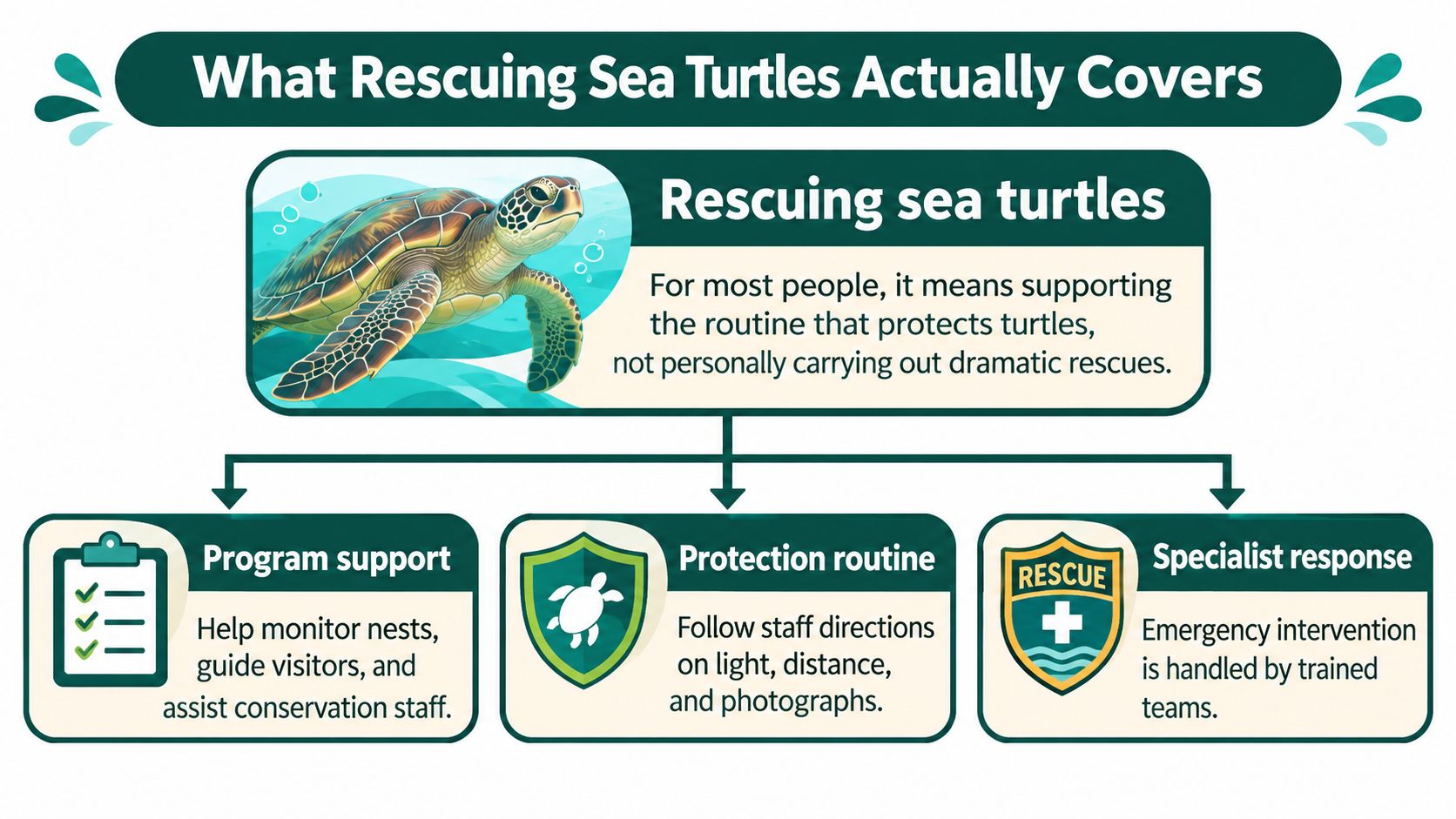
For volunteers joining a conservation programme, rescuing sea turtles means supporting the routine that protects turtles. Cleaning enclosures, preparing feed and filing accurate reports are the work; dramatic captures belong to trained responders. That distinction matters before you choose a placement, because a centre caring for recovering animals, a nesting-beach project and an emergency response network each carry different responsibilities, equipment and training requirements.
Three levels of sea turtle work and who leads them
| Level of Work | What It Involves | Who Leads It | |---|---|---| | Observing and reporting | Recording species, location and condition, then alerting the local stranding network | Volunteers can contribute after induction; the trained network decides next steps | | Routine centre care | Cleaning tanks, preparing food and maintaining habitat under a facility protocol | Supervised staff, with volunteers taking assigned tasks | | Emergency rescue and treatment | Capture, stabilisation, veterinary care and release decisions | Trained responders and permitted facilities only |
When you record an animal, describe what you can see and let the trained team identify the species. Helping at a rehabilitation centre still leaves treatment decisions to qualified staff, and a volunteer who respects that boundary is more useful than one who pushes past it.
Rescue belongs within wider protection
There's reason for cautious optimism: the IUCN Marine Turtle Specialist Group's 2025 assessment classified more than 40% of marine-turtle populations as Low Risk–Low Threat, compared with 23% in 2011, while identifying fisheries bycatch as the most pressing global threat. Bycatch means accidental capture in fishing gear.
Rescue treats individual animals and can build public engagement with prevention. Rehabilitation alone cannot compensate for continued entanglement or the loss of nesting beaches, so local teams also need habitat protection, safer fishing practices, monitoring and community participation.
For help weighing these types of work against each other, see our guide to marine conservation volunteering. For rest days between shifts, Manta Ray Night Snorkel Hawaii's guide shows how visitors can explore Hawaii's marine life while snorkeling alongside trained crews.
Check which level a project offers before assuming it includes direct animal contact. A clear description of ordinary duties is more useful than a page full of release photographs.
Daily Tasks and Centre Routines
A centre shift usually begins with instructions, not an animal encounter. Staff allocate jobs according to the animals' needs, the site's protocol and your experience. After the relevant induction, you may help with the following tasks, but only where they're assigned.
Cleaning and tank maintenance. Follow the site's order for siphoning debris, scrubbing approved surfaces and cleaning equipment. Ask which tools belong to each area rather than moving brushes or buckets between tanks.
Food preparation and feeding records. Prepare the food staff specify, follow their instructions for portions and record exactly what was given. Don't add food because an animal appears interested or substitute something you've brought yourself.
Habitat upkeep. Clear debris from designated enclosures or beach areas without altering barriers, shelters or equipment. Report damage rather than improvising a repair around animals.
Beach cleanups. Collect plastic and discarded fishing line where the team directs you. Line attached to an animal is an emergency-response issue, not ordinary cleanup material.
Recording observations. Use approved forms and plain descriptions. Note what happened, rather than deciding that an animal is ill, stressed or ready for release.
These jobs require attention even when they become familiar. A missed entry or an unreported change leaves the next person with less useful information.
What a routine day might look like
This is an illustrative routine, not a witnessed shift or a promised timetable. A morning briefing could cover the day's feeding instructions, cleaning assignments and areas volunteers must leave undisturbed. You might then prepare feed under direction, complete your allocated tank-cleaning tasks and return equipment to its designated place.
After a midday rest, the afternoon could involve habitat maintenance and checking that observations have been entered clearly. Before finishing, you'd hand over unfinished work or concerns to staff. The useful habit is to close each task properly, not move on when something more interesting happens.
The published programme on Nusa Penida, Indonesia, includes feeding, tank cleaning and other tasks agreed with the local team. That doesn't make coastal monitoring, nest work or night patrols standard inclusions. Those activities belong only to programmes that explicitly list them.
Practical rule: If a task isn't on the project page, assume it isn't included until the team confirms it in writing.
HeyLocals volunteers join activities that already exist and help where it's useful, with what they can offer. You're fitting into an ongoing operation, not arriving to create a new role.
Experience changes what staff may assign
One permitted US rehabilitation centre's volunteer guidance starts with cleaning duties, allows volunteers with more than 100 hours of experience to assist with feeding and water-quality testing, and reserves hands-on rehabilitation assistance for its most experienced volunteers. Its volunteers work under medical-team supervision because sea turtles are federally protected under the US Endangered Species Act.
That's one organisation's progression, not a threshold that transfers to another country or facility. Previous volunteering may help you understand routines, but the local team still decides what you're authorised to do.
Cleaning can be repetitive, and staff may change your assignment without much notice. A turtle's care requirements take priority over variety for visitors. The honest human reward is learning why a task matters, then returning to do it carefully again.
Why Handling Turtles Stays With Trained Teams
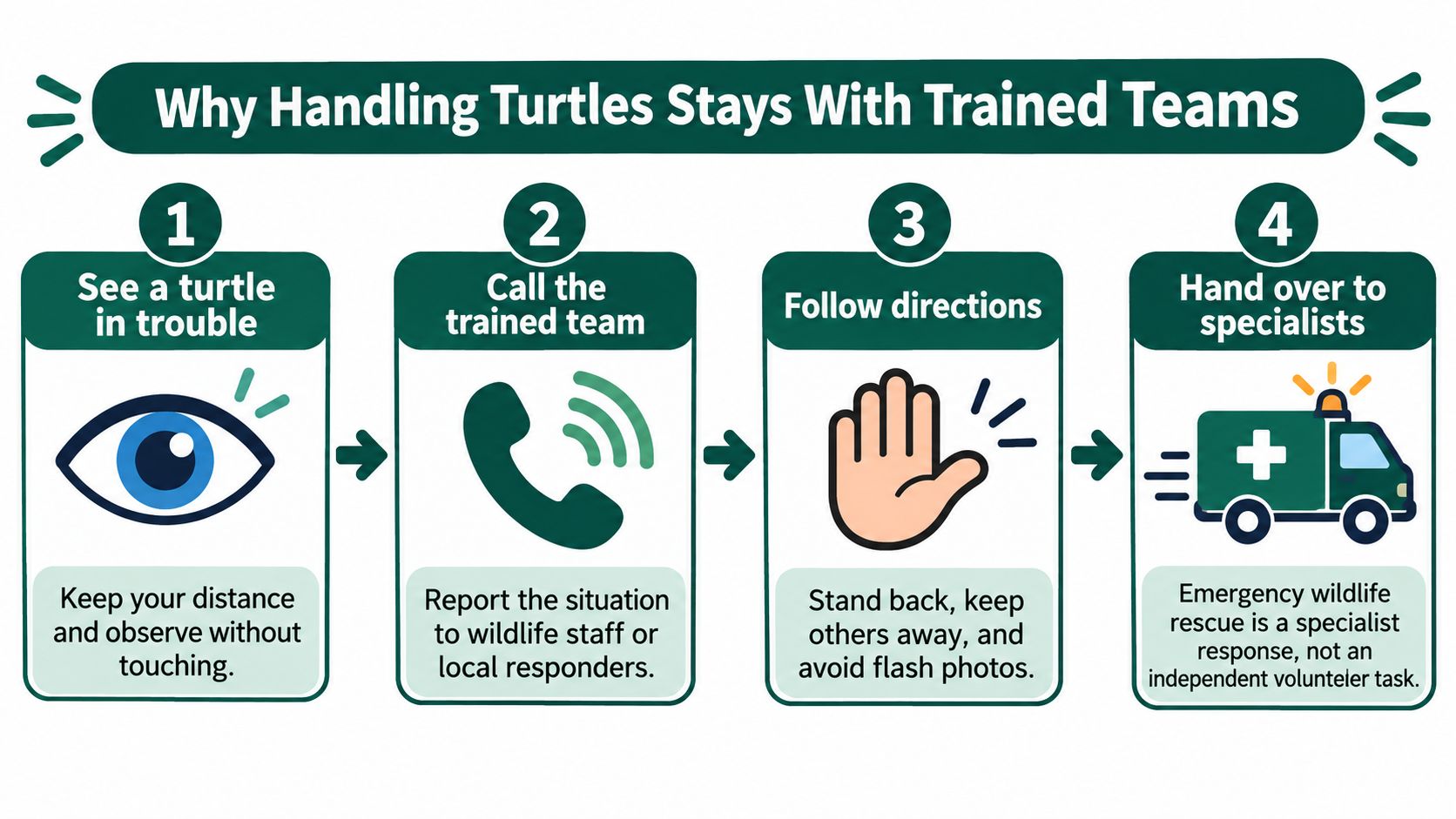
The assumption that a struggling turtle needs immediate hands-on help can lead an untrained person to make the situation worse. Emergency wildlife rescue is a specialist response, not an independent volunteer task. Your first responsibility is to avoid creating another hazard.
Use this sequence to keep your response focused on getting qualified help.
What to do when a turtle appears in trouble
Keep your distance. Keep people and pets away, and don't approach the animal for a closer photograph.
Record useful details. Note the location, movement, visible injuries and any visible line wraps, buoy numbers or identification marks. Observe only what you can see safely.
Contact the designated authority. Call the local stranding network or wildlife authority. Reporting arrangements differ between countries, so establish the local procedure during induction.
Follow instructions exactly. Don't turn a request to observe into permission to capture or transport.
Provide temporary protection only when directed. Shade and moisture may be appropriate under responder instructions. Don't place an injured or unresponsive turtle in water.
For entanglements, NOAA's Sea Turtle Disentanglement Network specifically tells observers not to attempt capture or disentanglement, not to cut the anchoring line while gear remains attached, and not to enter the water. Location and entanglement details help the trained team plan its response.
Why shortcuts aren't harmless
Pulling on flippers can injure an animal. Cutting a visible line may leave dangerous gear attached, while improvised intervention can also compromise the information responders need about the incident.
NOAA's marine-life-distress handling guidance describes authorised lifting by the front and back of the top shell, keeping clear of the head, and transfer to the closest permitted facility able to manage the case. That's a controlled responder protocol, not an invitation for a traveller to try lifting.
Diagnosis, treatment decisions, restraint and release authorisation stay with specialists. Decisions about relocating eggs also belong to the responsible conservation team. Whether a volunteer may assist with direct contact is determined by local authorisation, training and supervision.
For a separate wildlife-watching activity, the Snorkel Turtle Canyon turtle viewing guide offers visitor context, not rescue training. Our volunteer selection criteria can help you consider whether a placement matches your skills and expectations.
The accompanying video is supplementary viewing, not practical wildlife training.
Responsible rescue often means less physical intervention and better reporting. For an untrained person, getting accurate information to the right team is frequently the most useful action available.
Nesting Beaches and Egg Work
Nesting-beach conservation protects reproduction and habitat. It isn't the same job as emergency rescue, and it doesn't give volunteers discretion to move eggs or manage hatchlings.
The published marine-turtle nest-protection guidelines recommend relocating a nest on the same beach when relocation is necessary, placing it among other nests with at least 0.75 metres of separation where possible, or choosing conditions resembling natural nest sites, typically near the top of the beach. Those requirements explain why moving eggs isn't a simple response to a nest that looks exposed.
Your role on a nesting beach
Specialists decide whether relocation is necessary, select the replacement site and control the transfer. Volunteers may assist with permitted observation, record-keeping or nest-area maintenance after training, but shouldn't independently assess threats or disturb nests.
Follow the lighting rules. Use lights only as staff permit, rather than assuming a particular torch is acceptable.
Respect distance and photography instructions. Don't chase animals, crowd a nesting turtle or use flash without permission.
Prepare for the actual shift. Ask about shift length, terrain, rest time, season and available equipment before choosing beach work.
Night patrols and nest monitoring apply to some nesting-beach programmes, not every turtle placement. Walking on uneven sand in darkness is a different commitment from working around a centre during the day.
A quiet patrol can still be a properly completed conservation shift.
A partner archive describing nesting activities in Costa Rica doesn't establish a currently bookable HeyLocals turtle placement there. Choose from current project information, not an old activity description.
Nobody should book expecting to see a nest, hatchling or release. You need to be comfortable contributing even when careful observation produces an uneventful record.
Seasonal Rescue Work and What the Numbers Show
Cold-stunning shows why rescue teams need flexible capacity. When turtles become weak and immobile after exposure to unusually cold water, responders may receive many animals within a short period. Treatment and subsequent care can continue long after the initial emergency.
These North American examples provide context for rescue operations, not a schedule for any HeyLocals placement. Their periods and measures differ, so they shouldn't be read as a ranking of project performance.
Recorded cold-stunning events and what they show
| Location and Period | Reported Figure | What It Shows | |---|---|---| | Cape Cod, Massachusetts, late October to early January | NOAA reports about 770 cold-stunned turtles per season on average in recent years. | Recurring seasonal demand on responders | | Florida, 2010 | In the same NOAA account, more than 4,500 turtles were recovered. | The largest Florida cold-stunning event described in that account | | Virginia Aquarium, November 2024 to early 2025 | The Virginia Aquarium documented 77 cold-stunned turtles and transported 17 for release after treatment. | Documented animals and animals transported for release are different counts | | North Carolina Aquarium, December 2024 to March 2025 | The North Carolina Aquarium received nearly 800 cold-stunned turtles for rehabilitation. | Large admissions create substantial demands on facility capacity | | Massachusetts and Texas, 2024 | A US Senate committee cited 916 strandings in Massachusetts and 799 in Texas. | Annual state stranding totals describe a different measure from individual cold-stunning events |
The Virginia figures don't establish what happened to every other animal. An admissions total doesn't tell you how many turtles recovered or how much space remained available, either. Read each figure for what the organisation counted.
Recovery takes longer than the emergency
In NOAA stranding data on cold-stunned turtles, 76% of animals admitted alive were ultimately released, typically after three to eight months of rehabilitation, with mortality concentrated in the first four days at primary-care facilities. Early specialist care carries the highest stakes. Sustained rehabilitation carries the bulk of the workload.
That gap matters for volunteers. An emergency draws attention for days; the cleaning, food preparation, record-keeping and reliable handovers continue for months. Most of the useful contribution sits in that routine, repeated accurately each shift.
Seasonal uncertainty also affects what you'll do. A busy response period can require rapid changes to assignments, while a quieter period may involve maintenance rather than new admissions. During a surge, trained responders make the decisions; volunteers add capacity by absorbing the support work and reporting what they observe, not by stepping into treatment.
Ask about shift patterns, rest periods and the likely work during your dates, not just the destination's busiest wildlife season. The right question is whether you can contribute to the workload that exists.
How to Judge a Project Before You Apply
A suitable project should be able to explain its ordinary work and its boundaries. Ask how a normal week runs, who supervises each task and where volunteer observations end up.
A checklist for choosing responsibly
Current status and authority. Is the project currently live and authorised, and who manages it day to day?
Included and excluded tasks. Which duties are listed for volunteers, and which remain staff-only?
Contact and supervision. Is any direct animal contact allowed, after what induction, and under whose supervision?
Release assessment. How do specialists assess readiness for release, and is post-release monitoring in place?
Useful records. Where do observations go, and are they shared with government or scientific networks?
Working conditions. What are the shift length, terrain, rest arrangements, seasonal conditions and available equipment?
Release assessment and record-sharing deserve particular attention. A release count alone doesn't explain whether animals were ready, whether later outcomes were tracked or whether the project helped prevent another injury.
Judge the follow-through
NOAA's loggerhead conservation and management guidance describes stranding networks as emergency-response and monitoring systems, with standardised records and basic information submitted within 48 hours where feasible. Those records help identify broader threats, so each stranding feeds a larger picture of risk.
A released turtle may still face entanglement, vessel strikes, disease or pollution. Ask whether the project strengthens survival, data quality, prevention or local response capacity, and accept an honest explanation of what it cannot yet measure.
Our guide to how we select projects explains our selection approach. HeyLocals also publishes a Safeguarding Policy, a DBS Check Policy and a Responsible Volunteering page. Its participant background-check procedure includes a signed self-declaration, and every volunteer must declare any criminal record.
Local coordinators oversee volunteers during their project, and staff directions on light, distance and photographs apply throughout your stay. A project that answers the checklist clearly is telling you it takes both the animals and your safety seriously.
Confirm the Routine Before You Book
Turn your expectations into a short written task list before you pay. A predictable week of useful work is worth more than the vague hope of a dramatic encounter.
The Sea turtle conservation in Bali project, on Nusa Penida, Indonesia, is listed from one week, with costs from US$970. Volunteers join the local team to care for rescued turtles, support their recovery and help maintain the habitat they depend on. Check the current dates, inclusions and your eligibility on the project page.
Get the working arrangement confirmed
Use the task list from the daily-routine section, and ask our team to confirm in writing which duties are included, who supervises them and what the season is likely to mean for your dates.
Read the answer for what it says about fit. If careful, repeatable work appeals to you, centre routines will probably suit you. If you are counting on constant novelty or guaranteed hands-on time with a turtle, reconsider that expectation before committing. Most volunteer contribution is routine care and accurate reporting, and holding back while trained staff handle an animal is often the responsible choice. If the reply is detailed about ordinary duties, I would take that as a good sign.
Choose the routine you can reliably contribute to, and let any photograph be a byproduct.
Releases depend on the animals, season, site and specialist decisions. Nobody should book expecting a guaranteed hatchling release, and a change of plan shouldn't be treated as a failure to deliver an encounter.
Send the task list with your intended dates. A clear answer about ordinary responsibilities gives you a sounder basis for booking than any dramatic rescue image.
HeyLocals helps you choose locally managed volunteering projects and provides preparation and support through its team and local coordinators. Visit HeyLocals with your proposed dates and task list to discuss whether the turtle-care routine matches what you can contribute.
Prepared with Outrank