Volunteer in Costa Rica: Teaching or Childcare
Volunteer in Costa Rica by comparing Esparza teaching and childcare: who each suits, 2026 school dates, daily rhythm and what to confirm.
To volunteer in Costa Rica with HeyLocals, your practical choice is teaching or childcare in Esparza, and the two roles are not interchangeable. One puts you beside school teachers and a class plan, the other beside day care educators and young children's everyday activities.
Why do so many guides describe Costa Rica as if it were one trip, when your dates, tasks and shared house life depend on the single project page you choose? If you pick the role first, then test that page against your calendar, routine and budget, you'll avoid the common mistake of booking a country instead of a placement.
Table of Contents
Which Esparza Placement Fits You
Treat Esparza as two live roles that happen to share a town. The right choice is the weekday you can repeat gladly, checked against the dates, shared-house setup and page-level inclusions for that single placement.
Who the two Esparza roles suit
| Traveller | What to compare | School role | Day-care role | |---|---|---|---| | Solo | Activity and shared living | Classroom support beside local teachers, shared house | Games, creative play and early learning, shared house | | Families | Age rules, adult duties, rooms | Confirm the school project's age rules, adult responsibilities and room options | Confirm the day care project's age rules, adult responsibilities and room options | | Students | Skills, preparation, credit | Language, sport or cultural support as staff direct; no promised academic credit | Play and early learning support as educators direct; no promised academic credit | | Older travellers | Routine, journey, comfort | Judge the school start, travel to the centre and shared house comfort individually | Judge the day care rhythm, travel to the centre and shared house comfort individually |
If you travel solo, weigh Teaching in Esparza against Childcare in Esparza by the work you would repeat each weekday, then by the free time around it. The school page should tell you how classroom support is arranged; the day-care page should tell you how educators use extra help with play, songs, stories and morning routines.
Shared living shapes both options. Expect the shared house as the baseline, and rely on a private room or host-family stay only when the chosen page states that arrangement. Ask how many people share the house, how bathrooms and quiet time work, and whether you can prepare materials or rest after an early start.
Checks That Change by Traveller
Families need page-level answers before reassurance. Confirm age rules for each child, what accompanying adults remain responsible for during project hours, and which rooms the project can offer your group. A school placement and a day-care placement may answer those questions differently, even in the same town.
Students should prepare for usefulness rather than credit. Basic Spanish greetings, simple classroom phrases, songs or sport ideas you can adapt, and patience while local staff direct you will serve you well. Treat academic recognition as a question for your own institution, because the placement itself does not promise academic credit.
Older travellers need a routine check before any age label. Judge the early start, the walk or ride to the centre, heat during the day, and your comfort with shared accommodation. If you need a ground-floor room, a quieter sleeping space or a slower pace, ask before you book rather than hoping staff can rearrange things on arrival.
Choose the role by the work you would happily repeat each weekday, then check the room, dates and routine on that role's page.
If childcare abroad is new to you, our guide to childcare opportunities abroad can help you compare day-care support with school-based roles before you commit.
What the Two Roles Look Like Day to Day
The difference stops being abstract on your first morning. At the school, you are given a small group, a page of vocabulary or a place beside the activity while the teacher runs the lesson. At day care, you are shown where play happens, which children need closer supervision and how the educators move the room from arrival to tidy-up.
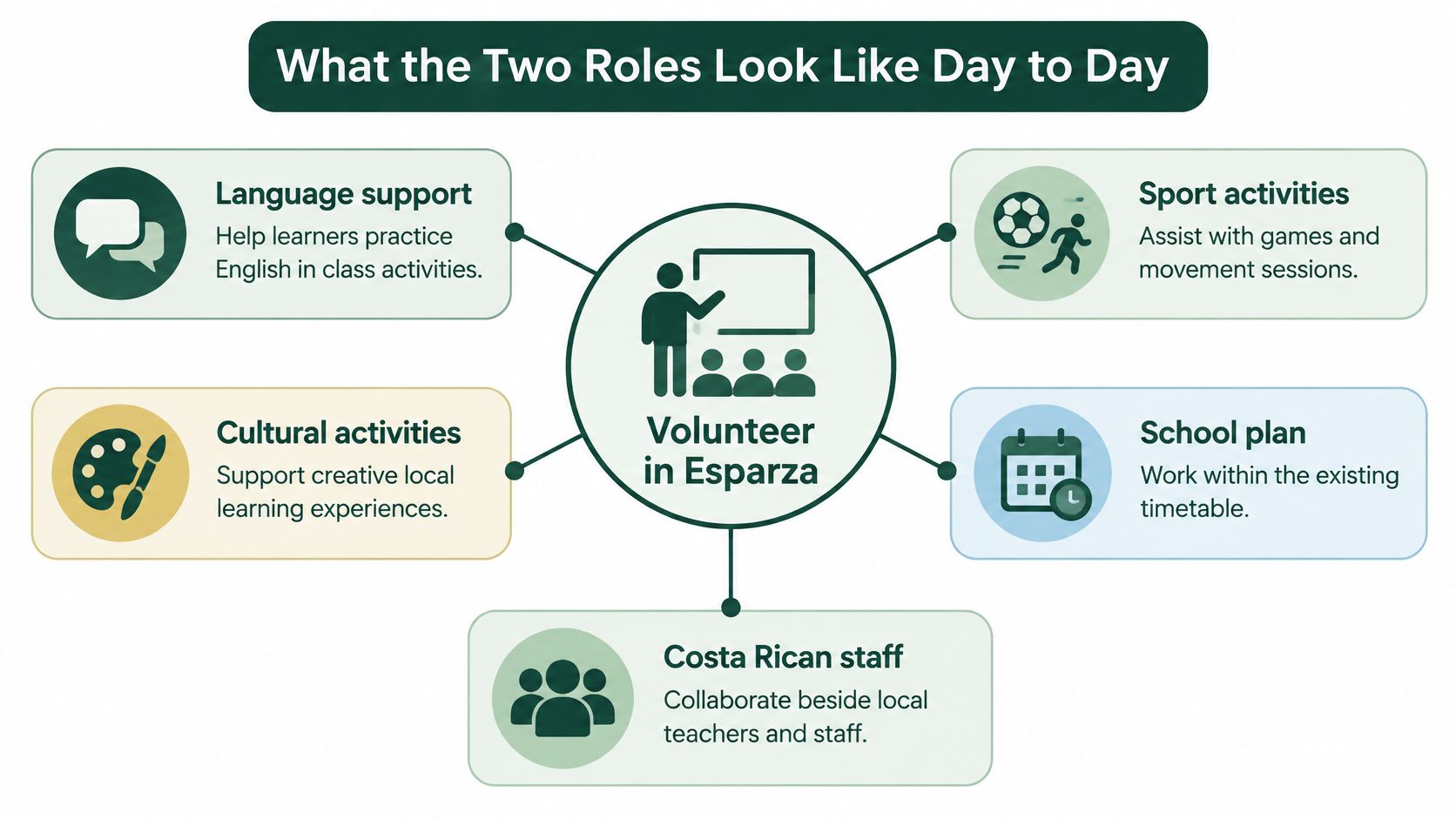
You Join Work That Already Exists
Local staff set the programme, lead the room and decide where help is useful. You arrive as support: join activities that already exist, help where it is useful and offer what you can without trying to redesign the day. On a first morning, careful observation helps more than a new system.
HeyLocals volunteer projects are community led and in some cases include contact with children and adults at risk, so staff instructions are the working plan for the day. Sitting with a small group, joining a movement session, resetting the play space or preparing simple material all count as placement work when the local lead asks for them.
Usually, no prior volunteering experience is needed to join a project. Listening, following instructions and preparing what staff ask for matter from day one. If you bring a skill, offer it politely and let staff decide whether it fits the plan.
A Labelled Example Day
This example shows pace only, so confirm exact hours and routes with your confirmed programme.
After breakfast at the shared base, you travel to the centre and join the school staff or day care educators for the activities already agreed.
During the placement block, you follow the local lead through classroom practice in teaching or play and early learning in childcare.
When that block ends, you use the remaining time for preparation, a shared meal or exploring, depending on your energy and what the programme has confirmed.
The point is the handoff. One placement keeps you close to lesson goals and pupil questions; the other keeps you close to play, comfort and early routines.
If clear tasks and older children's questions sound like a good weekday, teaching will probably feel natural. If songs, picture books, building towers and small daily routines sound better, childcare is likely the fit. Once that answer feels obvious, read that role's page for dates, shared-house life and inclusions before comparing anything else.
Culture, Timing and Child Protection
Costa Rican culture isn't a single relaxed stereotype. You'll hear pura vida used warmly and often, but it doesn't mean an agreed start time or a responsibility is optional. If staff expect you at the centre for the morning routine, being late because the day feels relaxed will create work for everyone else.
The image below shows the kind of ordinary arrival moment where first impressions are formed, at the school entrance rather than in a staged activity.
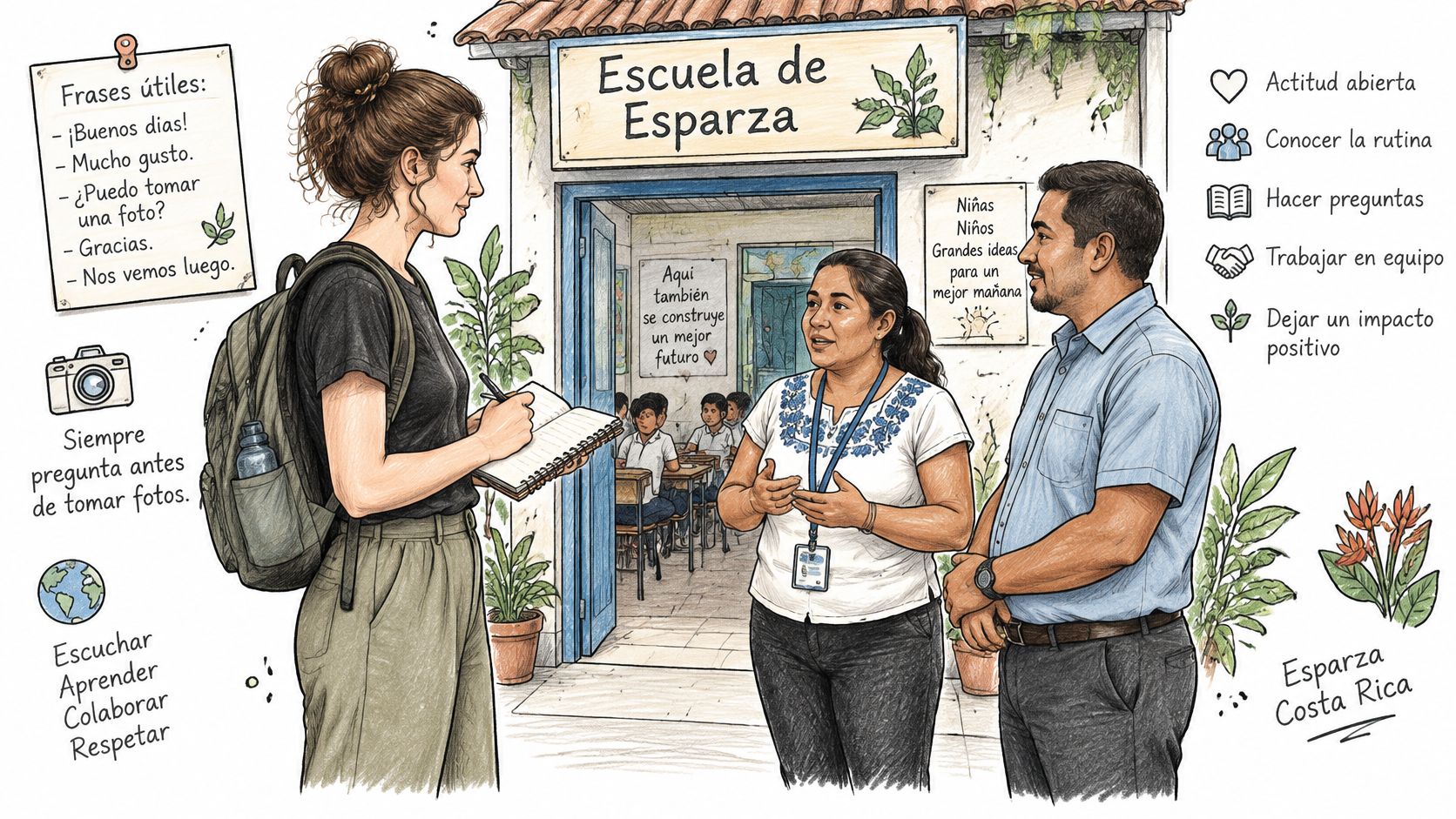
Join the Routine Before You Try to Help
Arrive ready to listen. Learn useful Spanish greetings before you travel, use names carefully, and ask what clothing the centre considers appropriate for classroom or day care work. Comfortable clothes still need to suit a professional setting with children, so check rather than guessing from holiday clothing.
Published guidance on Costa Rican education in the InterNations education guide describes a typical morning cycle of approximately 7:00 to 13:00 and an afternoon cycle of 13:00 to 17:00. Treat those hours as planning benchmarks only. The Esparza centre's timetable, breaks, preparation time and handovers come first.
Observe before leading anything. Watch how staff greet children, settle a room, signal a transition and close an activity. Then copy that rhythm instead of importing your own.
First week rule: If you're unsure whether to step in, ask the teacher or educator first and wait for a clear answer.
Photographs and Child Protection
Never photograph or post images of children casually. Costa Rica's Code of Childhood and Adolescence prohibits publishing the name or personal information that could identify a minor who is the author or victim of a criminal act unless there is judicial authorization grounded in public security reasons. That rule is narrower than a blanket photo policy, but it shows why your own consent never replaces the centre's requirements.
In practice, ask staff what consent process applies, obtain permission before taking any photograph, and avoid names, uniforms, location details or stories that could identify a child. If staff say no, put the phone away without debate. The same care applies to messages home and social posts after you leave.
The short video below is useful background before you travel to the destination, and you can also browse our Costa Rica destination page for country context.
Accommodation, meals and transport come from your chosen programme's confirmation, not from a country wide template. Read those details beside the role you've picked, because a routine that suits a school morning may not match day care hours.
The 2026 School Calendar and Holidays
Before you commit to the teaching role, check your travel dates against the calendar carefully. Costa Rica's Ministry of Public Education 2026 school calendar began lessons on 23 February, marked a Semana Santa break from 29 March to 5 April, ran the first period through 3 July and paused for a mid year vacation from 6 to 17 July. The second period opened on 20 July, and the calendar currently schedules the close of lessons for 9 December, so treat that end date as the published plan and confirm it against the latest MEP version before you book flights.
The timeline below helps you see where your proposed trip falls.
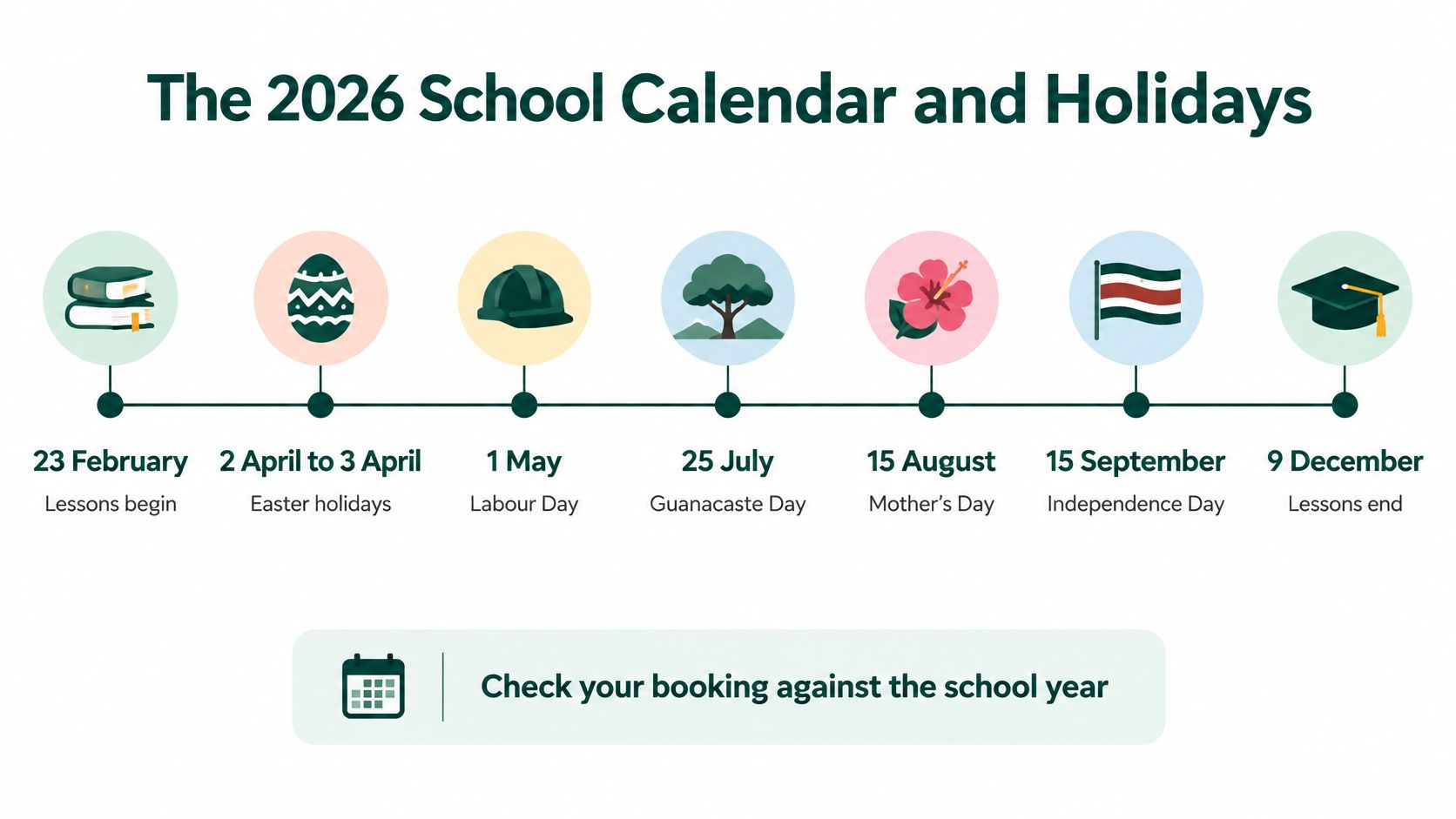
2026 Public School Calendar Dates
| Period | Dates in 2026 | |---|---| | Lessons begin | 23 February | | Lessons end | 9 December (scheduled) | | First school period | 23 February to 3 July | | Mid year vacation | 6 to 17 July | | Second school period | 20 July to 9 December (scheduled) | | Semana Santa | 29 March to 5 April | | Daycare availability during school holidays | Confirm separately with the day care project |
What a Holiday Date Really Means
If your dates fall inside a break, ask precise questions. Does this placement follow the public school calendar, do staff training days affect classroom access, and what would you do during that week? Vague answers such as "you'll help somewhere else" leave you guessing, so keep asking until the week has a shape.
Each centre runs its own operating pattern. An early years service can stay open through a school break, and a day care can close on days that sit inside the school term, so teaching and childcare availability must be checked separately.
Resist switching from teaching to childcare, or the other way, just to fill a holiday gap. The children are different ages, the staff expectations differ, and your preparation should match the role you chose. Changing roles to rescue a date usually creates a poorer fit for you and extra work for the centre.
Early starts deserve a practical test too. If children are in your travelling group, walk through the morning routine: waking, breakfast, and reaching the site on time. Older travellers should weigh transport and energy with the same realism. The exact Esparza timetable comes from the local organisation, so ask for typical hours for your chosen role.
The national calendar gives you the frame. The project page for the Esparza role you picked, teaching or childcare, gives you the dates that govern your week, so confirm your plans there.
Inclusions to Read on the Project Page
What does the fee cover on the Esparza role you picked? The answer lives on that project's page, and it differs by destination because each local organisation hosts volunteers according to its resources and the project's needs. Check these items on the page for your chosen role before you compare anything else.
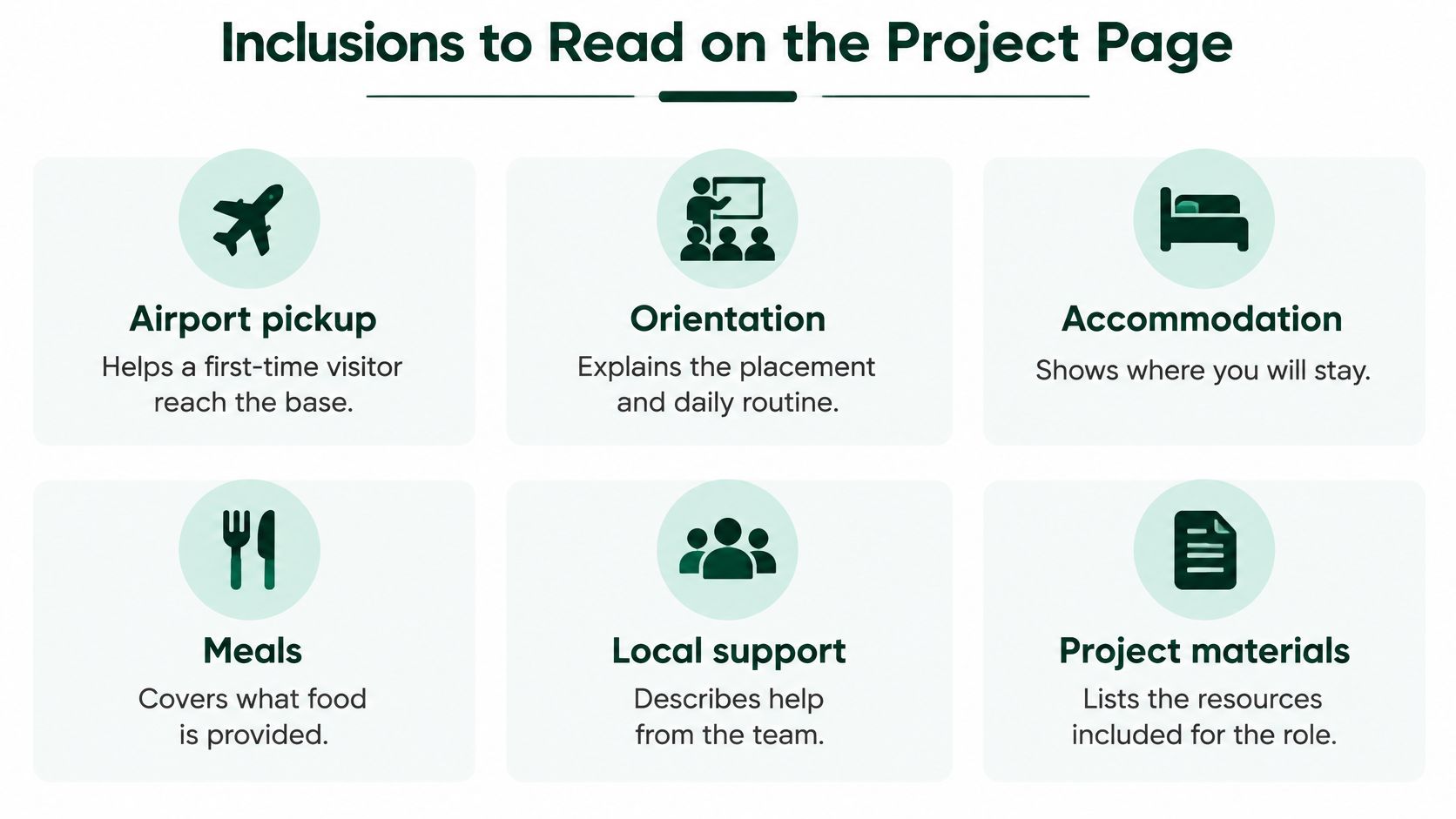
Inclusions and Exclusions to Check
| Item | What it does | Check on the project page | |---|---|---| | Airport pickup | Helps a first time visitor reach the base | Agreed window; pickups outside it need an individual check | | Orientation | Explains the neighbourhood, housing and placement | Stated on the page | | Coordination | Clarifies tasks and changes with the people running the work | Named contact and how changes are handled | | Meals | Shape the daily budget | The meal pattern for this project | | Accommodation | Sets where you sleep and who you live with | Housing type, room options and house rules | | Items marked excluded | Sit outside the fee | Arrange and price them yourself |
An agreed airport pickup helps a first time visitor reach the base without solving transport after a long flight alone. It only works if your arrival fits the agreed window. A late night arrival, an extra night or a pickup outside agreed hours needs an individual check before you rely on it.
Orientation explains the neighbourhood, the housing and the placement, so you know where to buy basics, how the living arrangements work and who to ask on your first project day. Coordination is different. It's how tasks and changes are clarified with the people running the work when a timetable shifts or staff need you elsewhere.
Keep the Esparza Pattern Straight
Meals and accommodation shape the money you still need each day. Read the housing and meal arrangement stated for Esparza itself. If the page describes shared housing, ask about room options and house rules. If it lists a meal pattern, count which daily meals still cost you money. Either way, don't carry over a host family stay or a two meal package you saw for another destination, because the Esparza page is the only version that applies to you.
The same discipline applies to anything the page marks as excluded. Those costs sit outside the fee, so add their figures beside the fee before you decide the trip fits your budget.
A responsible booking is simple to describe. The role, the dates and the services all match the same project page.
If a detail matters to your comfort, such as a quieter room, food you can eat safely or a specific arrival time, get the answer in writing. A confirmed inclusion on the project page is what counts.
Costs, Eligibility and Safety Checks
Three checks stand between you and a paid booking: the actual cost, your eligibility, and the safety net behind the project. If a project can't answer one clearly, treat that gap as a reason to pause rather than a detail to fill in yourself.
Build the Full Cost From the Page
Start with the lines the project page marks as included, then bring in the excluded items you already pulled from that same page. Write each figure beside its line and leave a field blank where the page gives no price. A blank is information too. It tells you exactly which questions to ask before money changes hands.
Don't assume a fee, discount or refund the page doesn't state. Our explanation of why volunteering abroad costs money shows what a fee normally covers, but your Esparza total still comes from your chosen page. Add personal spending separately, because shared meals don't remove every daily cost.
Included lines: Copy the exact wording for accommodation, meals, pickup and coordination.
Excluded lines: Price each one yourself rather than estimating from another destination's trip.
Unclear lines: Ask before paying, especially for extra nights or arrivals outside the pickup window.
Check Eligibility Without Guessing
Check the age rules on the exact page, whether a parent or guardian must be involved for anyone under 18, and what accompanying adults are responsible for. Families, couples and solo travellers should also confirm which room options exist, because a shared house may suit one group and not another.
Most placements need no previous volunteering experience, though basic English is generally expected. Students should confirm the skills staff expect, such as basic Spanish, confidence with sport, or experience helping young children settle into play. Don't promise a skill you don't have. Staff can plan around honest answers more easily than around surprises.
Older travellers and anyone with mobility, sleep or dietary needs should describe those needs plainly. Ask about stairs, walking distance, bathroom sharing and the pace of the morning. Comfort isn't a minor detail when you're repeating the same routine each weekday.
Ask Safety Questions in Writing
Ask the project for the nearest clinic and hospital, how long the journey takes, how the centre handles road closures or flooding, and who holds responsibility in an emergency. Keep the replies with your cost lines, along with the local contact you would call first, so one note holds everything you were told.
The adults around the placement are screened before they start: a written application, a full CV, at least two verified references, a values-based interview and verified identity. Where a role involves contact with children, staff and in-house volunteers also provide criminal-record certificates covering each country where they lived for six months or more in the previous five years. Knowing that lets you aim your questions at what remains, your own situation.
Solo travellers should confirm how you'll travel between the house and centre, what happens if you become ill, and how you'd leave the placement early if needed. Families need the same answers for each child, including who can consent to medical treatment and who supervises children outside project hours.
As you organise documents, money and communications, it can help to plan your international trip with confidence using a practical preparation checklist. Keep that general planning separate from project confirmation: the Esparza page for your chosen role is what defines your placement.
Confirm the Fit Before You Book
Reopen the page for the role you chose, teaching or childcare in Esparza. Confirm the dates, tasks, shared house setup and inclusions written there, and match them to your travel dates and your energy for a daily routine. If one detail doesn't fit, pause before you pay.
Booking also means completing the participation checks. You'll be asked to declare any criminal records, and a parent or guardian must be involved if you're under 18. The people running your placement are screened too, through written applications, verified references, interviews and identity checks, and staff in roles involving contact with children provide criminal-records certificates for each country where they lived for six months or more in the previous five years. HeyLocals supports volunteers before, during and after their trip, and local coordinators look after volunteers while they're on their project.
Use the inclusions table earlier in this guide as your final checklist for what the fee covers. For staying in touch with the local team and people at home, you can find an eSIM for Costa Rica before you travel if mobile data matters to you.
If you're still unsure which role fits, use the Find my project tool to compare your interests and dates. Your one next step is to open the Esparza page for the role you chose and continue only when every detail fits.
Ready to volunteer in Costa Rica in a way that fits your dates and the work you'd enjoy? HeyLocals helps you compare teaching and childcare in Esparza, check the inclusions on the right project page and prepare with support from our team and local coordinators. Visit HeyLocals to open the Esparza role you chose and confirm the details before you book.
Crafted with the Outrank tool