Volunteering Abroad for Teens: Consent, Age and Safety
Learn how volunteering abroad for teens works: age rules, parental consent, documents, safeguarding checks and placements that suit a young volunteer.
If a volunteering project accepts teenagers, does that mean a parent's permission makes it suitable for your child? Not necessarily. Age eligibility, parental consent and safeguarding are separate checks, and a reassuring answer to one doesn't settle the others.
Choosing volunteering abroad for teens means checking the exact placement, not just choosing a country or cause. Your teen needs a useful, age-appropriate role within a local team's existing work. You need written answers about responsibility, travel and support before anyone books.
Table of Contents
Age Rules and Eligibility at 16 and 17
A 16- or 17-year-old can volunteer abroad only on a placement whose rules accept their age, with written parental consent. At HeyLocals, volunteers can join from age 16 with basic English sufficient for everyday conversations and understanding instructions, but that doesn't make every project suitable for minors.
Usually, no previous volunteering experience is needed. However, healthcare or child-facing activities may require relevant studies, language ability or skills. Permission isn't a qualification: a parent's signature cannot authorise work beyond the participant's competence.
Age and consent rules by arrangement
| Arrangement | Age and consent rule | Adult travel | Free-time responsibility | |---|---|---|---| | Family trip with a parent or guardian | Teen travels with an adult family member; confirm the project's age rule and written consent | Parent or guardian travels | Confirm on the live offer | | School group | Set by the school and provider; check the placement's under-18 rules and consent requirements | Confirm the school's designated adult leaders | Agree responsibility between school and provider in writing | | Individual teen placement | Aged 16 or 17 with written parental consent; placement must be designated for under-18s | Confirm with our team | Confirm with our team | | Programme for adults 18 and over | Not automatically open to under-18s | An accompanying adult doesn't override eligibility | Not a substitute for an approved under-18 arrangement |
The word youth can be misleading. For comparison, the United Nations volunteering guidance states that international volunteer assignments have a minimum age of 25, while its Youth Volunteer programme covers ages 18 to 29.
Those are programme-specific thresholds, not universal volunteering rules. They show why you must confirm the exact offer's minimum age, permitted duties and adult-travel requirements rather than assume that young adults and minors have the same access.
Choosing a Placement With Structure and Room to Lead
The theme gets a teen interested; the daily structure decides whether the placement is workable. Start with the Students and Minors catalogue, then compare the working day the way you would compare two apprenticeships: who sets the task, who checks it, and who decides when the plan changes.
Our projects are community-led, and some involve contact with children and adults at risk. Volunteers join activities that already exist and help where it is useful, with what they can offer. Short-term help does not replace professional care, so a teen should never be cast as a substitute parent, primary teacher or sole care-giver.
Two illustrations of different routines
School support, generic routine: A teen works alongside a local educator on a set timetable. A suitable arrangement could involve preparing materials for an activity the educator has chosen, helping within that activity and clearing up afterwards, while the educator keeps responsibility for the class.
Sea turtle conservation in Bali: Daily duties follow the conservation team's calendar. Focus on how staff explain assignments, approve participation and respond when sea conditions, nest checks or group needs change.
Treat both as routine pictures. Specific dates still need confirmation, because a project name alone leaves a minor's acceptance and permitted duties unconfirmed.
For another conservation comparison, Rothschild's giraffe conservation in Nakuru describes work alongside rangers protecting Rothschild giraffes and planting trees with local communities in the Rift Valley. That establishes the project's focus; your teen's place on it still needs approval.
Turn interest into a practical shortlist
Use our guide to how we select projects to understand the selection approach, then put these questions to our team:
Exact acceptance: Does this project accept the teen's age on the proposed dates?
Accompaniment: Must a parent, guardian or another designated adult travel?
Permitted tasks: Which duties are available to someone of that age?
Also ask what happens on arrival: a clear induction, agreed daily duties written down in advance, and a named point of contact. Establish how the teen should ask for a simpler explanation, report fatigue or check an unfamiliar instruction.
Practical rule: Independence works best when a teen knows which decisions they can make and which require an adult's approval.
That framework leaves room for initiative without making the teen responsible for decisions beyond their role. Keep only placements where our team answers those questions in writing.
Parental Consent and Documents to Settle Before Booking
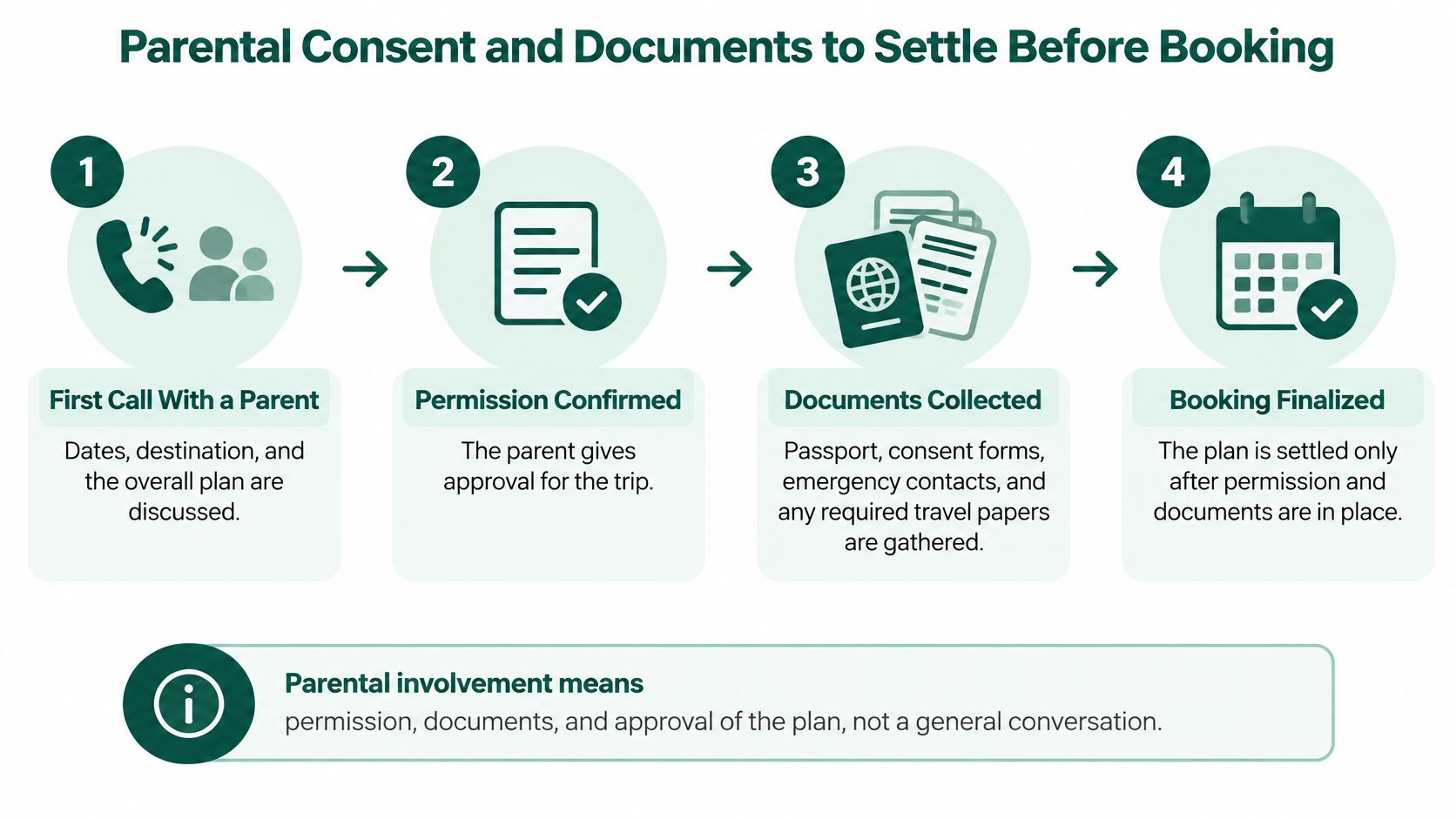
Parental involvement means permission, documents and approval of the actual plan, not just a conversation about travelling. Join the initial call about dates, insurance and arrival arrangements, while letting your teen explain their interests and ask questions directly.
At HeyLocals, participants must be at least 18 to book. Participants under 18 may travel only with written consent from a parent or legal guardian and only on placements designated suitable for under-18s. Our volunteering abroad guide for parents can support that family discussion.
Settle the paperwork in order
Confirm eligibility for the exact placement. Obtain written acceptance for the teen's age and dates so the paperwork relates to a suitable offer.
Agree accompaniment and free-time responsibility. Identify who takes responsibility outside project hours, including evenings and days without scheduled activities.
Check destination documents. The U.S. Department of State's guidance on international travel with minors advises carrying a birth certificate or other evidence of the legal relationship. Check what applies to your nationality, route and destination.
Verify permission-letter formalities. Ask the destination's authorities whether a minor travelling alone or with a non-parent needs notarised permission. Don't assume that an ordinary signed form satisfies border requirements.
Make consent trip-specific. Include departure and return dates, arrival arrangements and contact details for parents remaining at home. The UK government's guidance on taking a child abroad says permission from everyone with parental responsibility is normally required and warns that travelling without required permission can constitute child abduction.
Check the destination embassy's definition of a child. Legal definitions differ between countries, so use the rules that apply to this journey.
Settle insurance before booking flights. Confirm that the policy covers the participant, destination and intended volunteer activities, and understand exclusions and emergency assistance.
The sequence below summarises the family's approval process.
Give the parent a final sign-off
Keep emergency information accessible rather than buried in booking emails. The 3rd-i emergency contact list guide is a useful resource for organising that information.
Before paying, the parent or guardian should sign off on:
Travel plan: Project, dates, accommodation, transfers and arrival handover.
Responsibility: Accompanying adults, free-time arrangements and emergency contacts.
Documents: Passport, required permission, relationship evidence and destination paperwork.
Protection: Insurance terms and the written safeguarding arrangements.
Parental consent remains separate from any professional qualifications the role requires. Keep both decisions visible rather than treating one signed form as approval for everything.
Safeguarding Checks Parents Should Request in Writing
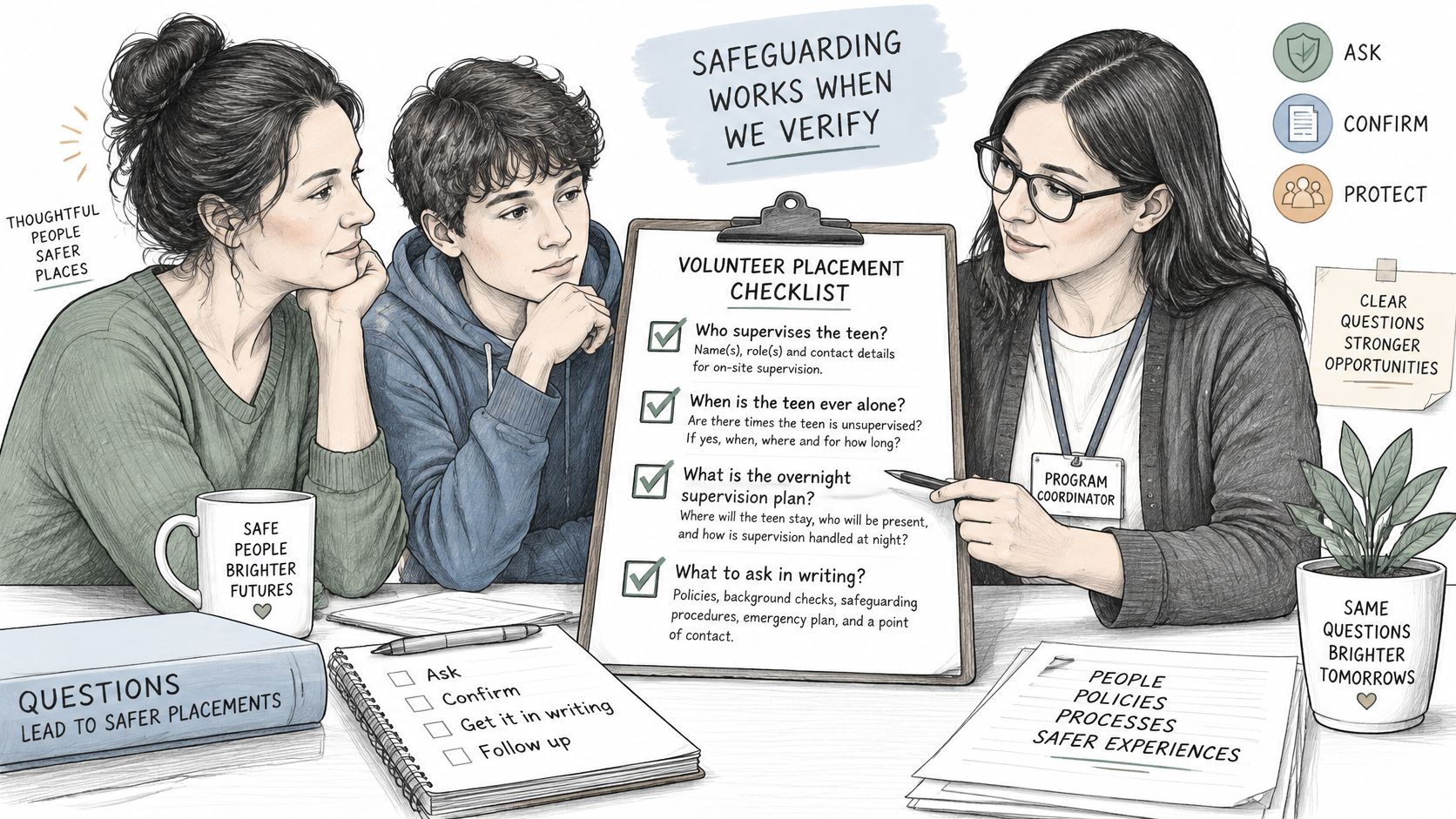
Who supervises your teen, and what happens if that person isn't available? That question is more useful than asking whether a project is safe. A background check alone doesn't explain daily supervision, reporting routes or emergency action.
The UNICEF-hosted guidelines on working with young people distinguish an under-18 participant's informed assent from parental consent. They also call for risk assessments, defined chaperone and safeguarding responsibilities, safe accommodation and transport, medical and travel documentation, and an emergency contact card.
Review these arrangements with your teen, not just on their behalf.
Safeguarding controls to request in writing
| Control | What to request in writing | Red flag | |---|---|---| | Supervision | Named adult supervisor and who is with the teen during tasks | Only a general promise of supervision | | Safeguarding plan | Risk assessment, code of conduct and incident escalation steps | No documented reporting route or responsible person | | Emergency contact card | Contact card for the teen, parent and local coordinator | No usable emergency contacts or backup route | | Accommodation and transport | Safe arrangements for travel, transfers and housing | Unclear arrival handover or unassessed housing and transport | | Limits on childcare | Written prohibition on unsupervised access and formal responsibility | Teen acting as sole carer or substitute parent | | Insurance and medical | Policy details and health information form | Unclear activity coverage or no health-response procedure |
Check what the rules mean in practice
Request the supervision arrangements or ratios for the actual activities, not a general description of the organisation. Ask who handles concerns about a supervisor, how an incident reaches the safeguarding focal point and who contacts the parent. The teen should be able to explain the reporting route in their own words.
For projects involving children or vulnerable adults, adolescents should never have unsupervised access or formal responsibility. They shouldn't operate independently of trained adult staff. At HeyLocals, short-term participants never act as substitute parents, primary teachers or sole caregivers.
Our volunteer code of conduct is part of understanding behaviour and boundaries. We also ask participants to complete a self-declaration in their personal area. That participant check is separate from parental consent and from any qualifications a role requires.
A promise of support isn't a safeguarding plan. The family needs to know who acts, how the teen reaches them and what happens next.
Make sure the plan explains accommodation rules, health needs, complaint procedures and emergency arrangements in language your teen understands. If an answer remains vague, pause the decision rather than interpreting reassurance as evidence. Request the written safeguarding plan before booking and keep a copy.
Who Benefits From a Short Teen Placement
The UK government's systematic literature review on youth provision and life outcomes links citizenship, community-service and volunteering activities with small-to-medium improvements in self-efficacy, social self-efficacy, resilience and wellbeing. Evidence about mental health is mixed, and part of the association may reflect healthier young people being more likely to volunteer in the first place.
In practice, the visitor usually gains the most measurable benefit: the skills and confidence the review describes. The host team still spends time explaining routines and supervising tasks. That asymmetry is normal for a short placement, and it's exactly why parents should look hard at what the teen contributes, not just what they gain.
Separate learning from community contribution
Exposure becomes learning only when preparation, bounded responsibilities, respectful interaction, adult reflection and follow-up give the teen a way to understand what they're doing. A placement shouldn't promise improved mental health or treat discomfort as something a teen must overcome without support.
On a one-week placement, that can mean a teen helping prepare materials for an existing activity, completing an agreed environmental task or supporting a locally directed fundraising activity. The contribution should be work the host wants and can supervise. A new initiative invented to occupy the visitor doesn't meet that test.
The UN Volunteers report on international volunteering highlights gaps in systematic impact measurement and cautions against assuming that short-term activity benefits communities. Teaching, healthcare and child-facing work may require qualifications, language ability or longer commitments. Trained adults retain responsibility.
Ask for evidence the host values
Request indicators that distinguish a useful contribution from an enjoyable itinerary:
Local ownership: Who identifies the need and approves volunteer tasks?
Continuity: How does the host manage volunteer turnover and work after departure?
Outputs: What completed work does the local team consider useful?
Protection: Which safeguarding controls govern the activity?
Follow-up: Does anyone assess contribution and participant learning afterwards?
For the teen, documented learning goals, task completion and reflection can be more informative than hours alone. For the community, listen to the local partner's definition of success.
A provider that answers only with volunteer satisfaction is answering a different question. The welfare, privacy and agency of local people come before the visitor's learning goals.
Maturity Signs and the Joint Yes Decision
Readiness often hides inside ordinary behaviour. A quiet teen who asks for instructions to be repeated may cope better in a supervised role than an outgoing teen who says yes before understanding the request. Confidence helps, but maturity shows in what the teen notices, asks and does after receiving an answer.
Discuss willingness to listen, follow house and safeguarding rules, communicate discomfort early and stick to agreed tasks. These behaviours can be rehearsed before departure. A readiness conversation works like a practice run: it shows where confusion might appear before the schedule begins.
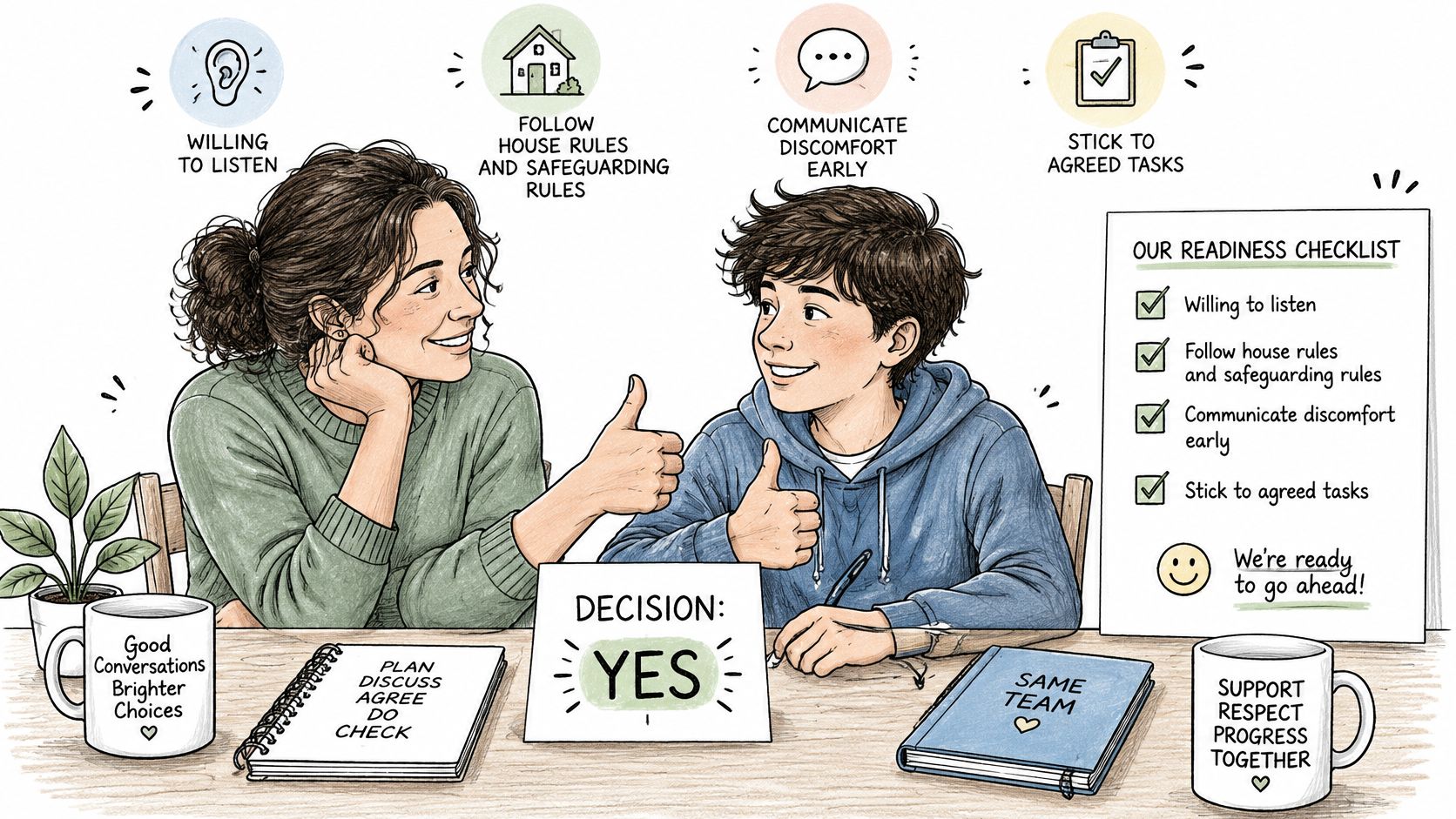
Let the teen do the talking
With a parent present, ask the teen to explain:
Unfamiliar routines: How would you respond if the schedule changed or an instruction wasn't clear?
Asking for help: Who would you approach if you felt unwell, overwhelmed or unsure?
Boundaries: What would you do if someone asked you to carry out a task outside your agreed role?
Reliability: How would you manage an ordinary, repetitive duty when another activity looked more interesting?
Let silence do its work. If an answer sounds vague, ask for a concrete example rather than supplying the expected wording. A strong answer identifies the problem, names an appropriate adult and explains the next action.
A 16-year-old reviews a school-support schedule, asks the coordinator to repeat an instruction and prepares one activity within the local educator's plan. After a tiring day, the teen returns to the agreed task list. Those actions show communication, reliability and respect for boundaries while remaining inside a supervised role.
Make the decision together
Keep three checks separate, each verified in writing on the live offer before anything is booked: age eligibility on a placement designated for under-18s, written consent from a parent or legal guardian, and a safeguarding arrangement naming who supervises contact. Participants also have to be at least 18 to book, so an adult completes that step.
The parent or guardian, our placement team and the host should assess the same documented criteria. A parent adds context about maturity. The placement team can clarify the arrangements. The host assesses whether its setting, routine and level of support suit the proposed role.
The answer can still be no, or not yet. That response may reflect the project's needs, the available support or a mismatch between the routine and the teen's readiness.
For a final exercise, ask the parent, team and host to complete the criteria independently, then compare their answers. Discuss any disagreement before approving the trip. Three aligned assessments make a shared yes stronger; one unresolved concern is enough reason to pause.
Confirm Dates and Age Limits Before You Book
Treat the live offer as the working document, the way a syllabus sets out everything a course will assess. Use the Find my project tool to narrow options by interests and dates, then read the offer line by line for the details that decide eligibility: minimum age, start dates, minimum duration, the role, the language requirement, whether an adult must travel, who is responsible in free time and the listed inclusions.
Then send our team one focused request naming the teen's age and proposed dates, and attach the shortlist of questions you built when comparing placements. Save each reply next to the offer so everyone is agreeing to the same arrangement.
One rule surprises families here: a teen under 18 cannot place the booking. The booking must be made by someone aged 18 or over, and the teen may travel only with written consent from a parent or legal guardian on a placement designated suitable for under-18s.
What to Save in Writing After the Offer Is Confirmed
The written offer naming the placement, dates, minimum duration and role.
Confirmation that the placement is designated suitable for under-18s.
The parent's or legal guardian's written consent for this specific trip.
The language level and any studies or skills the role requires.
The listed inclusions, which differ by destination because each local organisation hosts volunteers within its own resources and the project's needs.
The team's replies, so any later change can be checked against what was agreed.
If the dates, role or accommodation change afterwards, ask in writing whether the consent and approvals still apply to the revised arrangement.
Keep the saved file where the teen can read it too. Rereading the same written answers settles most last-minute doubts before departure.
HeyLocals offers international volunteering trips for families, students and minors, with preparation and support from our team and local coordinators. Visit HeyLocals to identify a placement, then share its live offer with the parent or guardian who will make the booking.
In this article
- Table of Contents
- Age Rules and Eligibility at 16 and 17
- Choosing a Placement With Structure and Room to Lead
- Parental Consent and Documents to Settle Before Booking
- Safeguarding Checks Parents Should Request in Writing
- Who Benefits From a Short Teen Placement
- Maturity Signs and the Joint Yes Decision
- Confirm Dates and Age Limits Before You Book