What Do Volunteer Coordinators Do: Before, During and After
Find out what do volunteer coordinators do before arrival, during the working week and when plans change, with practical examples.
A volunteer coordinator matches volunteers to a live project, prepares them, supports them on site and handles changes together with the host team. You're probably picturing your first morning in an unfamiliar town and wondering who tells you where to go, who sets your tasks, and who you call if the plan changes. That's exactly where the coordinator fits in, and knowing the boundaries early makes the whole placement calmer for you and for the local team.
Table of Contents
Responsibilities at a Glance Across the Placement
If you're asking what do volunteer coordinators do, the short answer is that they connect people, logistics and safety across each stage of a placement. They don't run the school, clinic or conservation site. They make sure you're matched, briefed, scheduled and supported so the people who do run it can work with you properly.
The Volunteero guide to coordinating volunteers describes this as a staged role covering onboarding, induction, scheduling, communicating changes and checking in on problems. It also covers records, cancellations and making safeguarding and health and safety procedures understandable. That staged view matters, because a coordinator isn't a continuous personal guide.
| Stage | What the coordinator does | What you can do | |---|---|---| | Before arrival | Matches your skills, dates and agreed stay to a live project and explains inclusions | Share your interests, dates and English level, and read the project page carefully | | Orientation | Briefs you on house arrangements, safety routines, the schedule and who to contact | Ask questions until the plan is clear | | Working week | Agrees daily tasks with project staff, checks transport and materials, answers questions | Arrive on time, follow staff instructions and flag problems early | | When plans change | Reworks tasks or timings and explains alternatives when an activity is unavailable | Tell the coordinator early and use the contact you were given | | After the placement | Collects feedback, closes arrangements and notes what worked for future arrivals | Share honest feedback about the placement |
How to Read This Table
Notice what's missing. There's no row for planning your free time, teaching your class for you, or being available for non-urgent requests at any hour. Those gaps are intentional, and they're a sign of a well-run placement rather than a lack of support.
If you want the broader picture of how organisations structure this work, practical nonprofit volunteer management strategies from VolunteerBadge is a useful companion read. The sections below walk through each stage in order, so you can check the detail before you book.
Matching, Preparation and Paperwork Before You Arrive
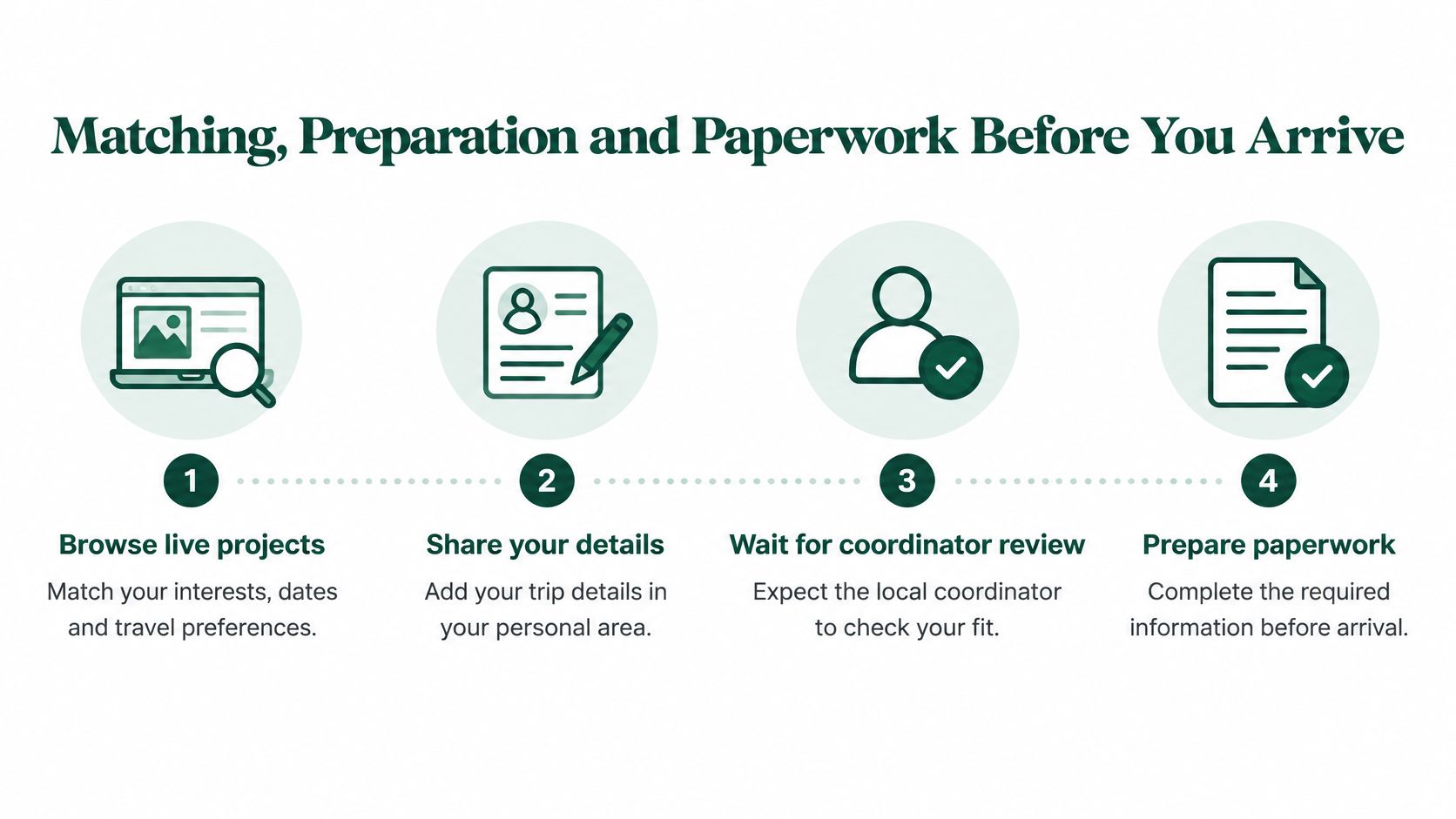
Good coordination starts before you've packed a bag. You browse live projects that fit your interests, dates and travel preferences, and the 'Find my project' tool narrows that search. Once you share your details with the team, a coordinator checks whether your skills, schedule and agreed stay match what the host project needs.
The visual below sets out the sequence you'll follow at this stage.
That fit check works like a two-way interview. The project confirms it can use what you offer, and you confirm the role suits you. A project might set a minimum stay, or ask for relevant studies or skills on healthcare placements, so honesty about your English level and experience protects you from landing in a role you can't do well. You can join from the age of 16 with a basic level of English that lets you manage everyday conversations and understand instructions, though some projects ask for more. Most placements need no previous volunteering experience at all.
Your Pre-Departure Checklist
Send your basics: Share your interests, dates and travel preferences with the team.
Check your English: Compare your level against the project's stated requirement.
Complete your self-declaration: You must declare any criminal record, for safety reasons, when you apply.
Read the fee details: Check what's included and what's separate, such as flights, visas, insurance and transport, on the project page itself because inclusions differ by location.
Confirm your arrival: Airport collection is arranged for the start day, so pass on your flight details in good time.
List your questions: Note anything unclear about the stay so the team can answer before you fly.
Take Teaching in community schools in Kandy as an example. You'd support English learning for children and adults in and around Kandy, working alongside local teachers rather than leading classes alone, with the city's temples, markets and surrounding hills there for your free time. The before you go guidance helps you work through the same preparation steps for whichever project you choose.
One boundary matters here. Entry and insurance requirements sit outside the coordinator's control, so check current official sources for your own nationality. By the time you fly, you should know your dates, your tasks in outline, your inclusions and your first point of contact. If any of those four is fuzzy, ask now rather than on arrival.
How Coordinators Brief You on Arrival
Arrival is the visible part of what do volunteer coordinators do. You're welcomed, introduced to your local coordinator, shown around the house and walked through the project routine. At HeyLocals, local coordinators look after volunteers while they're on their project, and that care starts with this orientation.
The welcome scene below shows the kind of first conversation where house arrangements and the daily schedule get explained.

The less visible part is the briefing itself. It covers house arrangements, safety routines, the schedule and who to contact for which question. A study of social and civic engagement in international volunteering identifies communication skills, realistic expectations and rigorous training as the three most important preparation concepts, and found that most respondents didn't have clear expectations when choosing an organisation or project theme.
Three Small Confusions Sorted Early
Say a briefing uses unfamiliar terms. Your coordinator explains it in plain language and confirms what the project team expects. Say an arrival instruction is unclear. The coordinator clarifies where to go and whom to call. Say an activity doesn't run on the day you expected. The coordinator confirms when it happens and agrees an alternative.
You'll also join activities that already exist and help where it's useful, with what you can offer, rather than starting something new. The short video below gives you a feel for how that first settling-in period looks in practice.
Before orientation ends, get three answers in writing. Who do I contact first for a daily question, who sets my tasks this week, and what happens if an activity is cancelled?
The Working Week Without Taking Over
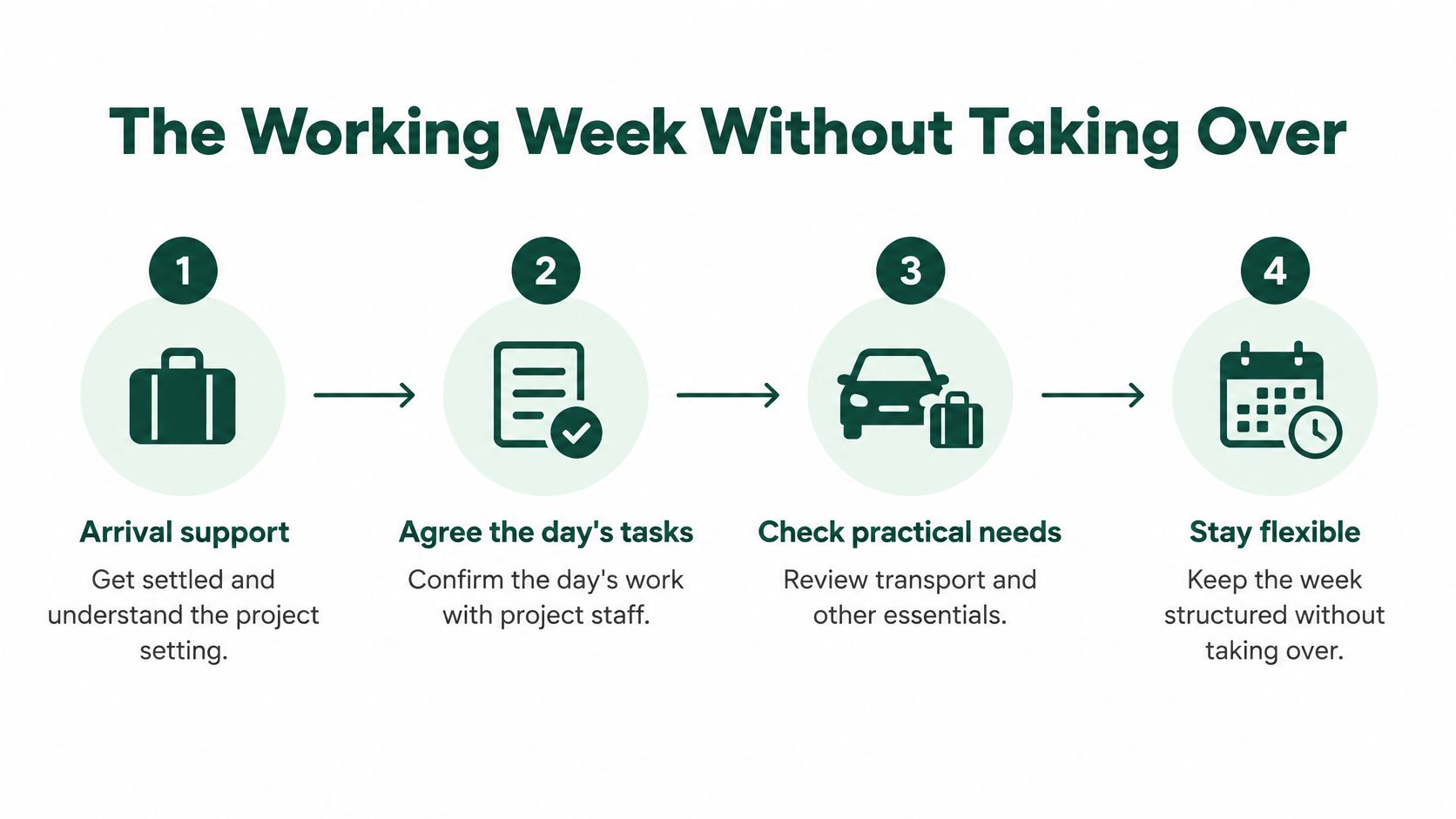
A coordinator's week has a rhythm rather than a fixed hourly diary, because settings like Bali and Tanzania differ in travel distances and daily routines. The shape stays similar though. It starts with arrival support for anyone new, moves into agreeing the day's tasks, and runs through practical checks and questions until the next day is prepared.
The process flow below shows that sequence from settling in to staying flexible.
Who Sets Your Tasks
Your coordinator agrees the work with local teachers, carers or conservation staff, and those professionals stay responsible for teaching, care and conservation. The coordinator checks transport, materials and timing around their decisions. That means your tasks won't be invented to fill your day, and classes or children's routines won't be reshaped around visiting volunteers.
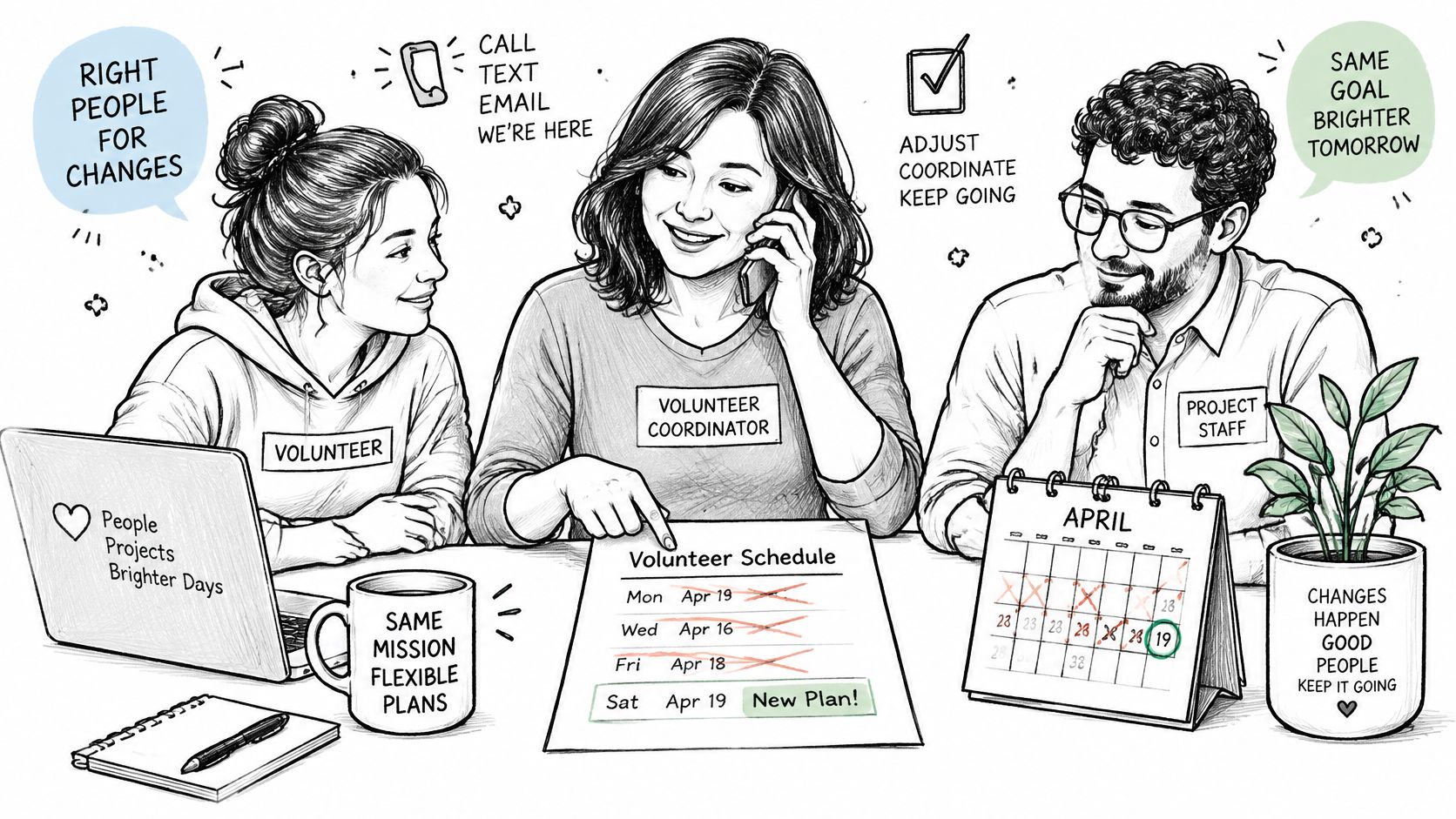
If a school changes its timetable, the coordinator renegotiates your tasks with the staff and explains the new plan to you. If materials aren't ready, the coordinator chases the practical detail so you aren't standing idle or improvising something unsuitable. Our guide to volunteer project management explains how that planning layer works behind a placement.
The Quieter Work You Rarely See
Much of the job is interpreting, in every sense. A Warwick study of an intercultural volunteer programme found that participants struggled to interpret behaviour outside their usual cultural frames, while divergent expectations between international volunteers and local stakeholders created frustration and barriers to stronger relationships.
That's why coordinators spend time explaining local routines and checking whether a proposed task fits the host team's priorities. They also prepare materials and arrangements for the next arrival while you're settling into your week. None of this makes the coordinator your personal guide for free-time plans, and that's deliberate.
Your part in a smooth week: Arrive on time, follow the project staff's lead, and raise small problems early while they're still easy to adjust.
Who to Contact for Each Kind of Question
One rule handles most situations. Start with the person who owns the question, and ask your local coordinator when you're unsure who that is. The distinction matters because each contact can only act on their own part of the placement: the HeyLocals team controls what was arranged and priced for you, the coordinator controls what happens on site, and project staff control the work itself.
| Question type | Who to contact first | Notes | |---|---|---| | Booking, dates and what the fee covers | HeyLocals team before departure | Check inclusions and separate costs on the project page | | Daily tasks, schedule or activity changes | Local coordinator | The coordinator agrees changes with project staff | | How to carry out the teaching, childcare or conservation work | Local teacher, carer or conservation staff | The coordinator supports the task but does not replace these professionals | | Late arrival or transport delay | Arrival contact in your documents, then the local coordinator | The local team checks revised collection and any agreed extra costs | | Medical emergency or immediate danger | Local emergency services first | Then the relevant local contact and your insurer, as appropriate | | Safeguarding concern | In-country coordinator | Reported and escalated through the agreed safeguarding route |
A documented volunteer coordinator role description from Staying Put frames this clearly. The coordinator works with service managers and safeguarding leads, ensures tasks suit each volunteer's capability, and connects volunteers with the responsible professionals rather than teaching, providing care or managing conservation work independently.
How the Roles Divide in Practice
Before departure, the HeyLocals team handles booking, dates and preparation. Each destination then has a named in-country coordinator who looks after the day-to-day welfare of participants and children and liaises with local authorities and partner project leaders. Professional emergency services sit outside both, and they always come first in immediate danger.
Your placement documents list the contact for each situation, so keep them somewhere you can reach offline. Using the right contact first gets you a faster, clearer answer than messaging everyone at once.
Handling Plan Changes With the Right Contact
Plans change on site for ordinary reasons. A class is moved, an activity is rained off, a staff member is away. What volunteer coordinators do in those moments matters more than the welcome, because confusion can turn into frustration.
The planning discussion below reflects the kind of conversation where a schedule gets reworked with project staff.
Three Kinds of Change
An activity is unavailable: The coordinator agrees an alternative with the project team and tells you the revised plan.
A timetable shifts: The coordinator adjusts your assignments, explains why, and checks the new tasks suit your skills.
Your safety or wellbeing is affected: You tell the in-country coordinator through the agreed incident channel as soon as you can.
An evidence summary on volunteer recruitment and retention from Switchboard reports that clear role development, communication, orientation and in-service training are positively associated with satisfaction, retention, longer volunteering duration and more hours contributed. It also notes that regular supervision isn't universally linked to higher retention, so targeted support tends to help more than constant checking in.
Say heavy rain cancels a morning activity. A common mix-up is assuming you should renegotiate the plan with project staff yourself. The coordinator does that negotiation for you: they speak with the project team, agree which tasks can move to the afternoon and which need a different day, then tell you the revised plan with the reasons behind it. You hear one clear answer, because the checking with staff has already happened before anything reaches you.
Part of that readiness is invisible. In every country where we operate, the in-country coordinator keeps an up-to-date local referral list, so the routes to the right local services exist before anyone needs them. Some changes still sit outside the coordinator's reach. They can rearrange your week around the host team's capacity, but they can't rewrite what the project needs or guarantee a replacement every time something falls through. Response speed also depends on local conditions, so don't expect instant fixes. The coordinator's job is to make your next step clear and to say plainly what can and can't change.
Closing the Placement and Recording Feedback
A placement winds down before it ends. In your final days, the coordinator typically confirms your end date and walks you through whatever closing steps your project uses, which can include returning keys, handing over tasks to a local staff member or briefing the volunteer who follows you.
What the Coordinator Does With Feedback
Feedback is how the coordinator learns whether the placement worked for you and for the host team. Tell them how the briefing, tasks and support felt, including anything that stayed unclear longer than it should have. Specific comments help most, because a clearer arrival instruction or a better orientation question can be fixed, while a general impression can't.
Say you mention that the orientation never explained where to wait on your first morning. The coordinator can add that point to the next arrival briefing. Your comments might sharpen a task description or flag a scheduling clash, and the person who benefits is usually the volunteer who comes after you.
Feedback shapes what the coordinator prepares next, within what the project can realistically change. Once you have gone home, the coordinator's role in your trip has ended.
After the placement, questions still reach us through the contact route in your documents, and the answer depends on what you're asking. So before you leave, do two things: ask what to keep in mind if you ever return, and confirm the best channel for sending feedback while your impressions are still fresh. That last conversation is where your experience becomes useful to someone else.
Choose a Project With Clear Coordinator Support
Shortlist before you book. We support volunteers before, during and after their trip, across 15 destinations including Cambodia, Cape Verde, Colombia, Costa Rica, India, Indonesia, Japan, Kenya, Nepal, the Philippines, South Korea, Sri Lanka, Tanzania, Thailand and Vietnam. Open each project page rather than comparing countries, because inclusions, dates and eligibility differ by location.
Four Questions for Every Project
Who coordinates locally: Who is the local coordinator, and what do they handle day to day?
What the fee covers: What's included, and what's separate?
How you're prepared: What happens before departure, and in what order?
When things change: How are plan changes and emergencies handled on site?
Our guide to how we select projects shows what sits behind those answers. Note where a page leaves you guessing, and ask us before you commit. Once your self-declaration and preparation are complete and your inclusions are checked, you'll book knowing who supports you and when.
Shortlist two or three live projects today, compare the four answers side by side, and continue with the one that gives you the clearest picture of support.
At HeyLocals, we match you to live, locally run projects and spell out who supports you before departure, on site and after you return. Browse the projects that fit your dates and interests, check the inclusions and coordinator support on each page, and take your next step with a clear picture of who's in your corner.
Refined using Outrank tool
In this article
- Table of Contents
- Responsibilities at a Glance Across the Placement
- Matching, Preparation and Paperwork Before You Arrive
- How Coordinators Brief You on Arrival
- The Working Week Without Taking Over
- Who to Contact for Each Kind of Question
- Handling Plan Changes With the Right Contact
- Closing the Placement and Recording Feedback
- Choose a Project With Clear Coordinator Support