Sea Turtles and Plastic: How It Harms Them and What Helps
Sea turtles and plastic: how ingestion harms them, which species are most exposed and which actions cut the risk.
As many as 52% of sea turtles may have ingested marine debris, according to a global model described in the NIST global meta-analysis overview. That's an estimate of potential ingestion, not a count of turtles killed by plastic. Confusing those measures makes the problem harder to understand and can lead people to support actions that don't address the exposure they're trying to prevent.
Understanding sea turtles and plastic starts with separating exposure, injury and death. From there, we can ask more useful questions: Which turtles encounter plastic? What happens after they swallow it? And which actions prevent contact rather than respond after harm has occurred?
Table of Contents
Which Sea Turtle Species Swallow the Most Plastic
Plastic ingestion by sea turtle species
| Species | Plastic found | Where the risk is highest | |---|---|---| | Olive ridley | All 37 examined in the Pacific longline assessment cited below | Highest relative risk in the global model | | Green turtle | 90% in the same Pacific assessment | Shallow coastal feeding grounds are an important exposure setting | | Loggerhead | 80% in the Pacific assessment | Mediterranean coastal waters are another documented exposure setting, but stranded samples don't establish a global hotspot | | Leatherback | None of three examined in the Pacific assessment | Not identified by this small sample; it cannot establish low risk |
The USGS Pacific longline assessment found plastic in all 37 olive ridleys, 90% of green turtles, 80% of loggerheads and none of three leatherbacks examined. These are results from turtles collected through a particular fishery, not population-wide rankings.
Read the sample before the percentage
A percentage answers a question about the animals examined. It doesn't automatically describe every member of that species, every ocean or every life stage.
For example, a study of loggerheads stranded in Cyprus, reported by The Cool Down, found plastic ingestion in 42.7% of 135 turtles. That doesn't contradict the Pacific assessment. The researchers examined different animals, in a different place, collected through a different route.
Practical rule: Treat a species name and percentage as incomplete information until you know where the turtles came from and how researchers selected them.
The leatherback result deserves particular care. An absence of plastic in a small sample means researchers didn't find it in those animals. It doesn't demonstrate that leatherbacks avoid plastic or that other populations face little exposure.
Feeding habits help explain exposure
Turtles don't all search for food in the same places or choose the same prey. Floating bags and fragments can resemble jellyfish or other food, creating opportunities for mistaken ingestion.
Green turtles may also encounter plastic while feeding in shallow coastal habitats. In that setting, the relevant question isn't only whether a turtle mistakes a bag for prey. It's whether litter overlaps with the places where the animal regularly feeds.
Life stage matters, too. A species-level label can conceal differences between small turtles living offshore and larger animals using coastal feeding grounds.
The useful conclusion is therefore narrower than a universal league table: several sea turtle species swallow plastic, but local feeding ecology and sampling conditions shape the measured rate. For a conservation project, check evidence from the habitat it protects before applying a headline percentage from elsewhere.
How Widespread Plastic Ingestion Has Become
2025 necropsy analysis: An analysis covering 10,412 marine-animal necropsies found plastic ingestion in 47% of 1,306 sea turtles and directly linked plastic ingestion to mortality in 4.4% of the turtles examined, according to AZoCleantech's account of the findings. Read the first figure as debris detected in examined turtles and the second as the smaller subset where investigators assigned plastic a fatal role.
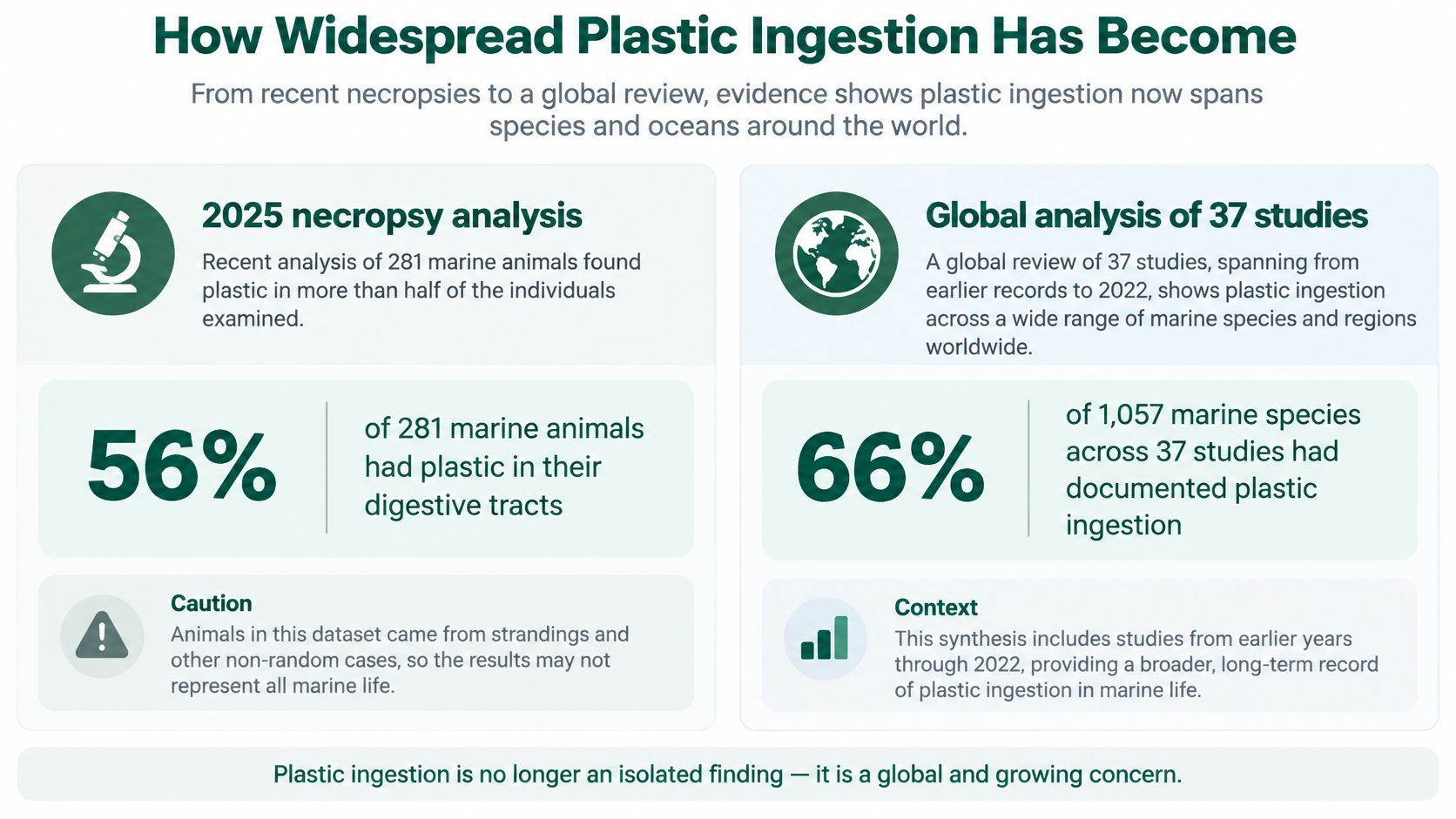
A necropsy is a postmortem examination. A series built from necropsies therefore describes animals recovered for examination; living turtles at sea are the denominator it cannot see. That sampling frame can make risk look larger than it is for turtles still feeding, migrating and breeding.
A threat with a long historical record
A global analysis of 37 studies assembled records reaching back before 1900 and reported significant increases in debris ingestion for green turtles and leatherbacks across the 1895–2012 record. The loggerhead increase did not reach statistical significance.
That uneven result is the useful part. The record supports a real rise for two species while leaving loggerheads unresolved in that analysis, so a single upward line for all sea turtles would misstate the evidence.
A missing significant trend needs precise wording. It means the analysis did not establish an increase with the required confidence; it leaves open whether a smaller rise, a regional rise or a later change escaped detection.
Compare like with like
Before repeating or comparing a headline, identify what the researchers measured:
Ingestion prevalence: the share of examined turtles containing debris.
Debris quantity: how much material researchers recovered, measured by count, mass or another method.
Attributed mortality: deaths investigators linked to debris, separate from deaths where debris happened to be present.
Sampling context: the species, location and route through which animals entered the study.
Each measure answers a different conservation question. A project investigating litter sources needs material types and locations; a veterinary team assessing harm needs injuries and animal condition.
Plastic ingestion is a long-documented, geographically widespread threat. Prevalence shows exposure in examined animals; attributed mortality is the stricter endpoint that follows only when evidence connects debris to the death.
How Plastic Harms Turtles Inside Their Bodies
A turtle doesn't have to suffer chemical poisoning for plastic to harm it. Physical obstruction, injury and disrupted feeding can be enough.
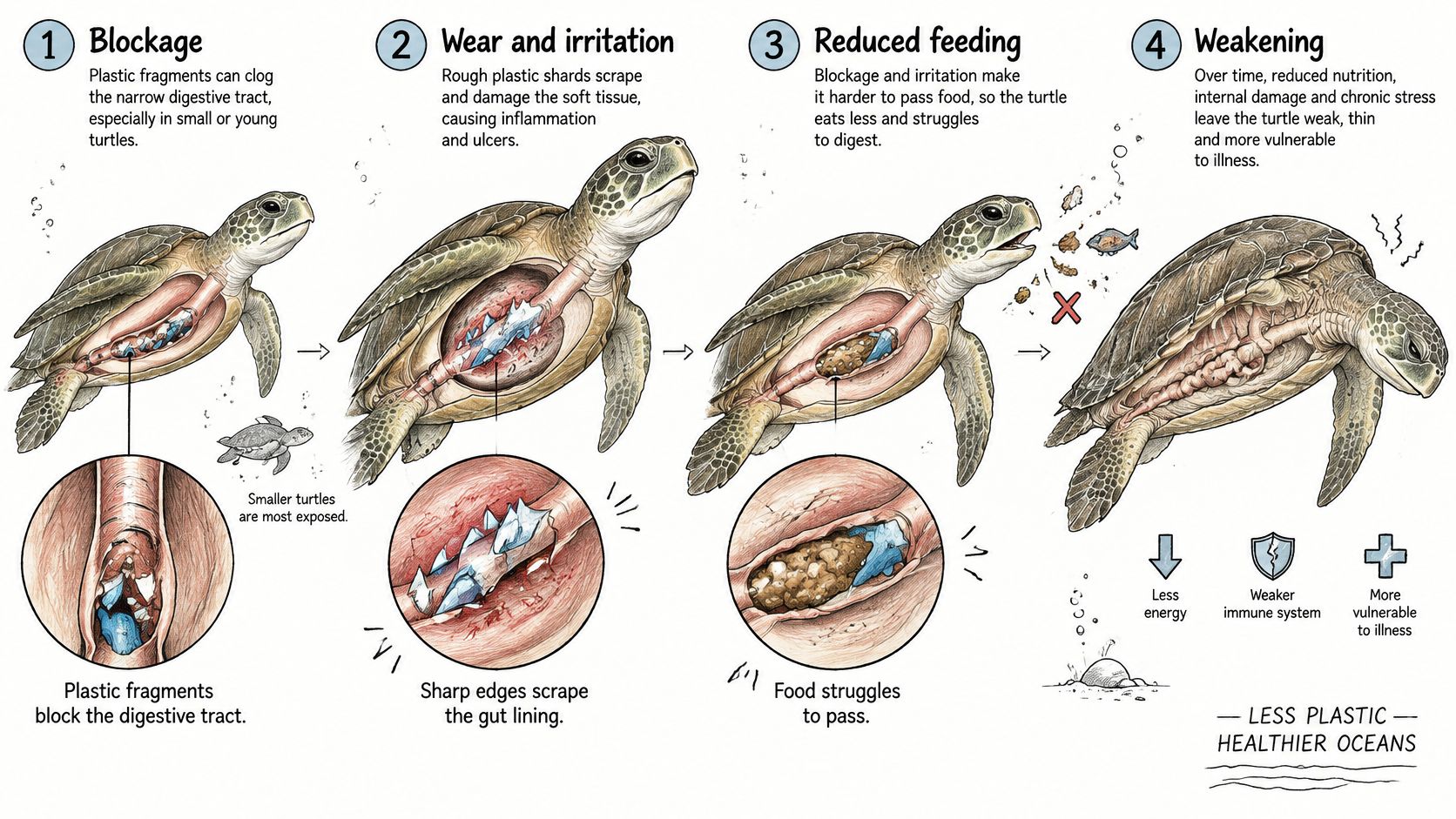
A review of plastic ingestion and sea turtle health describes how swallowed debris can block the digestive tract, produce false fullness, cause perforation and infection, and impair nutrition. These mechanisms can overlap, rather than follow a fixed sequence.
From swallowed material to physical harm
Consider a responder observing a small turtle that has stopped feeding. Plastic might be involved, but the visible behaviour alone can't establish the cause. A trained assessment is needed to distinguish the following problems from other illnesses.
Blockage. Material can lodge in the digestive tract and prevent normal passage. A small turtle has a relatively narrow gut, so an amount that looks insignificant to a person may create a serious obstruction. In a hypothetical rescue, refusal to feed could be the first observation, not proof of what's blocking the gut.
False fullness. Plastic can occupy space without supplying nourishment. A turtle may reduce its food intake even though it hasn't obtained the energy or nutrients it needs. The important distinction is between a stomach containing material and an animal receiving adequate food.
Perforation and infection. Sharp fragments can injure the gut wall. If the wall is perforated, infection can follow. A lethargic animal needs assessment, but responders shouldn't assume they can identify an internal wound from its appearance on the beach.
Poor nutrition. When normal feeding is disrupted, a turtle can lose condition and become less able to recover. Weak swimming or abnormal floating may prompt concern, although neither sign identifies plastic ingestion by itself.
Recognize warning signs without diagnosing
The difficulty for volunteers is that warning signs aren't specific diagnoses. Lethargy could have several causes. Buoyancy problems don't tell an observer exactly where plastic might be lodged, and a turtle's outward appearance can't reveal everything happening inside its digestive tract.
That's why observations should be descriptive. Record that an animal remains at the surface, appears unusually inactive or refuses food under supervised care, rather than recording an assumed plastic blockage.
Lethargy: Unusual inactivity warrants trained assessment.
Buoyancy abnormalities: Difficulty diving or maintaining a normal position needs attention.
Loss of appetite: Reduced feeding is a concern, not a diagnosis.
Suspected blockage: Difficulty passing material requires veterinary evaluation.
These signs justify contacting trained wildlife personnel. Whether ingestion becomes fatal depends on more than the mere presence of plastic.
Does Every Swallowed Plastic Kill a Turtle?
Not every swallowed piece kills a turtle. Plastic can cause fatal injuries, but an ingestion finding on its own establishes exposure, not a fatal outcome or the probability of one.
A Sicilian study of stranded loggerheads found marine litter in 103 of 344 turtles, or 29.94%, examined over seven years. That figure describes stranded animals, not a random sample of turtles swimming in surrounding waters.
Why stranded animals can distort the impression
Stranded and dead turtles are far easier to examine than healthy animals living at sea, which produces selection bias: the turtles available for study may differ systematically from the wider population. A rehabilitation centre's admissions show the gap. Its records explain the problems staff treat, yet they say little about how common those problems are among turtles nearby, because animals that never strand or need care never appear in the file.
That missing group is what distorts the picture.
Applied directly to living populations, stranded-animal evidence makes ingestion look deadlier than it is, since turtles that swallow debris and keep feeding, or avoid it entirely, never enter the count. The findings answer a narrower question: how much litter appears in animals that strand, rather than what share of ingestion at sea ends in death.
Small, localized carcass samples need the same restraint. Even if every examined animal contains plastic, the result can't support a worldwide prevalence estimate. It flags a local concern worth broader investigation.
What decides whether ingestion turns fatal
Survival depends on several interacting factors rather than a single threshold. Species and life stage shape feeding behaviour and digestive anatomy, so a juvenile in a coastal feeding habitat faces different conditions than an older animal elsewhere. Particle type and quantity matter too: a flexible film and a sharp fragment don't behave identically, and material that obstructs the gut presents a different problem from material that passes through. Nutritional condition adds another variable, since an already weakened turtle has less capacity to recover, while excretion can move some ingested material out of the body before it causes harm.
Juveniles and coastal feeding habitats deserve attention, yet neither justifies a universal prediction about death. Ingestion is common, fatality is conditional, and a claim is interpretable only when its sample is described.
Where Nesting Beaches Face the Highest Contamination
A nesting beach extends the exposure pathway onto land. Eggs incubate in the sand for weeks, and hatchlings climb through that same sand to reach the sea, so the beach itself is a place where contamination can be measured rather than assumed.
Microplastic contamination on sampled nesting beaches
| Beach group | Suspected microplastics | Note | |---|---|---| | Mediterranean nesting beaches | 80% | Highest contamination among sampled regions | | South Pacific nesting beaches | 0% | Lowest contamination among sampled regions | | All sampled nesting beaches | 45% | 209 beaches across 39 countries and six ocean basins |
A National Park Service account of the 2025 global assessment reports suspected microplastics on 45% of 209 nesting beaches across 39 countries and six ocean basins, including 80% of sampled Mediterranean beaches and 0% of sampled South Pacific beaches.
Both qualifiers in that finding carry weight. Suspected describes how the particles were classified during analysis. Sampled limits the percentages to the beaches examined. A regional result characterizes the surveyed coastline, and extrapolating it to an entire ocean basin would go further than the data allows.
Microplastic detection does not establish harm
Particles in sand raise specific questions. Could microplastics change sand temperature, drainage or oxygen movement around a clutch? Could such changes affect development or hatchling condition? These are hypotheses to test at each site, and a detected particle counts as a reason to investigate rather than a confirmed effect. The same caution runs in the other direction: a beach where researchers find no particles in sampled sand has produced a clean reading for that survey, in that location, at that depth.
Debris size decides what a cleanup can demonstrate. Collecting visible packaging documents the removal of visible packaging. Buried microplastics require a different kind of measurement, and a large collection total can sit alongside nest-level contamination that was never assessed.
This is why a nesting-beach project benefits from recording litter collection, sand monitoring and source reduction as separate activities. A monitoring record that can answer a question compares equivalent locations and depths using the same method, repeats measurements before and after an intervention, and, where regulations permit, relates the findings to nesting success and hatchling health. The record should also state plainly what the sampling could not detect. For readers comparing nesting habitats firsthand, the guide to sea turtles in Costa Rica offers a destination-specific starting point.
A single transect shows what this looks like in practice. A team that counts particles at set depths along the same stretch of beach each season can report whether contamination shifted over time and whether a change followed a local intervention. A one-day collection total, however large, only measures effort.
Which Actions Cut Sea Turtle Plastic Exposure Most
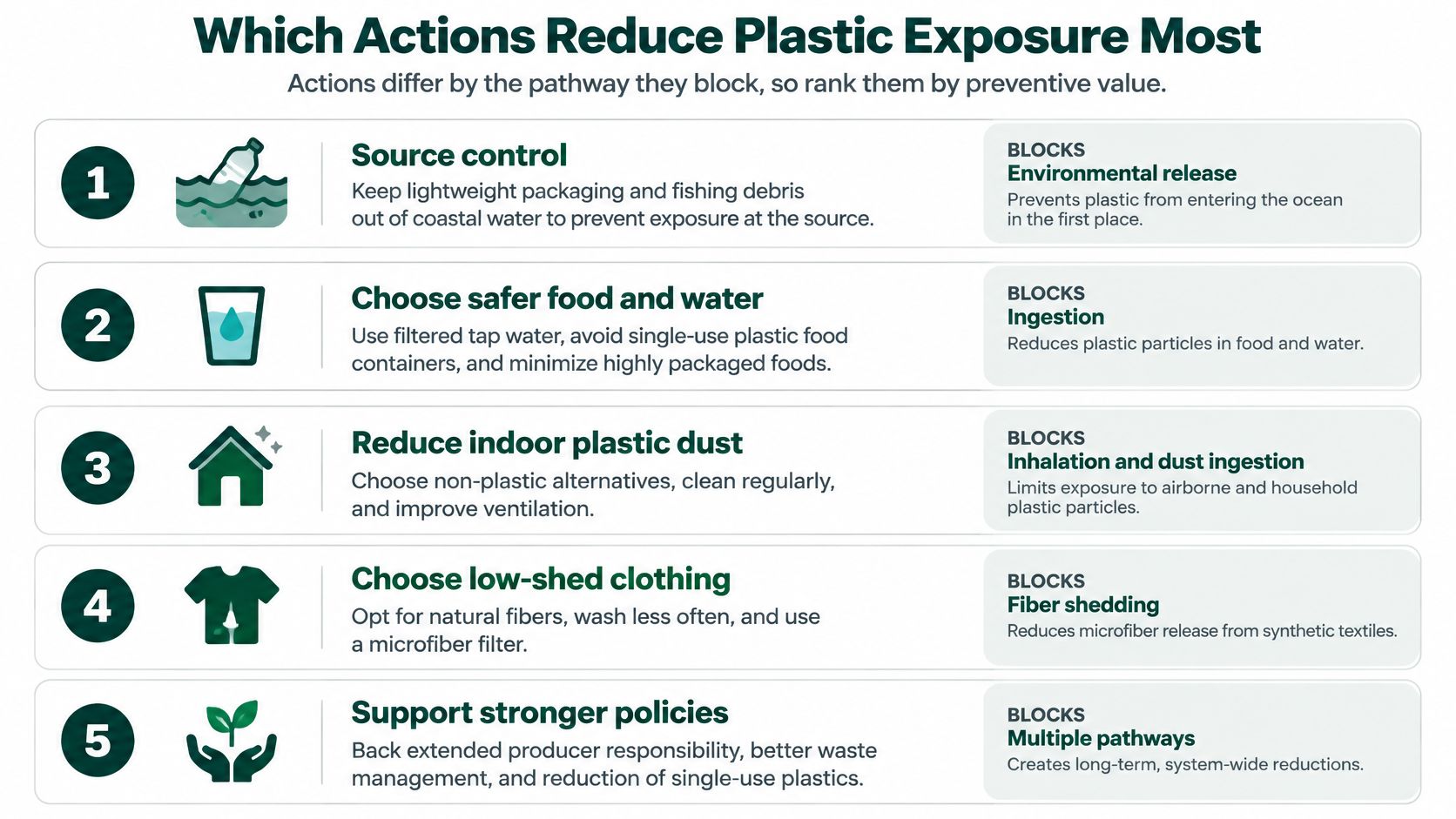
Prevention works by blocking the route that carries plastic to turtles. Rank each option by the pathway it removes: supply into coastal water, swallowable debris already circulating, contaminated incubation sand, or care for an animal after exposure. Swallowed plastic can injure without killing, and stranded turtles show only the visible end of the problem, so the order favors actions that reduce contact before rescue is needed.
Interventions ranked by the exposure pathway they target
| Action | Pathway it targets | Evidence strength | |---|---|---| | Upstream source control | Plastic entering coastal water | Strong preventive logic; limited direct trial data | | Removing fishing line and flexible packaging | Swallowable debris and line-related hazards | Strong logic; linked to documented exposure pathways | | Shoreline litter removal | Debris already on beaches | Useful but reactive | | Sand screening on nesting beaches | Microplastics in incubation sand | Emerging; limited evidence for conservation outcomes | | Trained referral of stranded turtles | Individual impacted animals | Needed for assessment and treatment; volunteers don't treat |
Start where exposure begins
Upstream source control comes first because it aims to keep material out of turtle habitat altogether. Secure waste storage, reduced unnecessary packaging and responsible management of fishing materials shrink the supply of debris before currents, wind and tides can carry it toward feeding or nesting areas.
A household or café comparing substitutions can use Nothing's guide to compare plastic-free straw materials. A swapped straw helps most when it sits beside secure bins, refill habits and responsible fishing-line disposal.
Targeted removal of fishing line and flexible packaging comes next. During an authorized cleanup, separate these materials in the collection record so coordinators can identify recurring items and possible local sources.
General shoreline litter removal still has value once debris has escaped into the environment. A useful cleanup ends with a disposal plan and a short source log: dominant item types, likely origin points and conditions that pushed material ashore.
Sand screening needs greater caution. It targets incubation sand, where buried particles and nest disturbance sit close together. Volunteers should leave excavation or sieving decisions to beach managers, who can weigh removal against harm to eggs and habitat.
Trained referral serves an individual animal after contact. Its lower rank reflects scope: treatment can change one outcome, while source control can reduce exposure for many animals.
Leave a record another team can repeat
Bring labelled collection sacks, gloves, litter pickers, a scale, a camera and a recording sheet. Follow the site coordinator's rules for sharp objects, fishing gear and protected habitat.
Count and weigh: Separate material categories so another team can repeat the method.
Photograph items: Include a size reference and avoid unnecessary handling.
Log locations: Record where each collection area begins and ends.
Record turtle encounters: Note observations and the response taken without inventing a diagnosis.
Never pull material protruding from a turtle or attempt treatment yourself. Contact trained wildlife personnel and follow their instructions.
Before joining an event abroad, use the marine conservation volunteering guide to think through responsibilities, supervision and the work you can realistically support.
Choose How You Will Help Sea Turtles
A useful contribution is one you can repeat and measure. Choose by exposure pathway: reduce new plastic before it reaches water, support records that separate ingestion from mortality, or join supervised work that strengthens locally managed conservation.
Choose a manageable commitment
Reduce avoidable plastic at home. Start with recurring packaging purchases, secure disposal and proper handling of used fishing line. The Green Living Guy's everyday steps against plastic pollution can help you turn a broad intention into a practical household routine.
Support useful conservation records. Favour projects that distinguish species, size class, plastic type and animal outcome. A careful record of an uncertain outcome is more informative than an unsupported claim about turtles saved.
Consider supervised volunteering. Choose work that fits your skills and leaves animal-care decisions with trained staff. Families and students should establish which activities suit each participant before committing; under-18s need a parent or guardian involved, and participants are asked to declare criminal records.
The sea turtle conservation in Bali listing in Nusa Penida, Indonesia, costs from US$970 and is listed from one week. Treat the listing as a starting point for questions about supervision, daily tasks and what the fee covers.
Judge the working practices
Before committing to a placement, establish who handles injured animals, how staff record outcomes and whether public reporting acknowledges uncertainty. Ask what volunteers do during routine work, because ordinary days reveal more than an exceptional rescue story.
A credible answer separates participation from impact: routine volunteer tasks support the site, while measured outcomes belong to staff records and long-term monitoring. That distinction keeps expectations honest and makes your effort easier to sustain.
Choose the single action you can sustain this month. If that action involves joining a project, check its supervision and data practices before committing your time or money.
HeyLocals organises international volunteering trips with local organisations, including opportunities connected to wildlife and environmental protection. Visit HeyLocals to explore suitable projects and discuss how your interests, skills and travel plans could support locally managed conservation work.
In this article
- Table of Contents
- Which Sea Turtle Species Swallow the Most Plastic
- How Widespread Plastic Ingestion Has Become
- How Plastic Harms Turtles Inside Their Bodies
- Does Every Swallowed Plastic Kill a Turtle?
- Where Nesting Beaches Face the Highest Contamination
- Which Actions Cut Sea Turtle Plastic Exposure Most
- Choose How You Will Help Sea Turtles