Sea Turtles Costa Rica: A Guide to Nesting Beaches
Sea Turtles Costa Rica explained: which species nest, where, why nest temperature matters, and how to visit or volunteer responsibly.
You're on a dark beach with a small group, listening for a shell on the sand and wondering what you're allowed to do if a turtle appears. That uncertainty is the useful starting point. A beach patrol is quiet work under a local team's instructions, and nobody can promise you'll see a turtle or a hatchling release on a given night.
If you're planning around sea turtles in Costa Rica, the useful questions are which species use which coast, what the rules mean once you're on the sand, and how to judge a conservation claim by the thing it measures. A crowded night is one moment. It isn't a population trend.
Table of Contents
Why Costa Rica Matters for Sea Turtles
A nesting turtle in front of you is one night inside a breeding cycle that brings her species back to the same coastline year after year. When a guide asks your group to stay behind her, the team beside you is guarding that cycle. Costa Rica is where several of those cycles overlap at unusual scale.
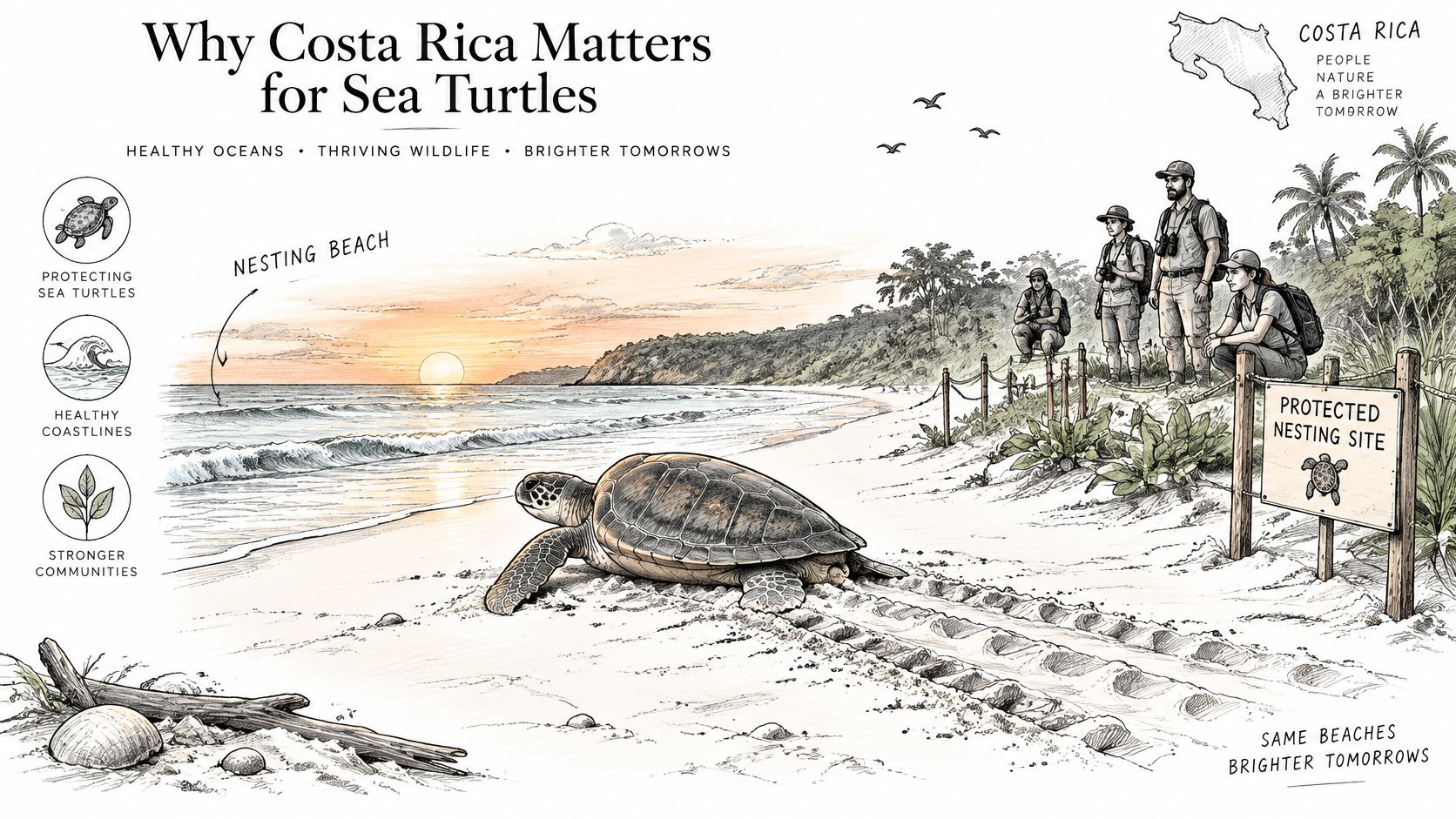
The country's 2020 IAC annual report records approximately 83 nesting sites across the Caribbean and Pacific coasts, with nesting by green turtles, leatherbacks, olive ridleys, and East Pacific black turtles, an estimated 27,000 nesting females a year at Tortuguero (the largest green-turtle nesting beach in the Western Hemisphere), and olive ridley arribadas at Playa Nancite that generally produce 20,000 to 116,000 nests a year. An arribada is a mass nesting event in which tens of thousands of turtles may come ashore over a short stretch of nights.
Those sites do not share a species list, a season, a monitoring method, or a community-management system. The country works less like one beach and more like a network of separate clocks: a Caribbean green-turtle project and a Pacific ridley project can run in different months under different rules. One beach tells you very little about the rest.
A visit shows you a long-running coastal system, and one animal is only a small part of it.
Hawksbills also turn up in beach monitoring, so a short species list on a leaflet can still surprise you. Before comparing trips, check the wider Costa Rica destination context, then ask each team which coast and which species its work covers. That answer tells you which part of this system you would be joining, and which clock you would be watching.
Sea Turtle Species and Where They Nest
Start with the coast and the beach, then check the species. This table pairs each species with a nesting site and what the published record counts, because a tally of nests and a tally of nesting females are different measurements.
| Species | Coast and main site | What the record counts | | --- | --- | --- | | Green turtle | Caribbean, Tortuguero | Nesting females per year | | Olive ridley | Pacific, Playa Nancite | Nests per year, laid during mass arribada events | | Leatherback | Caribbean, Playa Norte | 22 nests recorded in 2024 | | Hawksbill | Caribbean, Playa Norte | 63 nests recorded in 2024 | | East Pacific black turtle | Nesting supported in Costa Rica; no single site figure published | No site figure in the research |
The Playa Norte counts are single-beach figures for one year, drawn from the Area de Conservación Tortuguero's Caño Palma Biological Station report, which also logged 291 green-turtle nests at the same beach in 2024.
What the rows can and can't tell you
The green turtle row points you to Tortuguero on the Caribbean, where the published record counts the mothers coming ashore. If you also want to understand this species away from the nesting sand, dive sites with green turtles are a useful companion, because most of a turtle's life is spent at sea.
The olive ridley row points you to Playa Nancite on the Pacific, where the figure measures nests produced during arribadas. That is a count of egg-laying events rather than individual turtles, so it describes a different unit from the green turtle's nesting females.
Playa Norte is a different kind of row. One Caribbean beach, one year, three species counted side by side. Those are nest counts for that site in that year. They are not a national total, and they don't tell you which month to fly.
The East Pacific black turtle row is the honest gap. Costa Rica supports its nesting, and the published country report doesn't attach a site figure you can plan around. That gap is worth keeping in mind. A programme that reports what it counted, where, and in which year gives you something concrete to check, while one that promises turtles gives you nothing to verify.
Ask which months the team covers
A species row tells you where to look. When to look is a separate question. Nesting follows species, coast, site, and season, and there is no single national calendar you can print and trust.
One window is specific. Research volunteers at Goldring-Gund Station patrol during the leatherback nesting season, from October to March, to collect nesting-turtle data and monitor nests, as the Leatherback Trust describes. For every other species, ask the local team which months they cover before you build a trip around one animal.
Why Nest Temperature Shapes the Next Generation
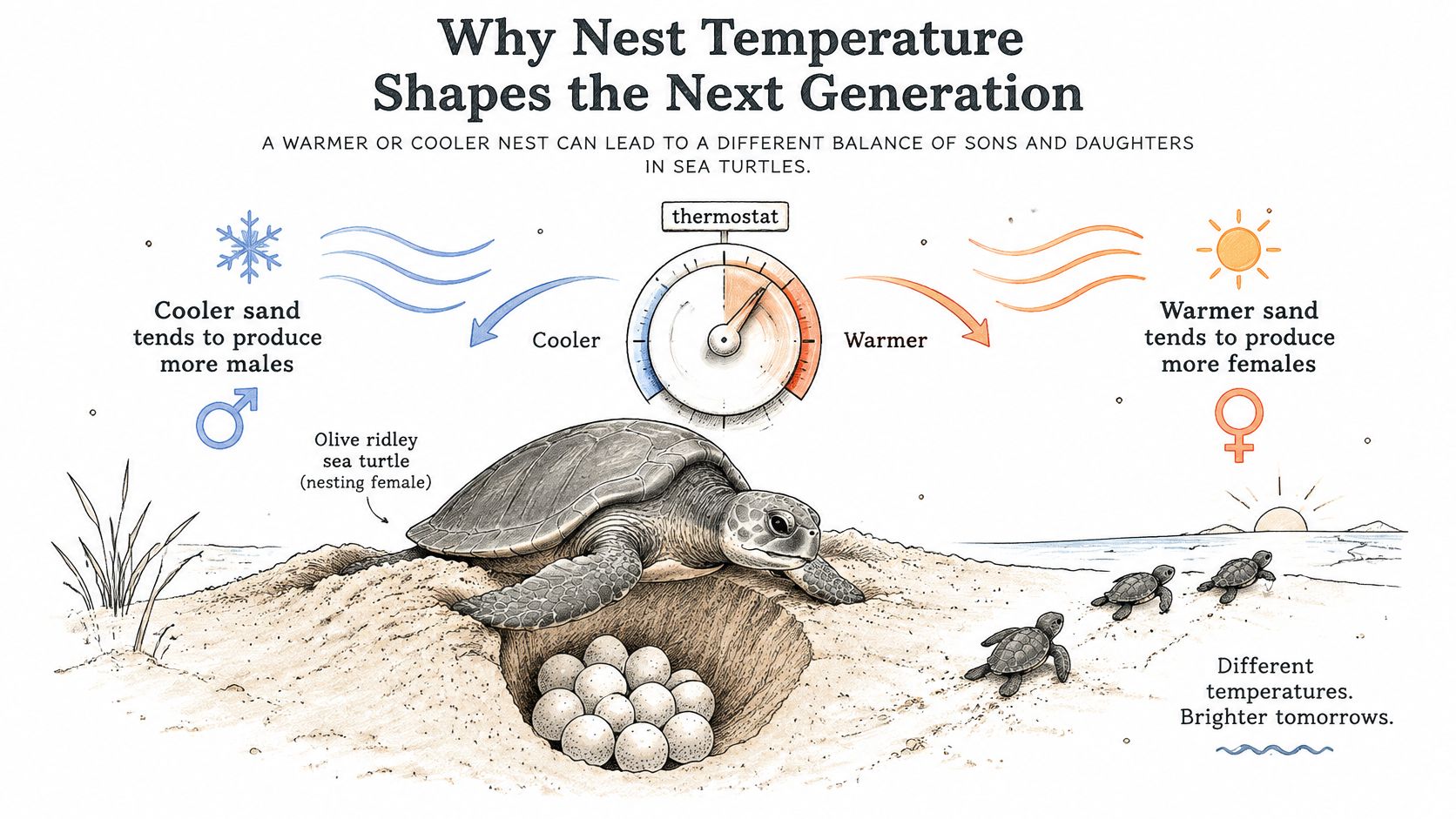
A sea turtle nest works like an incubator with no visible dial: sand temperature helps set the sex of each hatchling while the eggs develop. Visitors cannot wish a nest cooler, and small beach choices can change the setting.
For Costa Rica's olive ridley sea turtles (Lepidochelys olivacea), a Conservation Science and Practice assessment reports approximately 30.5°C as the incubation temperature expected to produce a 1:1 sex ratio, warmer nests producing predominantly females and cooler nests more males; at Playa Coyote, nests exposed to at least one hour above 35°C had emergence success of 78.9%, against 89.1% in nests that never crossed that threshold, and the same assessment estimated 78.6% of hatchlings from monitored Costa Rican nesting beaches were female-biased.
When warmer sand stops helping
Heat has a practical limit as well as a sex effect. More females can look like good news, because more future mothers might mean more eggs. It can also thin out males and leave a population with less room to absorb a hot decade. A beach that produces a crowd of hatchlings can still be producing a fragile mix.
The useful question is narrow: how hot did the sand get, for how long, and what happened to emergence afterward. A single warm afternoon is different from repeated hours above a threshold, and a single season is different from a trend.
Shade is part of the nest
East Pacific green turtles in Costa Rica often choose cover. Research found that 80.9% of nests were placed in vegetation, with 78% of those nests under trees, mean nest temperature of 30.7°C, and shaded locations cooler and less female-biased, as described in this Climatic Change study.
Moving or shading eggs should be judged against temperature logs and hatching results, not copied from one beach to the next.
Clearing vegetation, adding lights, or relocating every nest into a hatchery can change the temperature the eggs experience. Hatcheries can help on some beaches and harm on others. Ask what the team logs, and what those logs have shown on that beach.
Reading Nesting Numbers Without Overstating Them
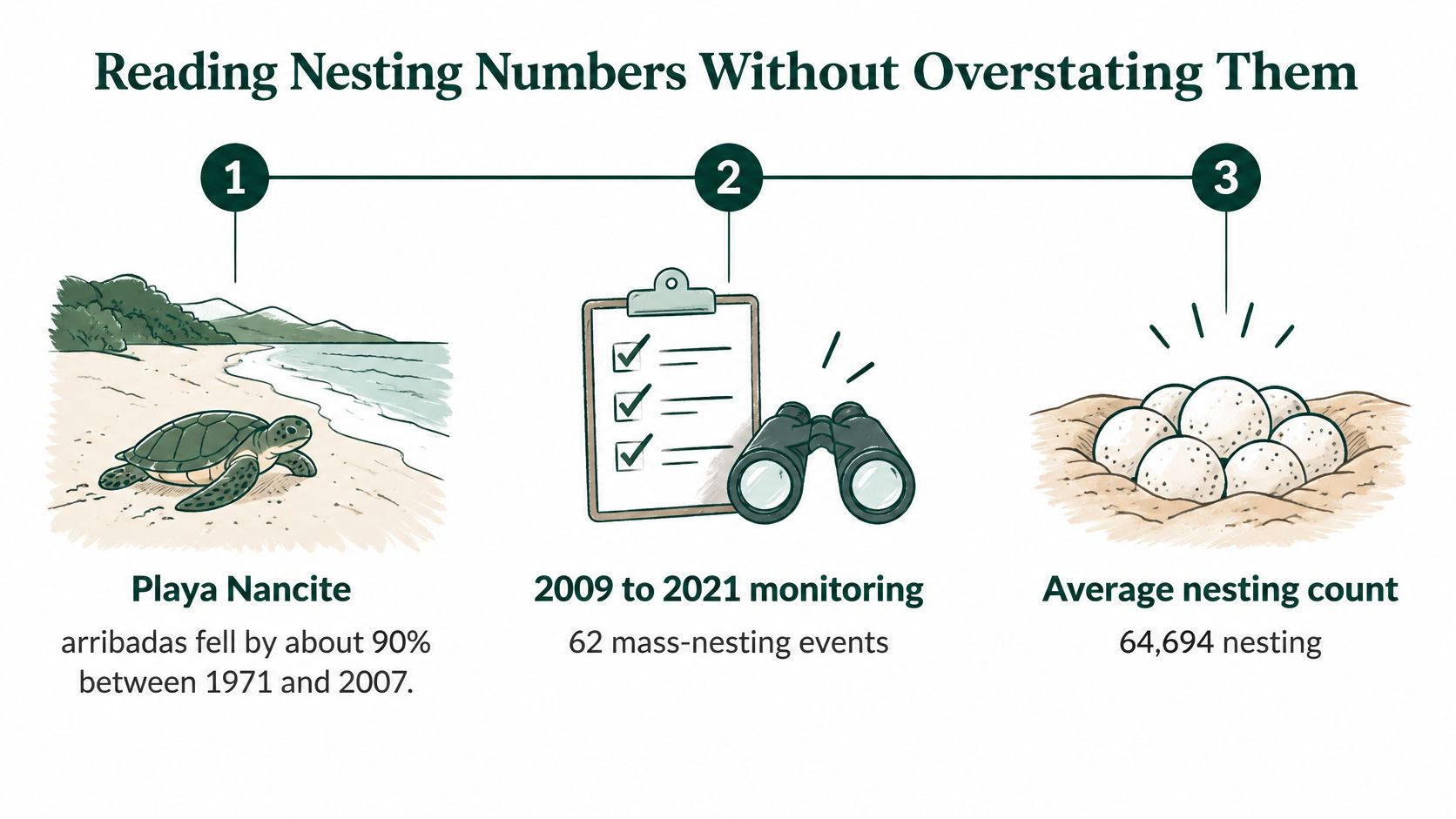
A huge night on the sand can feel like the whole story. At Playa Nancite, historical arribadas fell sharply between 1971 and 2007. A crowded season sits on top of that long fall.
Adults, nests, and hatchlings are different counts
These three counts work like three school rolls: parents at the gate, classrooms in use, and children who walk out the door. Mix them up and a recovery claim starts sounding bigger than the evidence.
Monitoring from 2009 to 2021 recorded 62 mass-nesting events and an estimated annual average of 64,694 nesting females, with a 14% increase in females per event, while mean hatching success was 33.4%, corresponding to an estimated average production of 2.17 million hatchlings per season, according to a Marine Ecology assessment. Those figures are an adult-abundance picture for those years, plus the share of eggs that produced hatchlings.
A large arribada can still yield a modest share of hatchlings. Adult counts, nest counts, and hatchling numbers answer different questions, and only the last of those speaks to how many turtles left the nest.
A later campaign shows the same gap in another form. A 2025 report recorded 575 nesting events at San Miguel and 719 at Costa de Oro, and released more than 24,769 hatchlings, while Corozalito recorded 2,410 nesting events across six arribadas, its highest activity in one season, in the CREMA 2025 campaign update.
A hatchling release measures early survival, not adult return.
No report can promise you will see a mass nesting, or that a release will happen on your night. Judge a claim by what it measures. Ask whether the number is nesting females, nests, or hatchlings released, which years it covers, and whether anyone is still counting the turtles that come back as adults.
Beach Rules You Will Meet at Nesting Sites
A typical night starts before the turtles do. You meet the team, leave white lights in the bag, and walk where you're placed. If a turtle comes ashore, you stay behind her and quiet. If she doesn't, the shift can still be the work. Tracks, nests, and an empty stretch of sand all get recorded.
Rules differ by park, so check the specific site before you pack.
| Site | Main rule | What it means for you | | --- | --- | --- | | Las Baulas National Park | Observe nesting turtles only from behind and in silence; touching and photographing are prohibited; only the guide uses a red-filtered flashlight | Stay where staff place you and don't use your own light | | Playa Nancite | Enter only with an authorised guide; no entry to the nesting area or dunes; lights and cameras need authorisation; touching turtles or eggs is prohibited | Ask before bringing any device | | Playa Cabuyal | No videos or photos of turtles at night; only approved red lights | Expect a long, dark shift and follow the team's light rules |
Why the light and the hands matter
At Marino Las Baulas National Park, visitors may observe nesting turtles only from behind and in silence. Touching or photographing turtles is prohibited, and only the guide may use a flashlight fitted with a red filter, as the Costa Rica Tourism Institute sets out for turtle observation. Bright light disturbs nesting turtles and hatchlings, so a phone torch "just for a second" is still a disturbance.
Playa Nancite restricts access itself, not only behaviour on the sand. Because entry goes through an authorised guide and even a camera or flashlight needs protected-area approval, anything you plan to bring has to be cleared before you arrive rather than decided on the night.
Playa Cabuyal shows the shift length people underestimate. Its night patrols run four to eight hours depending on how many turtles come ashore, and a 5 a.m. patrol counts tracks and checks the previous night's nesting. Videos and photographs of turtles at night aren't allowed, and only approved red lights are used.
The same pattern holds for research patrols in leatherback season at Goldring-Gund. The roster follows weather and turtle activity, not a brochure timetable.
Before a shift, ask what distance, lighting, and camera rules apply that night. Don't approach, handle, or relocate a turtle or an egg on your own, even if you think you're helping. If you want the wider habit behind these limits, read what responsible tourism looks like when the animal can't consent to a closer look.
Choose a Responsible Way to Take Part
Decide the kind of role before you pick a date. You can observe on a guided night tour, join a permitted nesting-beach programme, or support conservation away from the sand. None of those comes with a guaranteed sighting.
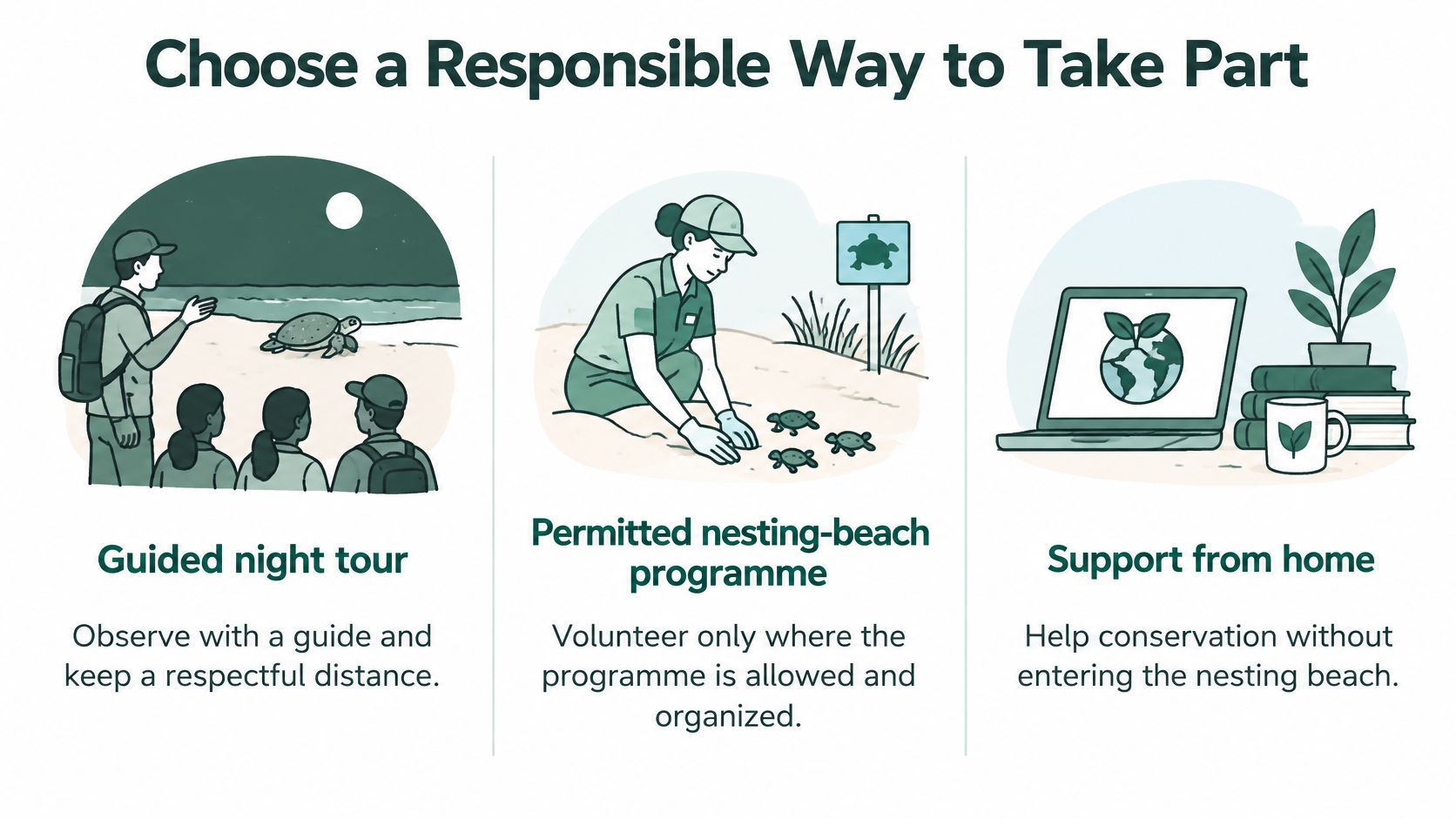
A nesting-beach programme is fieldwork. In protected areas, research, hatchery work, tourism, and volunteering need the relevant permits, and the local team sets the roster around weather and turtle activity. Tasks can include patrols, nest monitoring, and, where authorised, hatchery or research work. A centre routine is different. Tasks repeat under staff supervision inside a facility.
| Feature | Nesting beach programme | Centre-based routine | | --- | --- | --- | | Setting | Protected coastline under permits | Facility with tanks and feed | | Typical tasks | Patrols, nest monitoring and, where authorised, hatchery or research work | Preparing feed and cleaning tanks under staff supervision | | Schedule | Set by the local team, weather and turtle activity | Set by the centre roster | | Guaranteed sightings | No | No wild encounter is promised | | Photography | Often restricted, especially at night | Ask staff before taking any photos |
HeyLocals lists projects in Costa Rica and Colombia in Latin America, across project types that include animals and local wildlife, environmental protection, and education. That catalogue does not confirm a live sea-turtle placement in Costa Rica, so treat a volunteering page as a turtle post only if the live page says so. One confirmed option is sea turtle conservation in Bali, where you join a local team on Nusa Penida to look after rescued turtles, support their recovery, and help care for the habitat they depend on, at a placement that costs from US$970 and is listed from 1 week. Check age, dates, minimum duration, role, language, and inclusions on the live offer. Participants are asked to declare criminal records, a parent or guardian must be involved for under-18s, and most placements ask for no previous volunteering experience, though healthcare roles can require relevant studies or skills.
If you also dive, the Diving Escapades ocean conservation guide is a practical read on habits that matter once you're in the water, not only on the nesting beach. Our note on rescuing sea turtles is the companion piece if recovery work, rather than a night patrol, is what you want.
Each destination has a named in-country coordinator who handles day-to-day welfare of participants and children, responds immediately to incidents, escalates to the DSL, and liaises with local authorities and partner project leaders. Coordinators look after people and logistics. When a turtle comes ashore stays beyond anyone's roster.
Send these four questions before you commit.
Species and site: Which species do you monitor, and on which beach?
Distance, light, and cameras: What am I allowed to carry, and where do I stand?
The actual shift: Is this patrol, hatchery support, research, or observation only?
A changed night: What happens if weather or turtle activity cancels the plan?
No sighting and no hatchling release can be built into the itinerary. If the answers are vague, wait.
HeyLocals organises volunteering trips with local organisations, including wildlife care where a live placement is confirmed, and helps you match a project to your dates before you travel. If a nesting beach in Costa Rica is your interest, use the questions above with the team on the ground, and treat a centre-based sea turtle role as a separate choice with its own roster. When you're ready to look at current options, visit HeyLocals.