Service Learning Trip Guide for Responsible Travel
A service learning trip pairs a host-led role with a learning goal and reflection. See how to plan one and take part without taking over.
You're comparing two trips that look almost identical: a flight, a homestay and time helping in a school. Both sound worthwhile, but you need to know what you'll do, what you'll learn and whether the local team wants the help you can offer. A service learning trip should make those answers clearer before you book, not leave you to invent a purpose after you arrive.
Table of Contents
How a Service Learning Trip Differs from Volunteering
The difference starts with the classroom task, not the destination. Preparing a learning activity requested by a teacher is the service. Watching how that teacher adapts the activity, then examining what you learned from those decisions, is the learning.
A service learning trip sets learning objectives before departure, pairs them with a role the host team needs and makes time for reflection. The University of Texas at Arlington's service-learning guidance identifies preparation, performance and reflection as its core elements, with reflection taking forms such as journals, discussions and presentations.
A normal volunteering placement can still make a useful contribution to an ongoing project. It doesn't necessarily require the same deliberate connection between the task, an educational objective and an assessed reflection.
Service learning trip versus a normal volunteering placement
| Element | Service learning trip | Normal volunteering placement | |---|---|---| | Before you leave | Learning objectives set in advance | Task briefing may be enough | | Who sets the role | Host team names the help it needs | Visitor may arrive with a personal idea of helping | | During the day | Requested service plus observation of how locals adapt it | Service task without a required learning focus | | After the day | Reflection tied to the original goal | Informal chat or none | | Credit or assessment | Decided only by the student's school | Not an academic award | | What a short stay can claim | Support for an existing local project | The same honest limit, without a learning design |
Read the role row carefully. It describes a risk in visitor-led volunteering, not a recommendation: responsible placements should let the host define useful work whether or not academic learning is involved.
Preparation also changes what you notice. Rather than judging whether a lesson was enjoyable, you might examine how the educator changes instructions when pupils need another explanation. That gives your reflection something concrete to work with.
Keep responsibilities separate: The host directs the work. Your school decides any academic credit or formal assessment.
HeyLocals can help arrange the placement and an educational frame, but we don't mark your work. If credit matters, agree the evidence your institution expects before travelling. Neither format turns a short visit into a replacement for local staff.
Prepare, Perform and Reflect Each Day
Treat the placement like a short lesson with a practical contribution, not a holiday with a good deed attached. You need something useful to do, something specific to observe and a way to examine the connection.
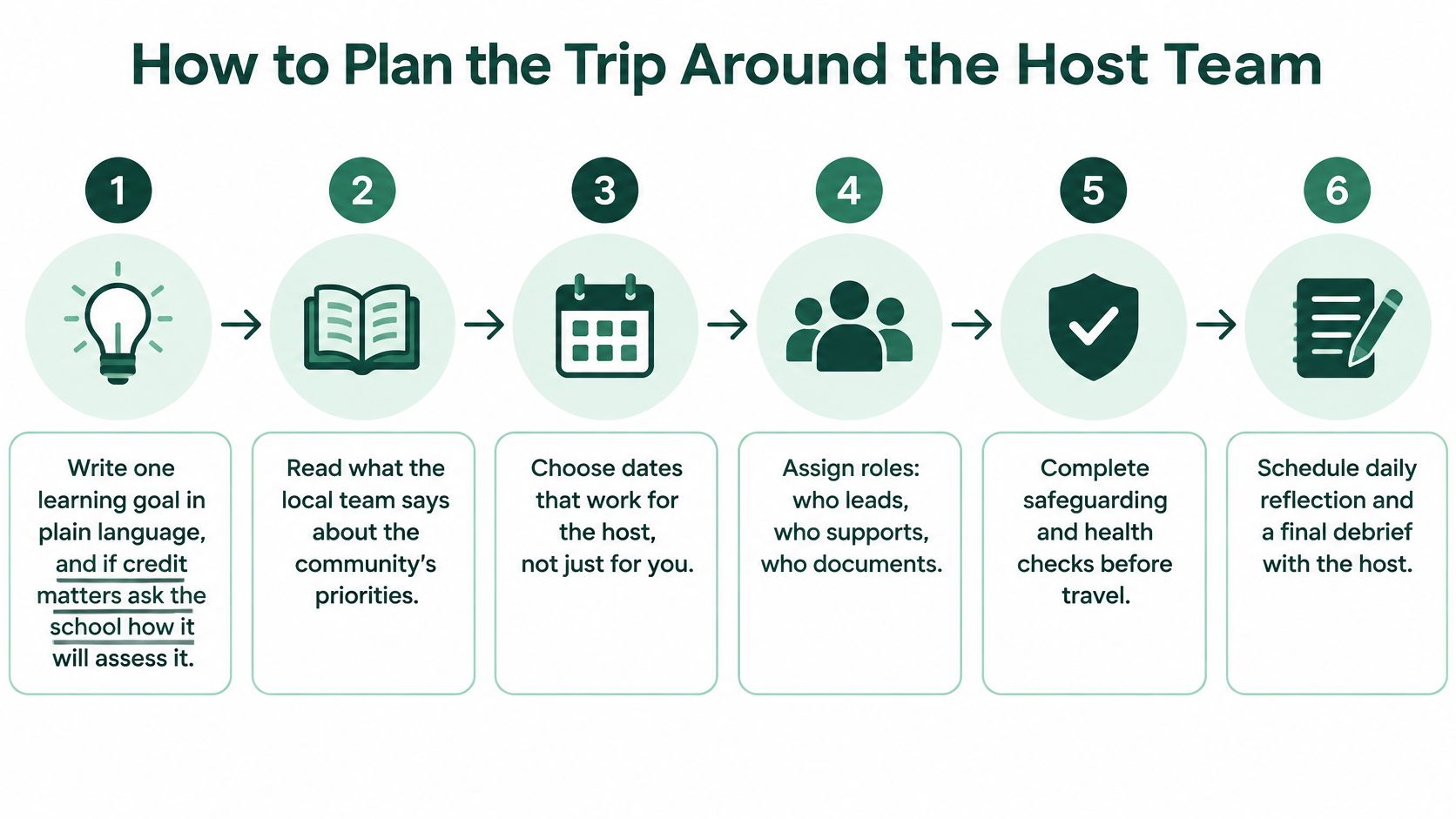
The planning sequence should leave room for the host's calendar, role boundaries and feedback.
Prepare with a question you can test
Before departure, write down a community aim and a learning aim. In an illustrative school placement, the community aim might be to prepare reusable reading materials the teacher has requested. Your learning aim could be to understand how the teacher adjusts an activity when pupils lose focus.
Avoid an objective such as improving education in the community. It's too broad for your role and gives you no sensible way to judge your contribution. For a suggested one- or two-week stay, use a modest question about a task you can observe.
A meta-analysis of 62 studies involving 11,837 students found small-to-moderate positive differences across educational, personal, social and civic outcomes, with reported mean effect sizes from 0.27 to 0.43. Stronger effects were associated with academic connections, community involvement, participant voice and required reflection. That's a rationale for careful design, not a promise that every overseas trip will produce the same results.
Perform the requested task and notice decisions
Once you're on site, complete the work the coordinator or teacher has assigned. If you've been asked to sort reading cards, don't abandon that task because leading a game would feel more rewarding.
Observe decisions without assuming you understand their reasons. A teacher might change the grouping, shorten instructions or replace an example. Record what changed, then ask about it at an appropriate time rather than interrupting the lesson.
Make reflection short and regular
Use this suggested daily routine:
Open with the host's request. Before the day begins, ask what the local team needs today.
Hold a ten-minute debrief. Discuss what the host requested, what you noticed and what you'd change next time.
Leave a handover note. Before leaving the site, record what's ready, what remains unfinished and anything the teacher wants handled differently.
These are suggested habits, not measured results from past groups. A study involving 295 university students concluded that reflection should run from the beginning through the end of a project, while its discussion connects rigorous reflection with deeper understanding and critical thinking.
If a blank page makes reflection difficult, Life Calendar's four-part structure for journal entries offers a writing scaffold you can adapt to your school's requirements. Keep the placement question central rather than producing a travel diary alone.
Leave children's names, identifying details and images out of journals and group chats unless the authorised safeguarding process permits them. Describe the teaching decision, not the child's personal story. Finish the trip by distinguishing what you observed, what the host confirmed and what you still don't know.
Teaching Support in Nakuru as a Learning Frame
A placement such as Teaching in Nakuru schools can suit service learning when the school's priorities and your institution-approved objective align. The host teacher names the useful role, your school decides whether the work earns credit, and each week's shape follows what the school needs.

A classroom day led by the teacher
Say the teacher wants reusable materials for a reading activity. Before class, they explain the lesson objective and ask you to organise words and pictures into sets. They decide which materials are suitable and whether your assistance will be useful during the lesson.
You prepare what's requested, check the sets are complete and watch the teacher introduce them. The teacher runs the lesson from start to finish. If they ask you to support a group, you follow their instructions within the agreed role.
During the activity, the teacher might replace an unfamiliar example, reduce the number of cards or demonstrate the task again. Those adjustments give you something specific to examine without treating the classroom as an experiment.
A useful observation records what the teacher changed before deciding why they changed it.
Turn observation into a better next attempt
Afterwards, ask the teacher whether there's an appropriate moment to clarify a decision. Perhaps you assumed that more materials would make the activity clearer, but the teacher removed some to simplify the instructions. A few sentences of reflection each day is enough to compare that assumption with what you saw.
Try this prompt: Did my idea of effective teaching match the classroom evidence, and what would I change in the next set of materials? Keep your conclusion narrow. One lesson doesn't establish how every class learns.
This approach follows Johns Hopkins' definition of service-learning, which connects learning with concerns identified by the community. The host school's need and your approved educational objective remain the controlling elements.
For a different educational setting, Health education in Kathmandu involves supporting health education for children, teachers and families to help the community look after its wellbeing. The subject changes, but you'd still need an agreed role and a relevant learning question.
Across placements, the pattern stays the same: the host names the useful role, your school judges the evidence, and your contribution stays within the role both sides agreed on.
What to Do When the School Day Changes
You arrive ready to help with a reading activity, and the school calendar has changed. The teacher has no class to host that day. No students to observe, no activity to support, and a morning that no longer matches the plan you prepared.
Your first step is to find out whether the host has useful work for you, and whether that work still supports a defensible learning objective. The local team names the role. Your job is to fill it well.
Revise the day with the coordinator
Check what's useful. Ask the coordinator whether the teacher needs materials prepared, resources organised or support elsewhere. Observation is only an option if the host approves it.
Accept the revised role. Let the local team redefine the task. Gathering children or improvising a lesson to fill the gap takes the decision away from the people who run the school.
Adjust the learning question. Instead of examining a live activity, you might document how the teacher plans to use the materials and what constraints shape that plan.
Debrief the same day. Reflection works as a short daily habit, so describe what happened, examine what it revealed about your assumptions and identify a practical next action before the details fade.
Protect assessment integrity. Your school owns any credit tied to the trip, so if the planned evidence is no longer available, ask whether an alternative meets its requirements.
Useful work alone doesn't guarantee an educational outcome. Sorting materials helps the school, yet it cannot stand in for classroom facilitation if that is what your institution intended to assess.
Keep a logistics problem in proportion
The Western Carolina University service-learning guide presents frameworks that distinguish partnership, objectives, logistics, reflection and assessment. Treating those as separate responsibilities helps you respond to a timetable change without confusing availability with permission.
When plans change: Revise the task with the host, and let the local team's priorities decide what fills the day.
Your handover should explain what you completed and what remains a proposal. A set of materials you prepared is a contribution on hold, and describing it as a tested success would mislead the next volunteer.
A disrupted timetable changes the day's work. The standing rules on access to children, supervision and professional boundaries stay exactly as they were.
Safeguards When a Placement Involves Children
A friendly classroom can still create expectations a short stay cannot meet. The useful role is the one the host names: participants work alongside local professionals and never act as substitute parents, primary teachers or sole care-givers. Projects are community-led, and some involve contact with children and adults at risk, so access decisions stay with the local team.
The risk is easier to understand before arrival than after a boundary has already blurred. A review of orphanage tourism and child protection examines risks involving children's rights, development, protection, trafficking and exploitation, challenging the assumption that visitor contact is beneficial.
Look for protection you can verify
Use our guide to volunteering at a daycare to think through the role, then check the actual placement arrangements:
Local control. The partner leads activities and decides what contact is appropriate.
Appropriate settings. Avoid residential-institution volunteering and opportunities built around emotional access to vulnerable children.
Screening and supervision. Confirm the required checks and the limits on unsupervised contact.
Privacy and consent. Photography requires an authorised process and informed local consent before images are taken or shared.
Reporting and response. Know how to report a concern through the coordinator, who receives it and what happens next.
Before accepting any project, the DSL or delegated senior staff review the partner's child-protection policy and visit the site to observe activities with children. Criminal-records checks also sit within safer recruitment for staff and participants. Your responsibility remains simpler and stricter: follow the agreed boundaries every day.
Keep different requirements separate
HeyLocals requires an ICPC issued within the last 6 months from UK-resident participants on placements of 4 weeks or longer involving direct contact with children. Check the live offer for the criminal-records certificate your particular placement requires.
Parental or guardian involvement for an under-18 participant is a separate requirement. Healthcare projects may ask for relevant studies or skills, and neither consent nor a certificate stands in for those qualifications.
For example, Childcare in Zanzibar describes support within everyday school life. Treat that as an illustration of hosted duties, then confirm supervision, tasks and eligibility on the specific live offer. The host owns access to children; your school owns any credit.
Is This Trip Right for You
Who can go, and at what cost? Before choosing a destination, ask whether travel is necessary for the contribution and learning you have in mind.
In an international e-volunteering study, three-quarters of participating students considered travel-based options financially prohibitive, while 64% said financial limitations influenced enrolment. The study also discusses lower participation in travel-based experiential learning among low-income students, visible minority students and students with disabilities, alongside participants' recognition of aviation's carbon footprint.
Use an honest fit test
Purpose. Can you name the host's requested role and your learning goal in a sentence each?
Affordability. Can you cover the package and the separate expenses it lists, such as flights, travel insurance and visas, without relying on an incomplete headline price?
Alternatives. Would local volunteering, remote collaboration or a longer placement meet the same need with less travel or turnover?
Access. Have you checked the physical setting, communication needs and available support rather than assuming the placement will be accessible?
Staying power. Are you ready to keep a short daily reflection habit, and to let the coordinator revise the plan when the school day changes?
A project description can help you test those answers against a real week. The Childcare and learning support in San José listing, for instance, sets out the role alongside what the package covers, which expenses sit outside it and the participation requirements, so you can weigh the full cost and commitment before deciding.
That still leaves the personal side of suitability. If you cannot explain why your presence fits the host's work, the trip is not ready to book. If you can, include financial access and travel emissions in the decision.
How to Plan the Trip Around the Host Team
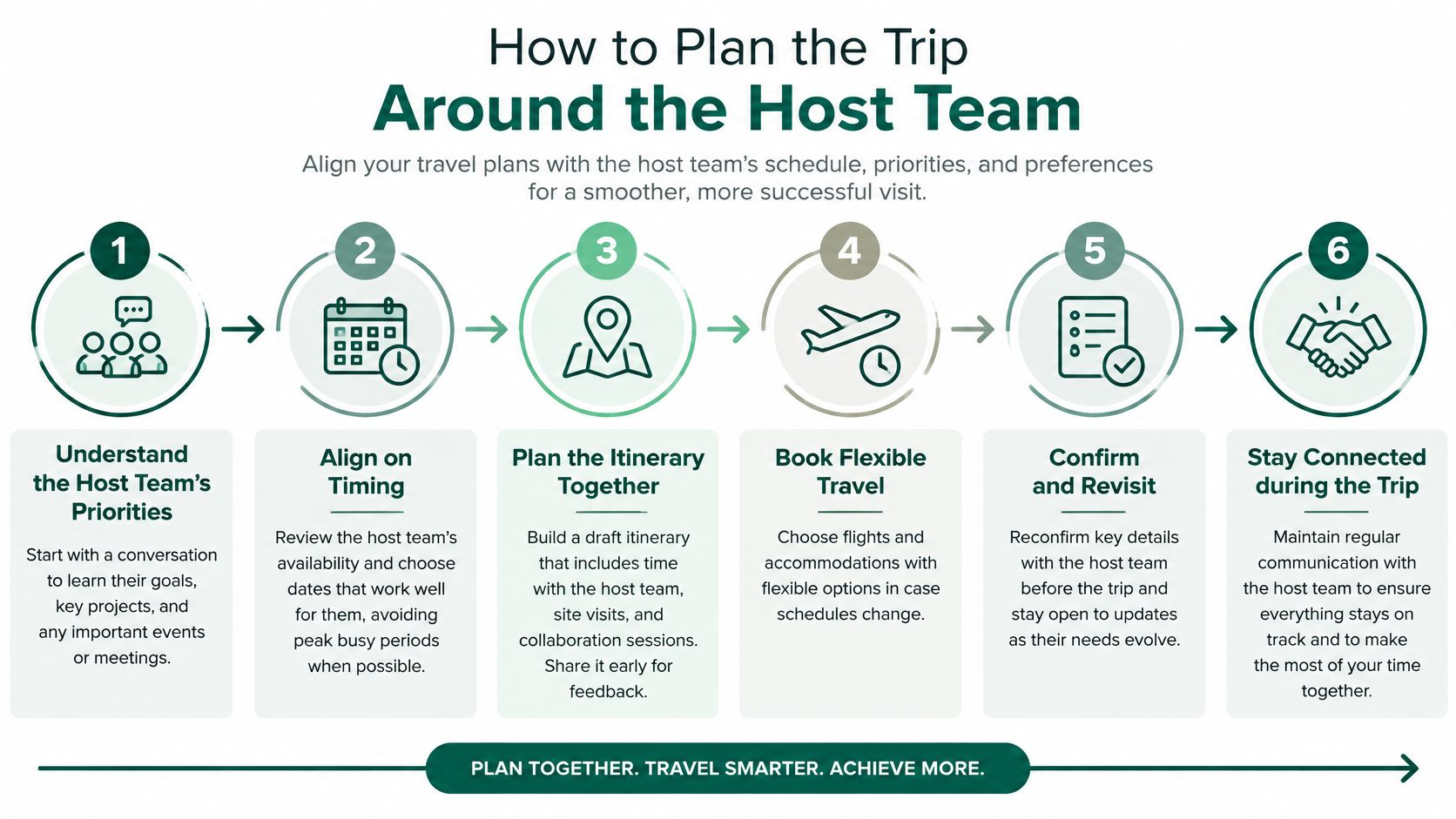
The school has already planned its week before you apply. Your preparation works backwards from that timetable: the host names the useful role, your school decides what counts for credit, and you fill the space between the two.
Put the educational and practical pieces in order
Write a plain-language learning goal. Pick something you can investigate through your agreed role, such as how a teacher runs reading groups with limited materials. If credit matters, ask your school what evidence it will assess before you choose the project.
Read about the ongoing work. Our project-selection guide explains how we choose partners. Understand what the organisation already runs before proposing any activity of your own.
Confirm the useful role for your week. Ask the coordinator what the host needs during your proposed dates, since your preferred task may not match that week's priorities. A support role means assisting the teacher's plan, and participants never act as primary teachers or sole care-givers.
Check the specific live offer. Verify age, dates, minimum duration, role, language and inclusions for your chosen project. Some education stays are listed from one week, though that minimum varies by placement.
Separate consent from qualifications. A parent or guardian must be involved for under-18s, and healthcare activities may require relevant studies or skills. Permission to travel and readiness for a role are different questions.
Answer the matching questions. Describe who is travelling, when you want to go and what you need. The local organisation reviews your answers against what the project offers before the trip is arranged.
Build a complete budget. Price the package and the separate expenses together, using the table below rather than a headline figure.
Ask about the timetable before you land. When does induction happen, how are daily tasks agreed, and when can the local team give feedback? Keep reflection as a short daily habit that fits your own evening. Teachers should not have to stay after work so you can journal, and any plan that reshapes their day needs their agreement first.
For everyday preparation, HYDAWAY's guide to sustainable travel practices for greener trips offers packing and low-waste ideas worth weighing alongside your host's instructions. Packing choices sit downstream of the larger question of whether the journey itself is justified.
Typical HeyLocals inclusions to confirm on the live offer
| Item | Typical package | You arrange separately | |---|---|---| | Placement and assigned activities | Included | No | | Accommodation for the stated period | Included | No | | Meals as described in the destination guide | Included | Extra meals or snacks | | Airport transfers on start and end days | Included | Other local transport | | In-country coordination, support and induction | Included | No | | Pre-departure safeguarding training and orientation | Included | No | | Contribution to the partner organisation | Included | No | | International flights | No | Yes | | Travel insurance, visas, entry fees and departure taxes | No | Yes | | Vaccinations | No | Yes | | Criminal-records check where required | No | Yes | | Project fee | Destination-specific amount on the live page | Separate expenses listed above |
Fees differ by destination, so treat the live page as the price reference for your dates. An inclusion on one project page does not carry across to another, and the separate-expense column is where most budgets grow.
Confirm the Live Offer Before You Book
Make the decision only when you can name both the host role and the learning goal. If either is missing, consider whether a local placement or a longer stay would fit better than forcing an educational purpose onto a short visit.
Check that the information you're acting on belongs to the actual project. Keybaki's guidance to confirm school placement before sending fees provides useful context for verifying placement messages rather than trusting an unofficial assurance.
A clear project description helps you decide whether to take part.
We support volunteers before, during and after their trip, and the live offer remains the reference for every check on the earlier list. Families keep parent or guardian consent clear for under-18s. Students ask their school one question before paying any fees: what evidence does it need to award credit for the placement? A short stay supports work the community already runs, so the host names the useful role and participants never act as substitute parents, primary teachers or sole care-givers.
Once those responsibilities are understood, take one next step: use Find my project and describe who's travelling and what you need. We and the local organisation check the fit before arranging the trip. Your purpose is to support work the community already runs and learn from how local people do it.
HeyLocals helps you match an international volunteer placement with practical preparation and local coordination. Visit HeyLocals and use Find my project to share your learning interests, travel dates and who's coming, so we can check which host-led role fits.
In this article
- Table of Contents
- How a Service Learning Trip Differs from Volunteering
- Prepare, Perform and Reflect Each Day
- Teaching Support in Nakuru as a Learning Frame
- What to Do When the School Day Changes
- Safeguards When a Placement Involves Children
- Is This Trip Right for You
- How to Plan the Trip Around the Host Team
- Confirm the Live Offer Before You Book