Volunteer at a Daycare: What You Can Do and What to Avoid
Learn how to volunteer at a daycare safely: realistic tasks, preparation steps, safeguarding rules and role boundaries.
You're looking at childcare placements abroad, and the activities sound familiar: stories, songs, games and helping with the day. What's harder to tell is what you'll be allowed to do, who'll guide you and whether your availability fits the centre's needs.
The best reason to volunteer at a daycare isn't to take charge of a room. It's to offer useful support within an educator's routine, while the adults children already know remain their steady points of reference.
Table of Contents
Realistic Tasks Volunteers Can Do at a Daycare
Daycare tasks: what volunteers can and cannot do
| Task | Suitable for a volunteer | Confirm with staff first | |---|---|---| | Reading or looking at picture books | Yes, with a child or small group | Which books, language and where you sit | | Songs, rhymes and finger games | Yes, following the educator's lead | Which songs and when in the day | | Creative play such as drawing or sorting | Yes, with supplied materials | Which materials and how much help each child needs | | Setting up staff-approved games | Yes, prepared before the children arrive | Game choice, space and clean-up | | Simple early-learning activities | Yes, as the educator directs | Age level, difficulty and vocabulary | | Tidying shared materials | Yes | Storage places and what must not be moved | | Routine help such as meals or hand-washing | Only when staff allow it | Exactly which tasks and under whose supervision | | Supervising a group alone | No | Not a volunteer responsibility | | Personal care, toileting or medication | No | Never a volunteer task | | Formal English teaching or therapy | No | Outside childcare support |
Your role is support, not independent responsibility. The HeyLocals disability-support project guidance illustrates why duties must be agreed locally and directed by caregivers. Specialist placement arrangements aren't permission to take on personal care or therapy in a daycare role.
Volunteers join activities that already exist and help where their contribution is useful. That might mean arranging crayons while the educator welcomes families, rather than leading the drawing activity yourself. Childcare support also isn't formal English teaching: conversation during play doesn't authorise you to introduce a language curriculum.
Match the activity to the room
A toddler room may need quiet, repetitive songs and hands-on play. Preschool children might enjoy a short story followed by drawing, but the educator should decide whether that fits their attention, interests and timetable.
Tidying needs instructions too. Ask where used materials go and which items staff clean separately. For background reading, BacteriaFAQ.com's infection prevention guidance for childcare staff can help you prepare questions, but the centre's own cleaning procedures govern what you do.
Usually, no prior volunteering experience is needed, though each project page lists its requirements, including English level. Willingness to follow instructions matters more than a packed activity bag.
Before contacting the coordinator, write down three tasks you could offer. Beside each, put a precise question, such as: “Could I prepare the picture books, and who chooses which ones we use?”
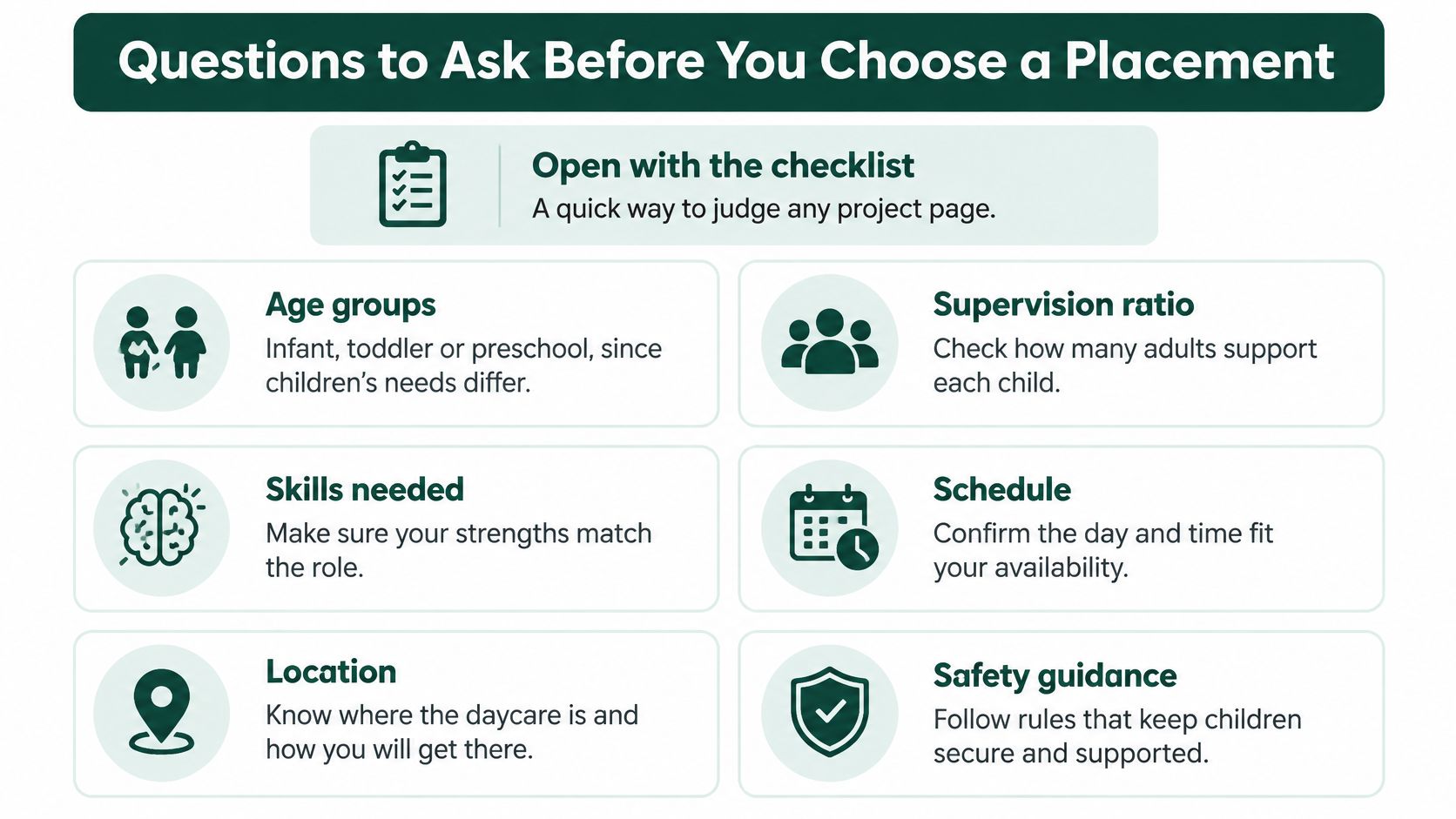
Questions to Ask Before You Choose a Placement
A solid project page answers most of these before you contact anyone. For the rest, ask the coordinator directly.
Age groups: Will you work with infants, toddlers or preschool children? The answer determines appropriate activities and how much support you'll need.
Daily hours and minimum stay: Confirm both so your availability matches the children's timetable, not just your travel plans.
Live status: Check that the placement is currently running before you shortlist it. An old description isn't confirmation.
Local leadership and continuity: Who chooses activities each day, and how does the centre maintain familiar relationships when volunteers change?
Supervision: Confirm volunteers aren't counted in staff-to-child ratios and that someone on site responds to incidents.
Named safeguarding lead: Ask who receives concerns and how you'll reach them during your shift. HeyLocals placements have a named in-country coordinator who handles day-to-day welfare and escalates concerns.
UNICEF reports that fewer than one-third of children aged 3 and 4 worldwide attend an early-childhood education programme. That gap gives childcare support context, but it doesn't make an unqualified visitor a replacement for an educator.
At HeyLocals, we prioritise support within children's own families, schools and communities. Use Find my project to narrow options by dates and interests, then assess the practical fit using our volunteer selection criteria.
Listed childcare options include teaching and childcare in Zanzibar. Check each project page for ages, hours and responsibilities rather than assuming another programme offers the same arrangements.
Better placements offer children steadier support, not volunteers more responsibility.
Red flags include promises that you'll run a group alone, requests to collect photographs of children, or an inability to name the safeguarding lead. Shortlist two placements and write one unresolved question beside each before choosing.
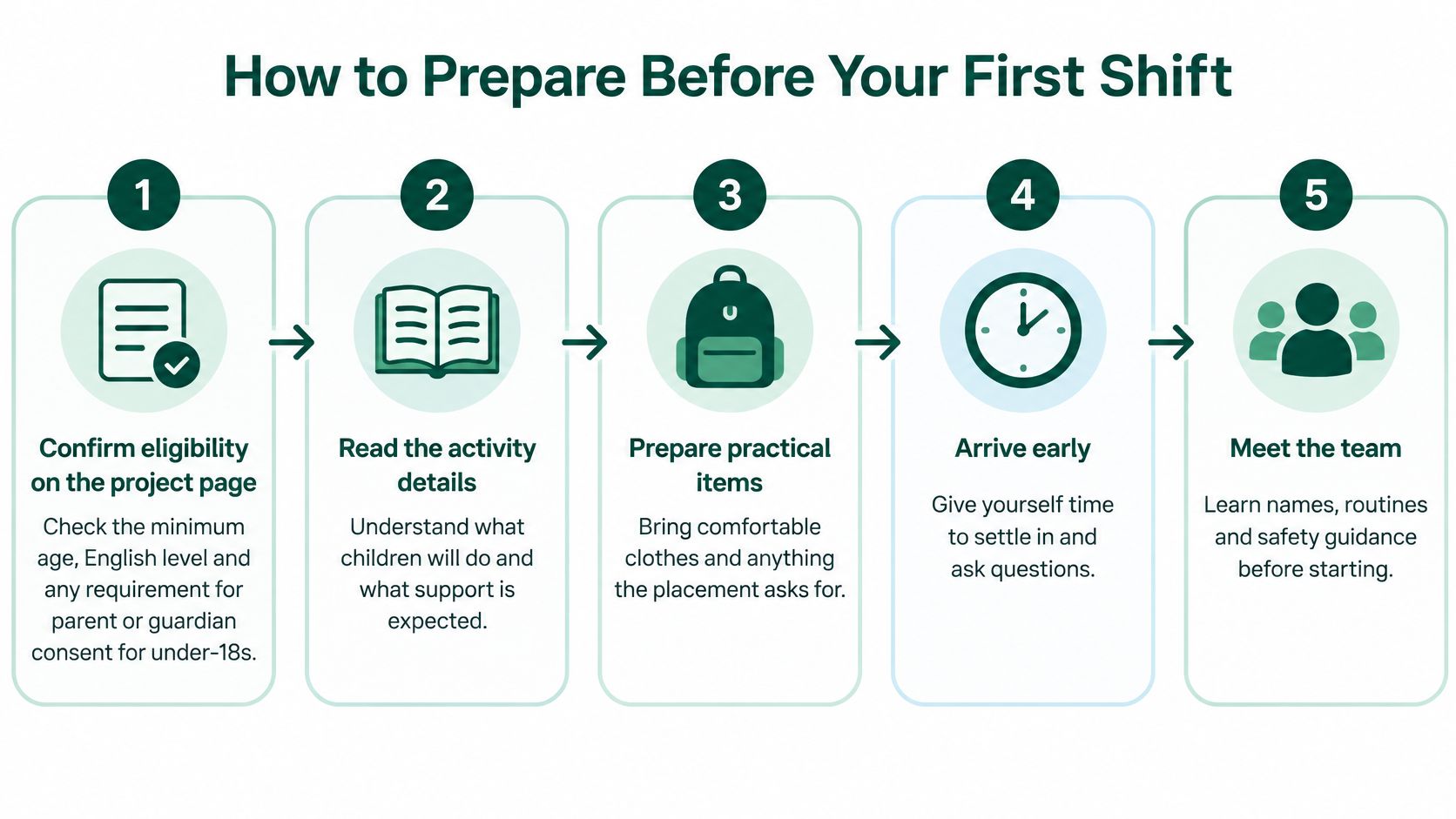
How to Prepare Before Your First Shift
Confirm eligibility on the project page. Volunteers can join HeyLocals programmes from age 16 with basic English for everyday conversations and understanding instructions, though some activities ask for a higher level and a parent or guardian must be involved for anyone under 18. Check the minimum age and language level on your specific placement rather than assuming one project's conditions apply to another.
Gather the documents a child-contact placement requires. Where your role involves direct contact with children, you will need a valid criminal-records certificate from your country of residence, a signed Safeguarding Self-Declaration and a signed Code of Conduct. Declare any criminal record accurately, including pending matters, and allow time for certificates to be issued, since some take weeks to arrive.
Complete the pre-departure safeguarding training module. The declaration, code of conduct and training module work as a set: the paperwork confirms your history, and the module prepares you to work under local supervision from your first day. Finish it early enough to raise questions before you travel, using the published participant screening information as a reference for what programmes ask of you.
Read the centre's rules before arrival. Check start times, clothing expectations, phone use and who you report to. Keep eligibility, role qualifications and parental consent separate from the safeguarding paperwork so nothing gets overlooked.
Prepare an activity with the educator. As an activity idea, ask staff to choose a familiar song or story, then prepare a small set of picture cards in the language, materials and difficulty they approve. Children can point, repeat or join in at their own pace; you support the moment rather than turn it into a lesson.
Organise the practical details. Plan transport, save the local emergency contacts supplied by your team and bring only the items the placement requests. Check entry, health and insurance requirements separately against current official sources relevant to your nationality and circumstances.
Ask for your first-day plan. Confirm where you will meet, which tasks you will start with and when you will check in with staff. Knowing what volunteer coordinators do helps you direct each question to the right person before arrival.
Bring preparation, not a programme
Cards staff cannot use create extra work, even if you spent time making them. Arriving with an improvised timetable and expecting educators to fit around it makes the same mistake on a larger scale.
Practical rule: Get agreement on the activity before spending money or filling your luggage with materials.
Safeguarding Rules and Role Boundaries
Staff should be able to see and direct you, and you should never be alone with a child. UNICEF USA's safeguarding policy requires two or more adults to visibly supervise children's activities and directs suspected abuse to the designated safeguarding officer immediately or as soon as practically possible. Ask for the partner's child-protection policy and named reporting route before your placement starts.
Safeguarding situations and the right response
| Situation | Action | Who to tell | |---|---|---| | A child asks you to take or share a photo | Don't take or share it; follow the centre's approved process | The staff member on site | | You're asked to spend time alone with one child | Decline and move to a space where staff can see you | The staff member on site | | An adult or child asks for your personal contact details | Decline and keep contact through the centre | The staff member on site | | A child is hurt or unwell | Get help from staff straight away; medical care comes first | The nearest staff member | | A child says something that worries you | Note the words used and don't question the child further | The named safeguarding lead | | You suspect a colleague or another adult | Report through the provided route; don't investigate or confront | The named safeguarding lead | | You want to give a gift or promise to return | Don't give or promise; mention it to staff if asked | The staff member on site |
Keep contact within the centre
Don't exchange personal phone numbers or social media accounts. Never use your personal device to photograph children without the required permission and authorised process; a child asking for a picture isn't that permission. Don't offer private gifts or promises to return.
If a child shares something concerning, listen calmly without probing or promising confidentiality. Record their words objectively through the centre's process, rather than adding an interpretation or approaching the person you suspect.
Before we accept a project, our designated safeguarding lead, or delegated senior staff, reviews the partner's child-protection policy and visits to observe activities. Each destination also has a named in-country coordinator who responds to incidents, escalates concerns and liaises with partner leaders and local authorities.
These are practical foundations of ethical volunteering abroad, not paperwork to set aside after arrival. Enthusiasm and screening aren't enough: safe practice also needs training, boundaries and supervision. Learn the safeguarding lead's name on your first day, and ask directly if nobody can tell you.
How to Respond to Children's Cues Without Taking Over
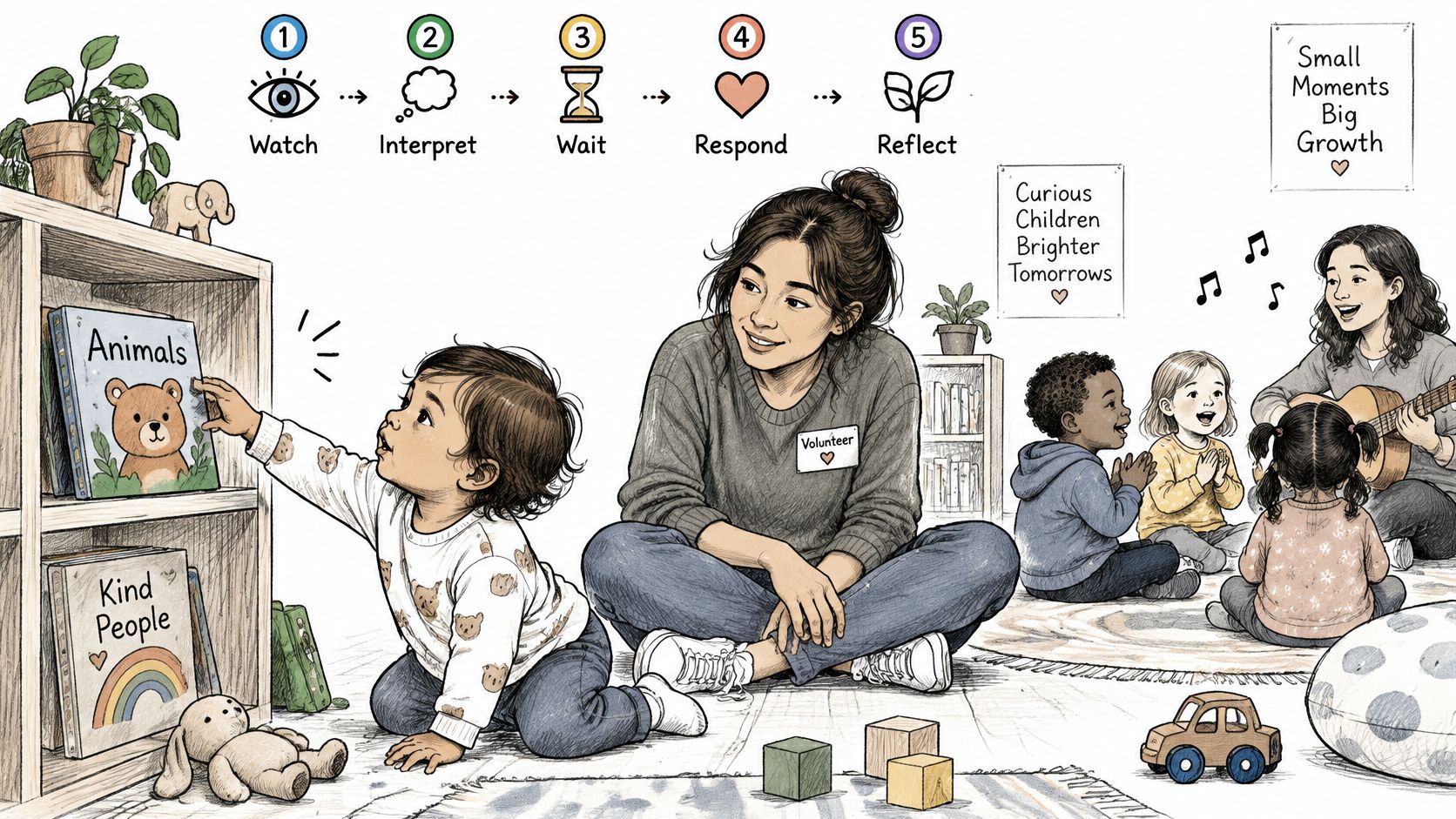
Say a toddler reaches towards a picture book while the group sings. You could put the book away and insist they join in, or immediately start a separate story. Neither response begins by checking what the child is communicating or what the educator has planned.
The World Health Organization's nurturing-care guidance centres responsive caregiving, noticing children's signals and responding appropriately. WHO also recommends nurturing-care training before volunteers begin and while they serve.
Follow the signal without directing every move
Watch the child's cues. Notice their movement, sounds, gestures and requests. Reaching towards a book might mean interest, so wait for a clearer signal rather than assuming you know what they want.
Pause before helping. The child may be reaching successfully without assistance. Give them room to manage rather than completing every action for them.
Respond within the agreed activity. If the educator has approved looking at books nearby, offer access while staying inside that boundary. Otherwise, check with the educator instead of launching an alternative session.
Let the child re-engage. Keep the interaction brief and allow them to turn a page, return to singing or move back into play. They don't owe you participation.
Share objective observations. Tell the responsible staff member about an injury, illness or concern and record it through the approved process. Describe what you saw and heard, and leave any diagnosis to staff.
For further reading about giving just enough help, the child development insights from Playz offer background on scaffolding. Apply that reading only within the educator's directions, never as permission to assess or treat a child.
Judge your contribution by the quality of the interaction. Did you notice, interpret and respond, then leave room for independence?
Leave familiar adults at the centre
Follow local guidance on comforting, physical contact, meals and rest. Let familiar adults lead the moments that matter most to a child: settling in, eating, comfort after a fall. Ask the educator before introducing an activity or changing the timetable.
Where a short stay is accepted, provide bounded support and a clear handover. Participants never act as substitute parents, primary teachers or sole caregivers; in disability, hospital or disadvantaged-background settings, they work alongside qualified local staff in a supporting role only.
You don't diagnose, treat or investigate. Stable relationships with familiar adults matter more than your wish to feel valued.
Confirm One Placement Before You Commit
Choose one currently live placement whose age range, language requirements and dates match yours. A clear, limited role is a stronger reason to apply than a long list of things you might get to do.
Get the practical arrangements confirmed in writing. You should be able to explain where you'll work, who directs you and what happens when you need help without filling gaps with assumptions.
Put the agreement on paper
Children and schedule: Confirm the age range, attendance days, working hours and minimum stay.
Costs: Establish what the fee includes and which expenses you'll pay separately.
Agreed duties: Identify the tasks the centre has approved for volunteers, including any preparation or handover.
People responsible: Record the safeguarding lead's name, the reporting route and how to reach your in-country coordinator.
Two placements can look equally attractive on paper. Compare them line by line on the written answers, not on which destination sounds more exciting. The stronger offer comes from a centre that has already decided what volunteers do, named the person who supervises you and priced the stay clearly. A programme that expects you to run a room of children alone is asking you to fill a staffing gap, and short-term help never replaces professional care.
Walk away from answers that stay vague. The right placement includes quieter work, such as preparing materials or tidying, when that is what staff need, because your value sits in how well you fit the educator's routine and the children's stable relationships.
HeyLocals helps you choose community-led volunteering projects and supports you before, during and after your trip. Visit HeyLocals to find a childcare placement that matches your availability, then bring your questions about duties, supervision and routines to the team before committing.