Teach English in Costa Rica: Roles, Requirements and Prep
Want to teach English in Costa Rica? Learn realistic volunteer roles in Esparza, Spanish needs, school calendar checks and classroom prep.
Search for advice on teaching English in Costa Rica and you'll meet the same answer within a paragraph: get a TEFL certificate, apply to a language academy near San José, and budget carefully on a modest local salary. That's sound guidance for one plan, a paid move of a year or more. It's close to useless if what you're weighing is joining a school for a few weeks to help a teacher who already has a class, a syllabus and a timetable.
Those are two different jobs with two different bottlenecks. The paid route turns on work authorization, hours and take-home pay. School support turns on what the teacher asks you to do, which class you're placed in, and how much Spanish you need to follow an ordinary school day. Answer the second set first and the rest of the planning gets simpler.
Table of Contents
Which Teaching Route Fits and What It Requires
| Route | Typical setting | What it usually needs | Confirm before you commit | | --- | --- | --- | --- | | Volunteer support in an Esparza school | Public school, teacher-directed groups | Basic Spanish phrases, basic English, an assignment agreed with the teacher | Age range, class, timetable and role | | Paid teaching at a private language institute | Private sector, where most English teachers work | Work authorization and employer sponsorship before employment starts | Sponsorship, contract terms and take-home pay | | Public school teaching under MEP | Public sector, national curriculum | The qualification and residence rules the employer sets | Which teaching qualification the school recognises, and who sponsors residence | | Remote English teaching | Online, self-arranged | A client base or a platform account, plus your own internet connection | Residence, tax position and platform terms |
Only the first row is built around a short stay. The other three are employment, and employment in Costa Rica runs through immigration before it runs through a classroom.
The private-institute row is where many teachers end up. Guidance on the Costa Rican market puts monthly earnings for many teachers at roughly ₡280,000 to ₡660,000, with higher pay possible but uncommon in international schools, and reports that about 71.2% of English teachers work in the private sector against 28.8% in public institutions (TEFL.org's Costa Rica guide). The same guidance states that employers generally need to sponsor residence and work authorization before employment begins. Ask any employer whether the offer includes sponsorship, and get the answer in writing before you book a flight.
Public-school teaching is the row people misread as an entry route. The curriculum is national, while the teaching qualification the school will accept and the residence route are set by the employer. Treat those as two separate questions with two separate answers, and don't plan on either until someone at the school confirms it.
Reading the rows against your own position
Savings: a paid post pays a Costa Rican salary while you carry the setup costs of the move. If you can't cover several months of living costs from your own funds, the paid route isn't ready for you yet.
Visa position: a tourist entry never includes the right to paid local work. Only an employer-sponsored route does, so treat an offer that dodges the question as a no.
Timetable: school-year contracts, academy evening hours and volunteer terms start in different months. Match the row to the dates you have free.
Language: on our education placements, volunteers can join from age 16 with a basic level of English that allows them to manage everyday conversations and understand instructions.
The volunteer row is the one that stays teacher-directed. You help with practice, preparation and activities the teacher has already agreed for that group. You don't arrive with your own syllabus, and you check the age range, minimum duration and assignment on the live offer before building a trip around them, because those are the details that move between terms.
If you're comparing countries for paid work rather than classroom support, how to teach English abroad sets out the certification and hiring norms that sit behind the Costa Rican version.
What a Volunteer Does in a Rural Esparza Classroom
The places where English teaching help is most useful in Costa Rica are rarely the places that pay best. Esparza High School sits on the useful side of that line. Teachers and school leadership there work through practical challenges adapting the country's action-oriented English curriculum in a socioeconomically disadvantaged setting, and the workload lands on a small department.
You aren't importing a method into a vacuum. English instruction in Costa Rican schools goes back to 1825, formal teacher training at the University of Costa Rica began in 1954, and the government declared English learning a national priority in 2010 (history of English teaching in Costa Rica). An established system with its own objectives, its own teacher preparation and its own link between English and employment is already running.
The Ministry of Public Education treats English as a core academic subject aligned with the Common European Framework of Reference, aiming for at least A2 by the end of primary school and B1 or B2 in secondary, depending on the study plan (MEP English curriculum guidance). Practical language practice earns its place when it serves the objective the teacher is already working toward. Delivered as a separate mini-course, it competes with the syllabus and loses.
The staffing numbers at Esparza put the shape of the job in focus: 40 groups across grades seven to eleven, four teachers in the English department, and a separate conversational-English teacher for tenth and eleventh grades, according to a University of Costa Rica study of the school. Four teachers covering forty groups is the actual picture. You join that team as an extra pair of hands.
What a helper does in a class period
Rehearse a short conversation with one pupil while the teacher runs the rest of the room.
Take a small group through a task the teacher has already set, at the pace the teacher wants.
Review vocabulary the class has met, rather than introducing new words they'll meet later without you.
Prepare materials before the bell: cutting picture cards, sorting worksheets, writing prompts on the board.
Expect large classes, uneven connectivity and limited materials, and expect the English level to differ between two groups on the same morning. Take the teacher's lead on grouping rather than testing pupils yourself.
Three boundaries keep the role honest. A volunteer can ease a staffing shortage; a volunteer can't replace a trained local educator. An assistant works under the teacher's direction, while a qualified teacher holds the lesson. In practice that means you don't set the syllabus, grade pupils or take a class alone unless the teacher has arranged it in advance.
Our placements run with in-country partners, and each destination has a named coordinator who handles day-to-day welfare, responds when something goes wrong and liaises with the project leaders. That's the person to ask about class sizes, materials and how the English department splits its groups before you travel, not after.
The Spanish and English Level You Actually Need
No single Spanish qualification applies to English-teaching volunteers in Costa Rica, and a guide that quotes one is guessing. The useful question is narrower: what does your role, in this school, in this term, demand? Costa Rica's Ministry of Public Education publishes English-teaching resources that emphasise concrete classroom procedure and communication, including punctuality and explicit rules for missed work and make-up tests (MEP English teaching resources). The Spanish that helps follows the same logic. Phrases tied to routines beat a certificate.
The Spanish that earns its place
Greetings and farewells. Asking someone to slow down or say something again. Classroom instructions students already know: open your book, work in pairs, listen first, one more time. Thanking staff, asking where the materials are stored, asking which entrance the class uses. None of this proves fluency. All of it helps you follow a school day, build rapport with the teacher, and keep a small confusion from derailing a lesson. Basic greetings and classroom phrases are a sensible goal for a short placement, and the level needed rises with the role rather than with a language test.
English works the same way. The role might involve pronunciation practice, conversation support, vocabulary review or small-group work. The teacher decides which, and the level you need follows from that assignment rather than the other way round.
A three-question self-check
Can you introduce yourself in four sentences, give three instructions clearly enough for a class to follow, and understand a pupil's answer at normal speaking speed without asking twice? Three yeses and you can run a conversation activity. The honest test for Spanish is whether you can follow the school's daily routine and ask where something is kept. If you're unsure how to judge your own English, the English level you need for volunteering abroad sets out a practical way to assess it before you apply.
Ask the school, not the internet: how do staff communicate with visitors, which instructions must you understand in Spanish, and does the teacher want you to lead, model or only assist?
Those three answers, written down, tell you more than any general statement about required levels.
A Classroom Routine That Builds Speaking Practice
Start with a diagnostic, because classes in Costa Rica aren't interchangeable. The 2024 EF English Proficiency Index placed Costa Rica 41st among 116 countries with a national score of 534 against a global average of 477, and fifth among 21 Latin American countries (EF EPI 2024 Costa Rica fact sheet). That average hides a wide provincial spread: Heredia 569, San José 545, Alajuela 537, Cartago 504, Guanacaste 460, Puntarenas 443 and Limón 438, a gap of 131 points between the strongest and weakest province (EF EPI 2024 Costa Rica fact sheet). Puntarenas is the province Esparza sits in, so a rural class there will often sit nearer the bottom of that range than the top.
The skill profile points the same direction, with component scores of 535 for reading, 496 for listening, 494 for writing and 489 for speaking (EF EPI 2024 Costa Rica fact sheet). Reading is the strength; speaking is the weakest reported skill. That is the argument for spending class time on talk rather than on another worksheet.
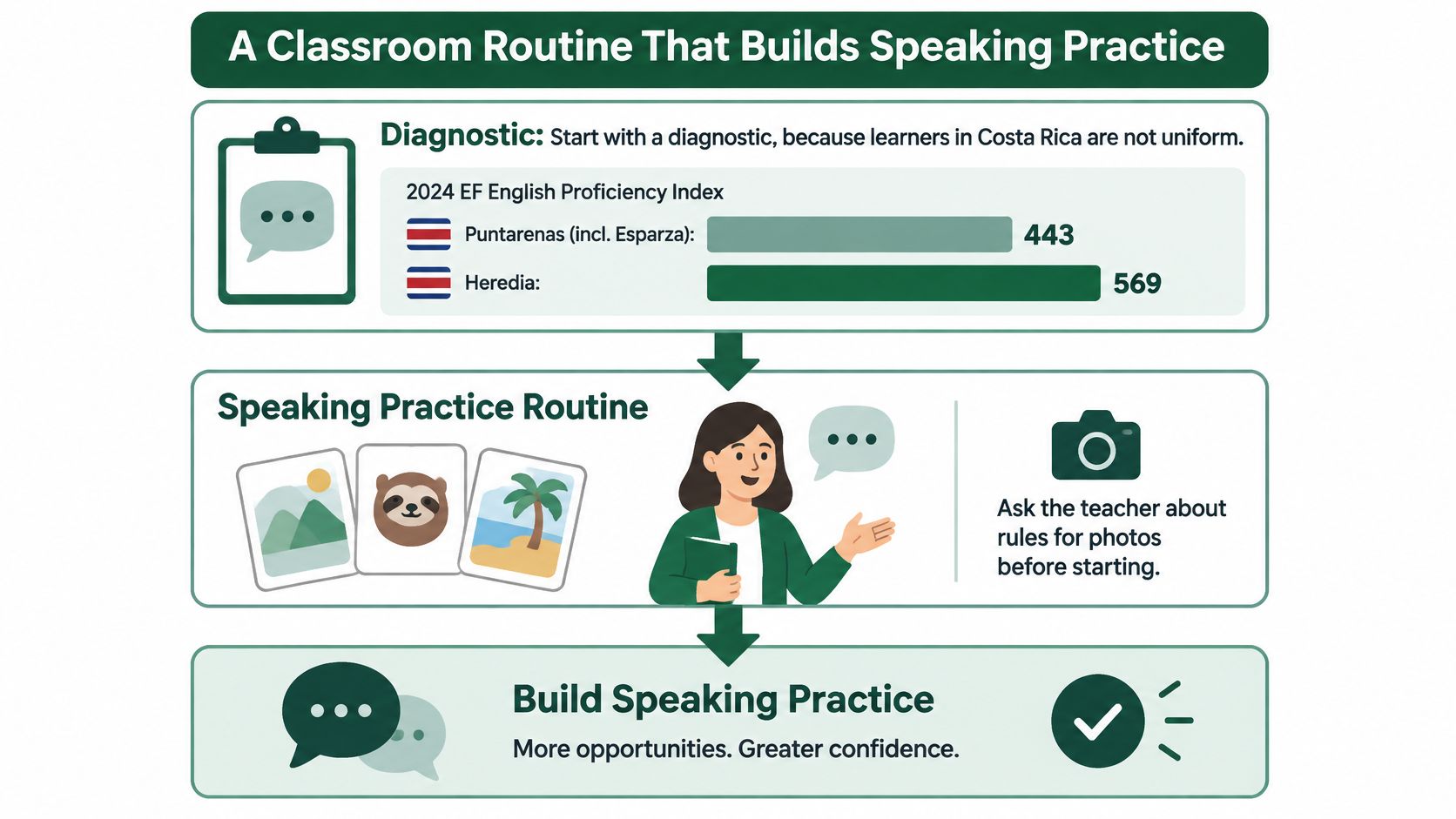
A 60-minute shape that works in volunteer support settings, built so a helper runs the stages the teacher assigns rather than taking over the class:
Retrieval practice, 5 minutes. Pupils recall vocabulary they've already met. No new input, no handouts.
Model dialogue, 10 minutes. The teacher, or the two of you, performs a short exchange twice, then once with a deliberate mistake for the class to catch.
Guided practice, 15 minutes. Pairs repeat the dialogue with substitutions while you circulate and listen.
Communicative task, 20 minutes. Pairs use picture cards to ask for an item at a shop, then swap roles. The teacher raises or lowers the difficulty as the room needs it.
Feedback and exit check, 10 minutes. Note intelligibility, task completion and interaction, not just whether the words came back.
The shop scenario is an illustration to agree with the teacher rather than a script to impose. The teacher picks vocabulary the pupils already know, and the pair swap does more work than the cards do: the pupil who asked for the item has to answer next.
If the pair stage collapses into two confident pupils doing all the talking, the think-pair-share strategy guide from Kuraplan shows how to give everyone a private think before the pair talk begins. Run the same task again every two to four weeks and compare your notes, and let correction follow the teacher's agreed approach rather than your own instincts.
Plan Around the 2026 School Calendar and Handover
| Period | Start | End | | --- | --- | --- | | First period | 23 February 2026 | 3 July 2026 | | Mid-year break | 6 July 2026 | 17 July 2026 | | Second period | 20 July 2026 | 9 December 2026 |
A late-year arrival can still be useful in Esparza, but it has to be planned inside term time. The MEP 2026 school calendar schedules the second period to run until 9 December 2026, so a November start leaves real classroom weeks before the break. Use the calendar for planning, then confirm the school's own timetable, exam weeks and local observances with staff before booking flights.
Five questions for the first morning
What's the objective for this lesson? You need the target language rather than the topic title before you can help with it.
What's the routine? Where pupils sit, how books are handed out, what happens in the first five minutes.
What should you wear? Ask rather than guess, and ask about footwear if the day includes outdoor time.
What are the rules on photos and contact with pupils? Get this from the teacher or school, then follow it exactly.
How does the teacher want errors corrected? Recast, prompt, ignore during fluency work, or correct on the spot.
Write the answers down. They decide what you do in the first lesson, and they are the first thing a replacement asks for.
Our participants also complete an on-arrival in-country induction that repeats the key safeguarding messages, which is a good moment to raise anything that was unclear at school. If problems appear mid-placement, what volunteer coordinators handle during a stay explains who responds and how issues move upward.
The handover is where short placements earn their keep. After each session, write three lines: what was practised, which pupils needed support, and what task is unfinished. The last-minute absence planning guide from Teacher Planner is written for teachers, and the same logic lets the next helper pick up the same task instead of resetting the class.
Confirm the Esparza Placement Before You Apply
By the time you apply, the route, language level and school calendar should already have narrowed your choice. The last check is practical: whether the live Esparza offer still matches the classroom role you can responsibly take on.
Minimum duration and fee coverage: check both on the live offer and list expenses that sit outside it, such as flights and insurance.
Role and expected proficiency: confirm whether you would assist the teacher, model answers or lead a short activity, and which Spanish and English level the placement expects.
Participant screening: complete the participant questionnaire on the project page. For direct work with children, provide a valid criminal-records certificate from your country of residence, sign the Safeguarding Self-Declaration and Code of Conduct, and finish the pre-departure safeguarding training.
Parent or guardian involvement: if you are under 18, involve a parent or guardian from the start because consent is a separate requirement from any qualification or language check.
The Teaching in Esparza page should identify the school arrangement and what a volunteer contributes. Treat yourself as practice support inside a teacher-led class: ask who plans the lesson, which part you can prepare, and who remains responsible for behaviour and assessment. HeyLocals offers projects in Colombia and Costa Rica in Latin America. If Esparza's dates do not fit, ask whether a Colombian education placement is available, then compare the support you would provide. A country change can solve a date problem; it still has to fit the role.
A short call settles more than a week of email, and cheap VoIP calls to Costa Rica make that affordable from wherever you are. Before you book, write down the three questions you still cannot answer and send them to the coordinator. If an answer changes the placement or what you will do in class, decide before paying.
If supervised classroom practice in a Costa Rican school is what you want, HeyLocals offers volunteer projects in 15 destinations and lists a Teaching in Esparza placement, with preparation before departure and a named in-country coordinator for day-to-day support. Read the Esparza project page on HeyLocals against the checklist, then send your remaining questions before you book.
In this article
- Table of Contents
- Which Teaching Route Fits and What It Requires
- What a Volunteer Does in a Rural Esparza Classroom
- The Spanish and English Level You Actually Need
- A Classroom Routine That Builds Speaking Practice
- Plan Around the 2026 School Calendar and Handover
- Confirm the Esparza Placement Before You Apply