Teen Volunteer Programs: 2 Options to Compare in 2026
Compare teen volunteer programs by age, guardian involvement, supervision, safeguarding and daily structure before you choose a placement for your teen.
It's late, the laptop is open, and two tabs sit side by side. One shows a school on an island. The other shows a classroom in the Guangxi mountains. Your 16-year-old wants to go, and you want to know what happens at 4pm on a Tuesday and who answers the phone at 6pm.
Volunteers can join HeyLocals projects from the age of 16, with enough English to hold everyday conversations and follow instructions. That settles eligibility. The questions that decide whether you sleep tonight are different: who owns each task in the room, who watches the hours around it, and who picks up when something goes wrong.
The age floor and English level
Sixteen meets the age requirement. Readiness is a separate question, and so is supervision, so keep the three apart in your head from the start.
The English bar is practical: your teen needs to manage everyday conversation and understand instructions, because briefings, safety rules and task handovers all run in English. Some activities ask for a higher level, and healthcare placements can require relevant studies or skills on top of that.
Keep parental consent and professional qualification in separate boxes. Signing the consent form answers the first. It does not answer the second, and families who bundle the two end up assuming a safeguarding question has been resolved when it has not.
What a teen does each day
Projects are community-led. Your teen joins work that already exists and helps where it is useful, with what they can offer. The local teacher, nurse or ranger sets the pace. On an education placement that means slotting into an educator's routine: running a game, drilling vocabulary, leading a song. It does not mean writing a curriculum from scratch.
School closures and exam weeks reshape the calendar, so ask what your exact dates look like before you picture the week. One line holds everywhere: a short-term volunteer never acts as a substitute parent, primary teacher or sole carer. Read any itinerary as a list of tasks, each with a named adult owner. If a task has no owner named, that is your next question.
Supervision, free time and accommodation
Split the day into three blocks before you judge it: time with project staff, time at the accommodation, and time alone. "Supervised" often covers only the first. Ask about each block separately, and ask who the named contact is for each one. Local coordinators look after volunteers while they are on the project, so find out their hours and how a teenager reaches them after dinner.
Family-tagged programmes such as Ubud and Palawan still need a project-level check on how much of the day a parent is present. The family volunteering trips page lists them, but the local team holds the final answer on how the hours run.
Safeguarding and who to call
Start with who the adults are. Staff and in-house volunteers on these programmes provide a written application, a full CV, at least two verified references before any placement, a values-based interview and verified identity. Roles involving contact with children also require criminal-records certificates covering each country the person lived in for six months or more in the previous five years. Every participant declares any criminal record, and a parent or guardian stays involved for anyone under 18.
Then measure what you are told against published standards. UNICEF USA's safeguarding standards for participation set the two-adults rule: two or more adults visibly supervising children's activities at all times, including activities conducted digitally. UNICEF's guidance on young people's participation and mental health recommends a named safeguarding focal point and a confidential reporting route a young person can use directly. UK government guidance on health and safety for educational visits expects an emergency response plan plus a communications plan with regular check-ins. UNICEF's child protection service guidelines add the operating principle: volunteers should be trained, supported, supervised and linked to formal structures, not left to improvise.
A named focal point, a confidential route your teenager can use directly, and a check-in schedule on paper are what separate a policy page from a practice.
Table of Contents
1. Volunteer teaching in Nosy Be
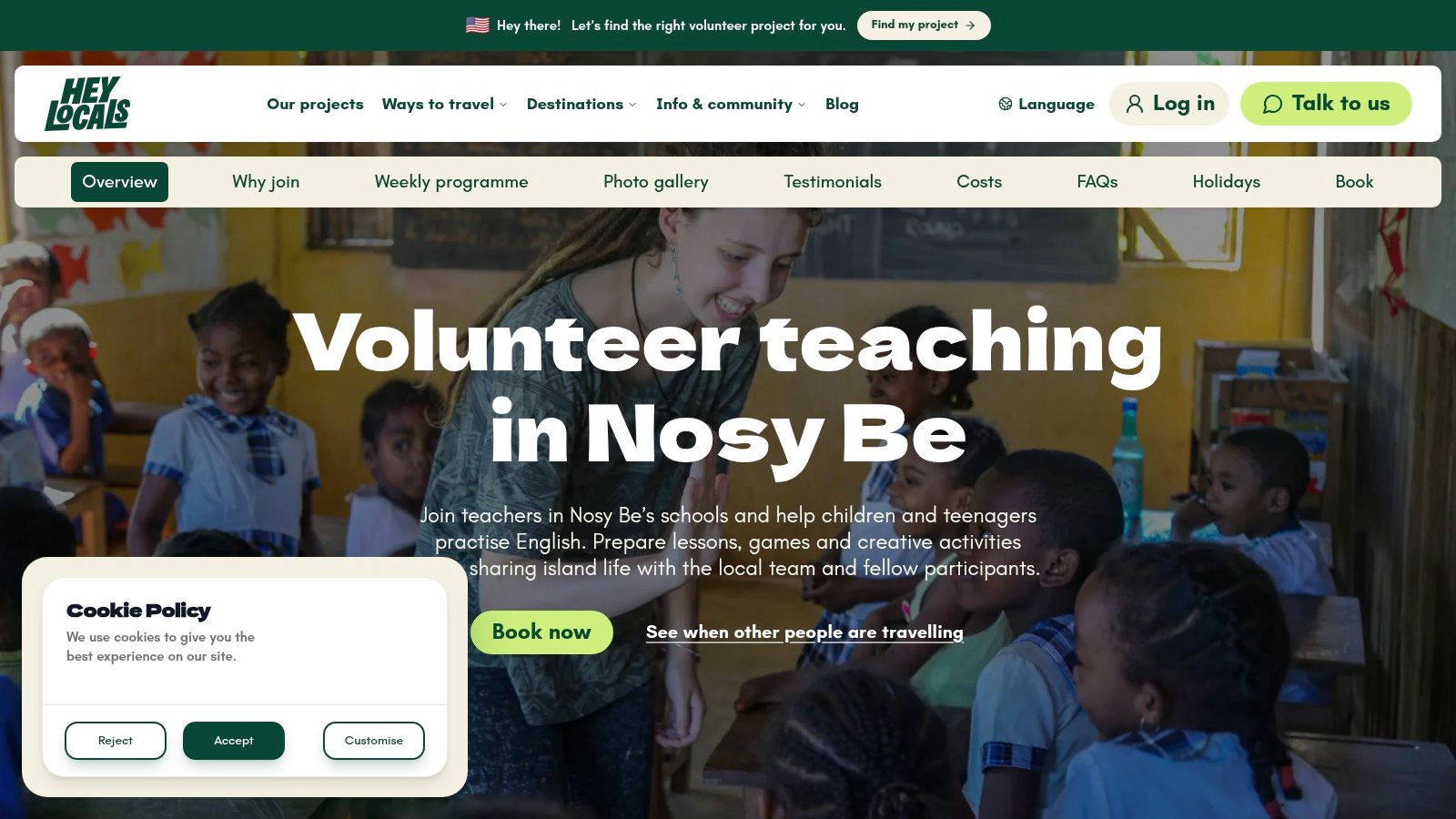
Nosy Be may sound like a natural choice for an island-school placement, but HeyLocals does not run volunteer projects in Madagascar. Its teaching catalogue includes placements in other destinations, such as Kandy, Sri Lanka. Before booking any teen teaching programme, check the live project page for the location, age requirements and activities offered. The guide to volunteering abroad for teens can help families prepare for the practical questions.
How the school day runs
In a teaching placement, the local teacher sets the lesson and decides what help is useful. A teen might lead a game, use flashcards or practise conversation with a small group. They should not be expected to take over the class or plan a curriculum alone.
School terms shape the routine. A placement described as classroom-based may include other tasks during exams or holidays. Ask what the schedule looks like on your exact dates and whether the teen will work with the same class throughout the stay.
Practical rule: Ask for a sample week, including who supervises each activity. The details matter more than a broad promise of classroom time.
Why short placements need a clear shape
Teen availability can limit participation more than interest does. A U.S. Government Publishing Office review of youth volunteering reports that the share of American teenagers who volunteered more than doubled, from 13.4% in 1989 to 28.4% in 2005. The same review found that 67.9% of teenage volunteers gave 99 or fewer hours across the year.
For a short placement, agree on a useful, realistic contribution with the local team. A teen might prepare reusable games or support conversation practice, if the teacher wants that help. The class's needs come first. A clear task gives the volunteer structure without turning the placement into a project designed only for the visitor.
Motivation also depends on whether the work feels relevant. A UK government review of barriers to youth participation reports that, in 2025 youth-volunteering research, 43% of non-volunteering respondents cited a lack of interesting local opportunities and 25% saw volunteering as boring or uncool. Talk with your teen before booking about the daily tasks, not just the destination. Discuss homesickness and what support they can ask for if the work differs from their expectations.
What retention looks like when it's measured
The four-year National YouthBuild evaluation reports that about 75% of young people assigned to the programme participated. Among those receiving services, engagement averaged eight months, 87% stayed involved beyond three months, and reported volunteering rose by roughly 21 percentage points at the 48-month follow-up. YouthBuild is not an overseas placement, but its measures suggest useful questions: how many participants begin, how many complete the programme, and whether they volunteer again after returning home.
Ask how the project gathers feedback after the trip. A final-day impression cannot show whether the experience led to continued volunteering.
Questions to put to the project team
Who supervises during lessons? Ask who is present in the classroom and who the teen reports to.
What happens during school holidays or exam weeks? Confirm the activities for your dates before booking.
Who handles safeguarding concerns and out-of-hours calls? Ask how your teen can contact the local coordinator and what happens if that person is unavailable.
What will the teen do on the first day? Get a clear outline of the introduction, tasks and supervision.
What help do teachers want from volunteers? The local team should be able to explain how the activities fit the school's needs.
2. Rural teaching in Guangxi
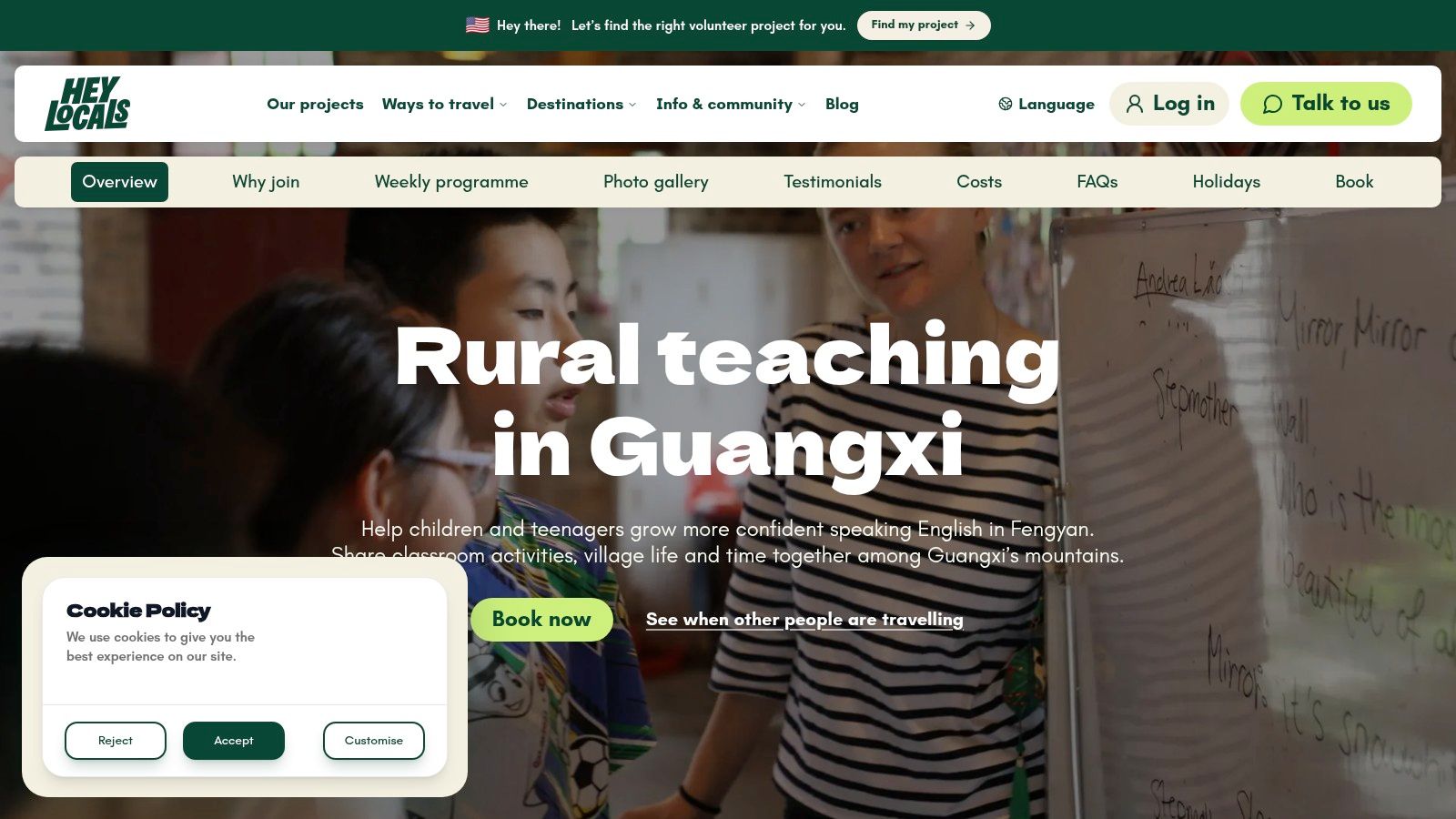
Village teaching looks gentler on a brochure than it is in the room. Fewer resources, mixed ages, and a class that may never have had a visiting speaker of English before. In the Guangxi listing, teens help children and teenagers in Fengyan grow more confident speaking English, sharing classroom activities and village life among the mountains. Confidence is the goal a short stay can reach.
A smaller room changes the job
In a rural school the teen's job is conversation practice: games, repetition, pronunciation, small-group work. That suits a 16-year-old. A visiting teenager lifts exactly the kind of work a stretched teacher struggles to give enough time.
It also means fewer people nearby. Staff may be shared across several classes, travel between sites takes longer, and the nearest coordinator may sit in another building or another village. State that trade-off plainly before you book: fewer adults, longer distances, less slack when something slips.
The local team sets the pace. The teacher's week decides what a volunteer can add, and a schedule built around the volunteer instead of the class falls apart by Thursday.
Start with the Students and Minors catalogue for the shortlist, then compare how the day is built rather than how the photos look. Confirm supervision, minimum age, dates and who accompanies the group on the specific live offer before you treat anything as available.
What participation gaps tell a family
Participation in voluntary work swings widely between countries. OECD analysis of PISA 2018 data, covering representative samples of 15 to 16 year olds in 20 jurisdictions, found voluntary work in the previous 12 months ranged from 77% in Indonesia to 28% in Italy, as reported in the OECD's review of voluntary work in the community. The same analysis found an 8 percentage point gap inside countries: 52% of students from more advantaged backgrounds volunteered, against 44% of the most disadvantaged.
For your family that is a prompt about money and clarity. Ask for the total cost, what the fee covers, what sits outside it, and what happens if dates move. The HeyLocals fee covers the costs of hosting volunteers, including accommodation, meals, organising activities and the people who support volunteers while they are there, and the arrangements included vary by destination.
Who volunteers, and who gets asked
The 2003 Gallup Youth Survey of 1,200 U.S. respondents aged 13 to 17 found 31% of teenagers reported volunteering for charitable activities, with academic standing splitting the sample: 42% of teens describing themselves as near the top of their class or above average volunteered, against 21% of those reporting average or below-average standing, according to Gallup's findings on teen social service. Parental education tracked the same way, at 24% where neither parent attended college, 33% with one parent and 41% with both.
Those figures describe unequal access more than motivation. Recruitment through schools and community networks reaches teens that appeals aimed at already-active families would miss.
Safeguarding across the whole arc
The 2025 global volunteering-sector survey that gathered responses from 10,053 people identified safeguarding as an urgent priority across the volunteer lifecycle, from participation through exit and re-engagement, in the IAVE insights paper on the future of volunteering. On a rural placement that matters even more, because the distance between the classroom and help is longer.
Published policies are the floor. HeyLocals asks every volunteer to declare any criminal record, and under-18s take part with a parent or guardian involved. Whatever programme you choose, I'd treat a vague answer on any of the following as a reason to walk away:
Travel time between sites. Ask how your teen gets to the school and who travels with them.
Language at the clinic or hospital. Know the plan before anyone needs it.
After-project hours. Ask who supervises your teen once classes end and where evenings are spent.
Weekly teaching hours. Ask how many classroom hours the timetable gives your teen, and what fills the rest of the day.
Who signs off tasks. A named teacher should own that answer.
How the two teen-eligible catalogue placements compare
My read: Palawan is the easier first placement for a 16-year-old, while Ahero suits a teen who can handle a plainer routine and more independent check-ins. Both are education placements, both sit inside HeyLocals' 15-destination service area, and both should be judged by adult cover rather than scenery. Fees are not free; listed entry points are from US$860 in Palawan, the Philippines, and from US$620 in Ahero, Kenya, with inclusions varying by destination.
| Item | Setting | Typical day | Adult cover | Out-of-hours and safeguarding | |---|---|---|---|---| | Volunteer teaching in Palawan | Palawan, the Philippines | English practice through lessons, games and creative activities alongside local staff | Local coordinator oversees the placement; ask which named teacher signs off tasks and stays in the room | Coordinator is the first contact; child-contact roles use vetted staff, and volunteers must declare any criminal record | | Teaching in Ahero | Ahero, Kenya | Classroom English support and confidence-building activities under the host timetable | Same standard: named local adults, a coordinator looking after the volunteer, no solo classroom responsibility | Same standard: written contact route, identity and reference checks for staff, criminal-records certificates for child-contact roles |
The activity list is nearly identical, so the decision is operational. A teen can join from 16 with basic English, usually without prior experience, but they are there to help where useful. They never act as substitute parents, primary teachers or sole care-givers. Before booking, get the named coordinator, the adults present during lessons, the out-of-hours route and the airport handover in one document. If the team answers quickly and specifically, either placement can work. If the answers stay general, choose neither.
Ask One Question Before You Book
One question does more work than any brochure: who should my teen call if they are worried outside project hours, and how will I be contacted? Ask for it in writing, alongside the agreed airport handover, so the name and number sit in the same document you'll open at midnight.
Week one is where nerves live. A good settling-in sequence looks like this: an introduction to the responsible staff member, a walk through the daily routine, one manageable first task, and a clearly identified person to approach. If your teen is homesick or anxious, they can say so early, and the coordinator and guardian can agree the right next step together instead of guessing from opposite sides of the world.
Confirm the communication arrangements with the team before departure. Reviews help you read a team's tone, and pages like what guests say about Abu Dhabi tours show how travellers describe a well-run day, but they can't tell you who is on call at 7pm for your 16-year-old.
For perspective, teen volunteering isn't exotic. In 2024, 44% of young people in England had taken part in some form of volunteering in the previous 12 months, according to the UK Department for Culture, Media and Sport Youth Participation Pilot Survey. A well-run trip is one route into that habit. No placement can promise transformation in a week, and any that does is selling you something else. If you're still weighing a purely leisure option for the same school break, MENA family adventure itineraries give you a comparison point for what a non-volunteering trip looks like.
HeyLocals runs community-led volunteering projects where your teen joins existing local work alongside teachers, coordinators and other volunteers, with support before departure, on location and after return. If you're comparing teen volunteer programs for a 16 or 17 year old, start with the placements that accept minors and put the out-of-hours question to our team before anything is booked. Visit HeyLocals to compare the current options and confirm the details on the live offer.