
Volunteer Programs in India: 2 Goa Options Compared
Compare volunteer programs in India, with Goa examples, covering project demands, eligibility, costs and responsible participation before you book.
You arrive at a kindergarten in South Goa before the morning rush. The teachers already have a plan for the day, the children come in small groups, and nobody is waiting for you to invent a curriculum. Your value sits in the gaps: a game that keeps four children busy while the teacher works with two others, English words repeated with the right sounds, a painting activity that doesn't end in tears.
That's the question when you compare volunteer programs in India. Not which placement sounds most meaningful, but which one fits what you can do on a Tuesday morning. This guide compares two Goa placements by daily role, preparation and supervision. Goa is one example of the wider India options, not a portrait of the whole country.
Table of Contents
How the Two Goa Placements Compare on Daily Role and Preparation
Choose the Placement That Fits Your Role, Then Confirm the Details
1. Kindergarten Volunteering in Goa
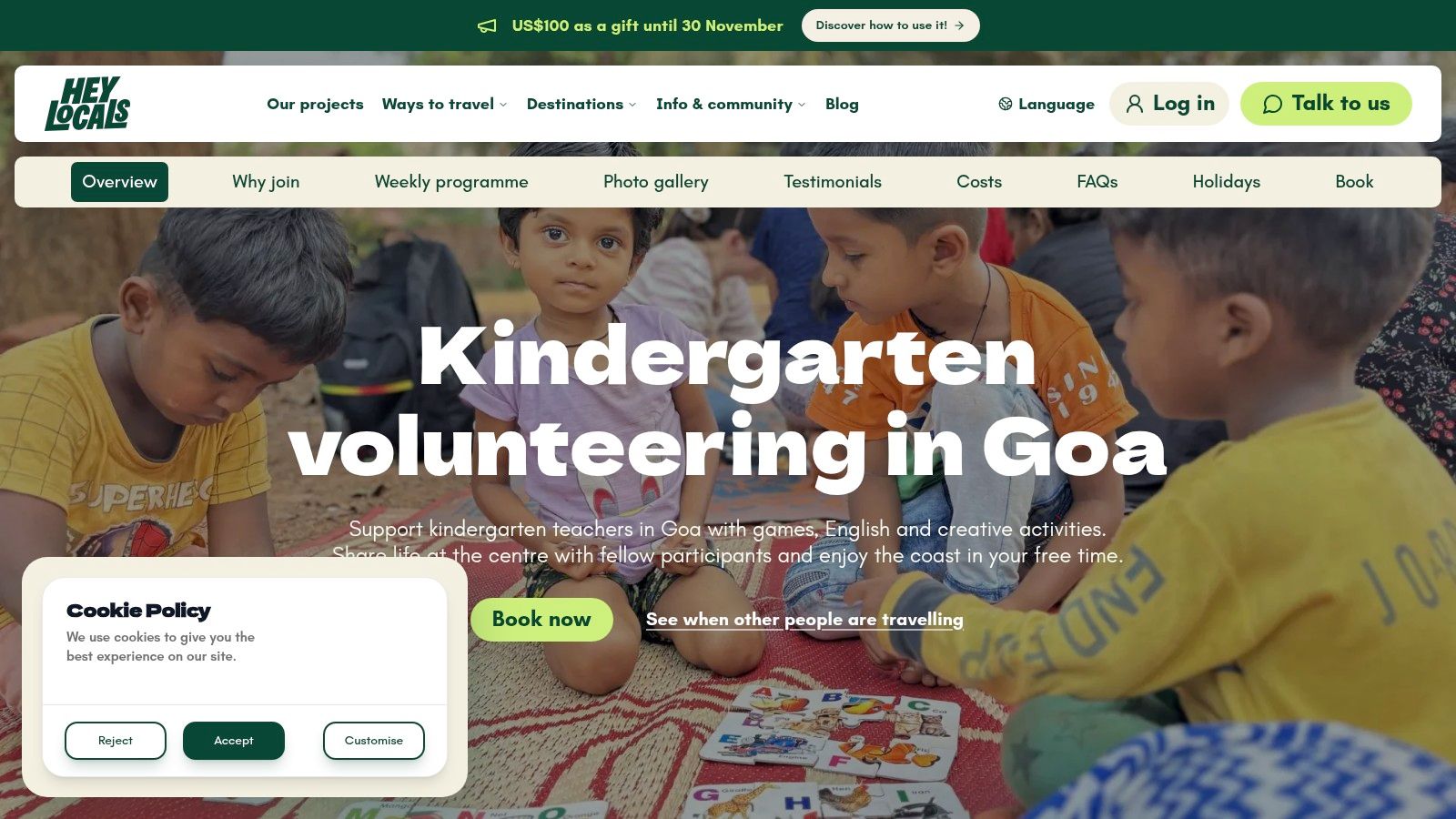
Education placements attract first-time volunteers more than any other category, and this version asks little of your CV and a lot of your patience. In Kindergarten volunteering in Goa you support kindergarten teachers with games, English and creative activities, share the days with fellow participants and use your free time on the coast. No previous volunteering experience is needed, and volunteers can join from the age of 16 with basic English that covers everyday conversation and instructions.
What the Day Actually Asks of You
You join a routine that already exists. The teacher sets the plan, decides which children need extra attention, and hands you a group. Your tasks are physical and repetitive in the best way: lead a song with actions so children hear English rhythm, play a matching game with picture cards, sit with four children and repeat colours until they answer without prompting. Then cut, glue, tidy, wash hands, line up.
Writing a curriculum, testing children and predicting their progress all belong to the staff who see them every week. Read the room for the first two days and ask the teacher one question at the end of each session: what helped, and what got in the way. Those answers are the actual training.
Structured support beats improvised teaching every time. In Haryana, a randomised evaluation of the Teaching at the Right Level approach recorded gains of 0.15 standard deviations in oral-reading assessments and 0.14 standard deviations in written-Hindi exams against comparison schools, after training teachers to identify children needing remedial help and place them in level-based groups with suitable materials and extra adult attention. The gains came from that structure: the right grouping, the right materials and close coordination with the teachers already in the room.
Classroom and After-School Sessions Run Different Routines
Same building, different job. A morning kindergarten session has a teacher, a timetable and a settled set of children. An after-school session may have mixed ages, no desks, children who have already sat still all day, and a parent waiting at the gate. Ask which ages attend, how many turn up, and what the adults are trying to achieve that week.
Here's the adaptation I'd suggest. A worksheet that works with six quiet children in a classroom becomes a short visual game for a mixed group in a corridor: flashcards on the wall, colours called out, children running to touch the right card. Same learning objective, different energy. Make that swap before you conclude the activity failed. If you're weighing a childcare-style day against a school day, our guide to volunteering at a daycare sets out what each routine asks of you.
Practical rule: Don't turn up with a lesson you wrote at home. Turn up with three five-minute activities that need no materials you can't buy in the nearest town.
Cultural Preparation That Actually Helps
India includes major Hindu, Muslim, Christian, Sikh, Buddhist and Jain traditions, and festivals such as Diwali, Eid, Christmas and Holi can change daily schedules, food practices and how busy a community is, as practical guidance for volunteers in India explains. English is more common in urban and educated settings, while regional languages dominate many rural communities.
So do the operational checks rather than the cultural-reading list. Learn greetings in the local language. Ask the coordinator what to wear at a kindergarten. Ask whether photographs of children need permission, and from whom. Confirm how the morning briefing works and how you get to the project. Check whether a festival week changes attendance or opening hours.
What to Measure Before You Leave
The people who make a placement work are usually local. A qualitative study of 35 community volunteers in Goa found that effective work was relationship-driven: volunteers connected residents with government welfare schemes, organised educational events and shared information through trusted networks, including WhatsApp. Retention rested on social recognition, personal satisfaction and family backing, while weak community support and scarce resources pushed people out.
For a classroom placement, your value shows up in continuity. Did you turn up every scheduled day? Did the same children get attention twice a week? Did the teacher get a break? India's national volunteering platforms show how wide the gap runs between registered interest and completed participation, so judge your own stint the same way. Ask the coordinator to confirm your hours rather than assuming they were noticed.
2. Construction and Renovation in Goa
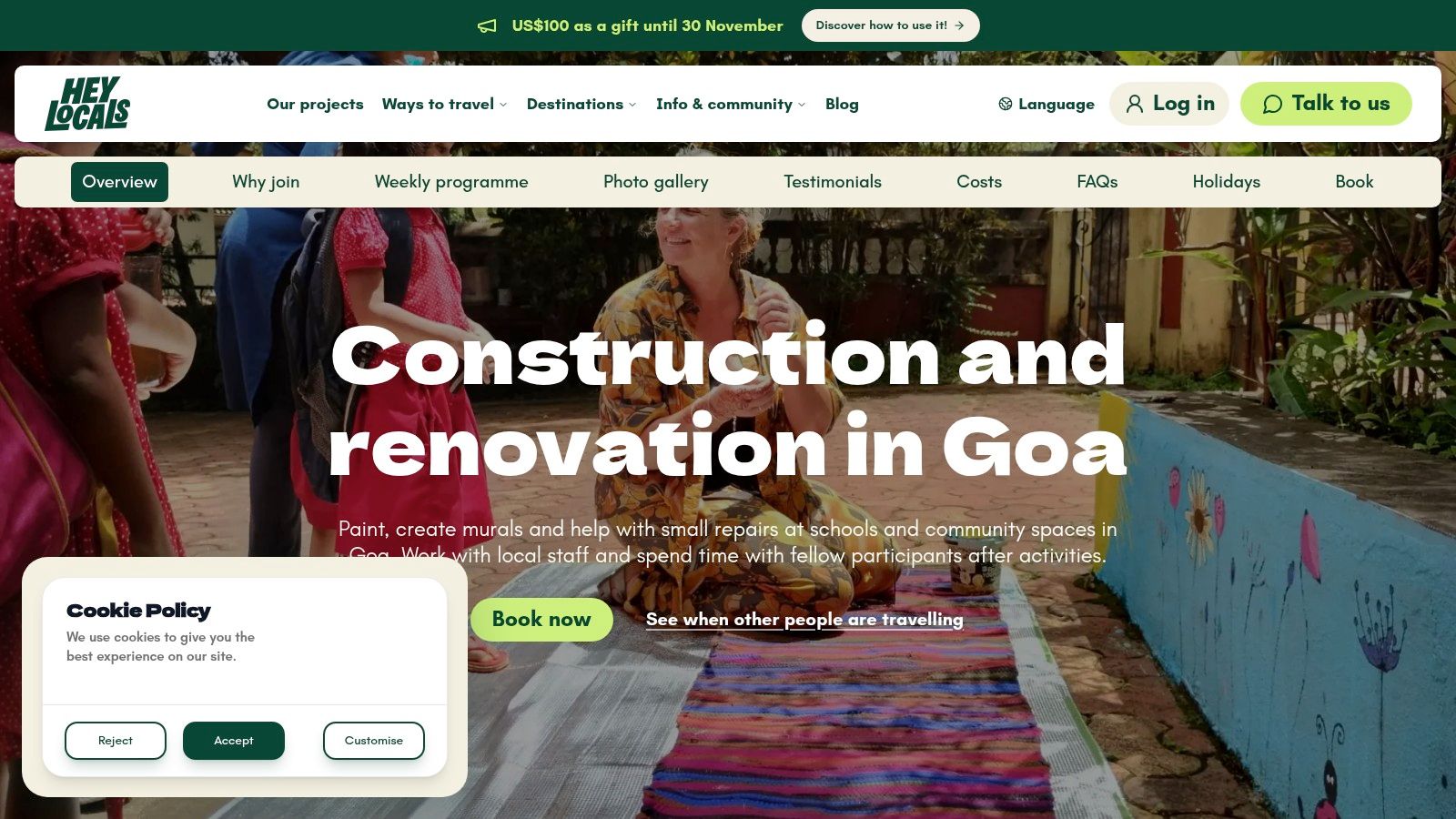
By 8.30 the corridor is taped off, the desks are stacked in one corner and the first coat is already drying slower than the humidity suggests. Painting a classroom wall is the most honest volunteering there is, and the easiest to get wrong. The results are visible, which is satisfying after a week of songs, and the work attracts people who want to build something permanent. In Construction and renovation in Goa you paint, create murals and help with small repairs at schools and community spaces, working with local staff and spending time with fellow participants after the activities.
The Work Is Visible, and That Changes the Brief
A painting day is sanding, priming, drying time in humid air, two coats, and a wall that stays tacky longer than you expect. Murals need a design the school has agreed to, not the one you sketched on the flight. Small repairs mean hinges, doors, benches and blocked drains. Before day one, ask who buys the materials, who decides the colour, and what happens if the paint runs out halfway along a wall.
The visible result also creates pressure to finish. A half-sanded wall photographed well on day one still needs the second coat on day three. Ask how the team handles work you cannot complete, whether a local worker checks the finish, and who owns the snag list after your group leaves.
Who Decides What Gets Painted
Research on volunteer tourism identifies recurring risks: ignoring community priorities, producing substandard work, reducing demand for local labour, creating dependency and reinforcing poverty narratives, as a review of volunteer tourism evidence sets out. The test for a placement is evidence, not promises. Ask who designed the project, whether Indian staff keep decision-making power, what you do that cannot be filled locally, how children and vulnerable adults are protected, and whether anyone measures the result after volunteers leave.
Construction is where displacement is most obvious. A local mason needs the paid work, and a wall painted by visitors is a wall a local painter wasn't paid for. Where the task is extra, like a mural nobody budgeted for or clearing out and repainting a store room, you add value. Where it replaces a contract, you don't.
A useful test for any renovation placement: if the partner cancelled your booking tomorrow, would the work still be budgeted, scheduled and finished? If yes, you're extra labour. If no, you're the plan, and that's a warning.
If you plan to raise money for materials, check the legal route first. Indian organisations receiving foreign contributions generally require registration or prior permission under the Foreign Contribution (Regulation) Act, as published guidance on volunteering in India notes. Sending cash to an individual bypasses every safeguard the partner has built.
Small Teams and Thin Margins
India's voluntary sector is large but thinly staffed. An Asian Development Bank country study cites a Society for Participatory Research in Asia survey estimating more than 19 million people working as volunteers or paid staff in NGOs across the country, and found that 73.4% of NGOs had one or no paid staff. The same study discusses national policy goals for the voluntary sector around collaboration, autonomy and accountability.
The practical consequence for you is simple. Your supervisor may be the same person buying cement, teaching a class and answering your messages. Ask who is on site each day, who signs off finished work, and what you do when nobody is available. Our guide to construction volunteer work covers site-day practicalities in more detail.
Same Brush, Different Working Day
Read the task list, not the category label. In the Goa placement, the same brushwork changes with the room. An empty classroom in the morning is preparation, ladders and drying time. A community room used after school adds boundaries: where children wait, which doors stay open, how wet paint is cordoned off and who is responsible for tools when the session ends.
Before you accept the schedule, ask where the work happens each day, whether beneficiaries are present while tools are out, who moves heavy materials, and what counts as finished enough to reopen the space. Treat Goa as one labelled case with its own sites and staffing, not as a template for every project in the catalogue.
Placements That Ask More Than a Brush
The classroom evidence in section 1 describes a bounded teaching support model, and it does not qualify anyone to support patients or people with disabilities. A supervised school routine may suit a first-time traveller. Disability support can require preparation for communication, safeguarding, mobility assistance and boundaries around personal care. A healthcare placement can add eligibility rules, relevant studies or skills, confidentiality and clinical supervision.
Before accepting any role, request the written task list, required skills or studies, training, permitted contact with beneficiaries, staff-to-volunteer supervision and the escalation procedure. Compare demands, not how often someone has travelled.
How the Two Goa Placements Compare on Daily Role and Preparation
Both projects run in the same state, so the decision comes down to the working day itself. The differences sit in who directs you, what tires you, and what you should ask before committing.
| Placement | Project focus | Who supervises you daily | What the work asks of you | Preparation to check | |---|---|---|---|---| | Kindergarten volunteering in Goa | Early childhood education | The class teacher during sessions, with a local coordinator looking after you on the project | Sustained attention on young children, slow and repeated English, energy for a noisy room | You will be around children all day, so ask how the teacher wants you to join in and what supervision applies to your contact with them | | Construction and renovation in Goa | School and community-space improvements | The site lead sets the task list and corrects technique, with the coordinator checking progress | Lifting, kneeling and working in the heat, plus patience with being shown how to do it properly | Ask what tools and protective gear are provided and how physically demanding a typical day runs |
Even inside the kindergarten placement, the role shifts by hour. A morning classroom session follows the teacher's plan, while an after-school activity expects you to hold the group's attention more yourself, so ask where your hours are scheduled.
Both placements accept volunteers from age 16 with basic English for everyday conversation and instructions, and usually no prior experience is needed. Anyone under 18 joins with parental consent. What separates the two is the tiredness: the kindergarten drains attention, the build drains your body. Choose the one you can sustain for the length of your stay.
Choose the Placement That Fits Your Role, Then Confirm the Details
Open the live project page for the placement that fits your skills, then confirm the age range, dates, minimum duration, language level, daily role and what the fee includes before you enquire. Use the Find my project tool to filter by interest, and ask the local coordinator what to wear, how daily briefings work and how you will travel to the site.
Keep two checks separate. A parent or guardian must be involved for anyone under 18. Professional qualifications sit in a different lane: healthcare placements require relevant studies or skills; kindergarten and renovation roles usually call for no prior volunteering experience. Ask about the specific site's calendar, language and community customs, because one region does not speak for the whole country.
Then decide on the daily reality. A structured classroom morning, a week of sanding and priming, and a role with closer supervision each ask something different of you. Pick the one whose Tuesday you can picture yourself doing well.
Start at HeyLocals, which runs volunteer placements with local organisations in 15 destinations including India, and open the project page that fits the role you want. The team and local coordinators can talk you through the routine, preparation and fee coverage.