Volunteering Abroad Short Term: Safety Red Flags to Spot
Planning volunteering abroad short term? Match your skills, spot safeguarding red flags, prepare health and paperwork, and make a brief placement count.
You have two or three weeks of leave on the calendar, a browser full of project pages showing smiling classrooms and beach clean-ups, and a quiet doubt in the back of your mind. You want to spend that time doing something useful, yet you've probably wondered whether volunteering abroad short term helps a local community or gives hosts another visitor to manage.
That doubt is healthy. Every short placement comes with a real trade-off: the time a host organisation spends orienting, housing, and supervising you is part of the impact equation, not a side detail. When you know how to read a project page for continuity, clear handover, and child-safe design, you can separate grounded local partnerships from trips built mostly for photos.
Table of Contents
What Short-Term Volunteering Abroad Really Means
Say a volunteer arrives at a village school for a two-week placement. They spend the first three days learning teachers' names, daily bells, and classroom habits, then spend the remaining days sitting beside a small group of students during one afternoon reading session. Nothing about the school changes overnight, yet the local teacher gets an extra pair of calm hands for forty minutes a day.
That modest picture matches how researchers define the format. According to a doctoral dissertation archived by the University of the Incarnate Word, short-term international volunteering generally means overseas service lasting roughly 1 to 8 weeks, setting it apart from long-term development assignments that run for months or years.
Think of a short placement like working a guest shift in a busy restaurant kitchen. You can chop vegetables, wash prep trays, and pass plates alongside the cooks, but you can't rewrite the menu or run the pass. A short-term volunteer fills a supporting role, never replacing the local staff who keep the work going year-round.
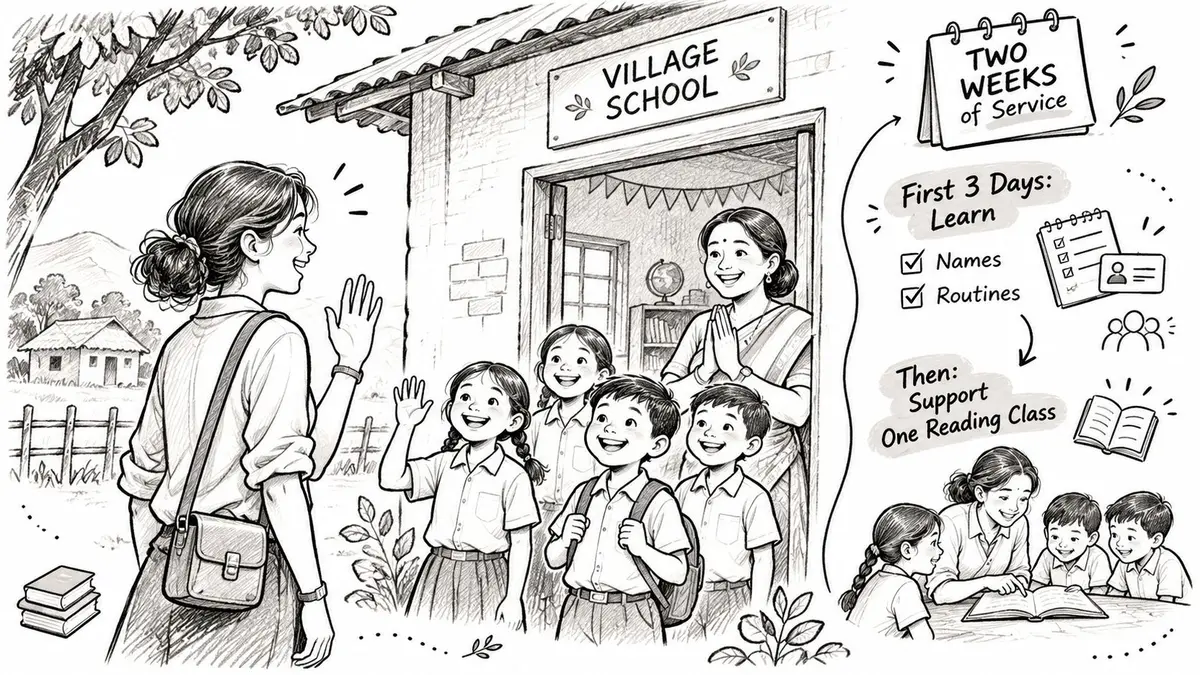
A well-run short placement fits you into work that already exists, rather than inventing a showcase task around your arrival.
Why Short Placements Fit Modern Schedules
Few university students, working parents, or career-break travellers can pause life at home for two years. Structured orientation, accessible durations, and bounded roles make international service realistic for people who only have a few weeks free. At HeyLocals, we offer volunteering projects in 15 destinations, spanning Cambodia, Cape Verde, Colombia, Costa Rica, India, Indonesia, Japan, Kenya, Nepal, the Philippines, South Korea, Sri Lanka, Tanzania, Thailand, and Vietnam.
Getting real value out of those weeks comes down to three practical decisions: understanding what your skills and dates can contribute, checking whether a project protects children and uses local time responsibly, and preparing properly before you fly.
Matching Your Skills and Dates to the Right Placement
A good placement match works like choosing the right piece of a jigsaw: the host organisation already has a picture half built, and your job is to find where your shape fits rather than forcing a corner piece into the middle. Most placements are designed for everyday helpers rather than specialists. Usually, no prior volunteering experience is needed to join a project, and volunteers can participate from the age of 16 with a basic level of English that lets them handle everyday conversations and follow instructions. Healthcare placements are the main exception, as clinical settings usually require relevant studies or professional qualifications.
If you're under 18, a parent or guardian must be involved in the arrangement, so confirm those requirements with the coordinator before picking dates or flights. Find your situation in the left column below to see which placement type fits and what single check matters most before booking.
| Your situation | Placement type that usually fits | What to check before booking | | --- | --- | --- | | No prior experience, basic English | Community education, environmental or wildlife work | Whether the activity needs more English than you have | | Teacher or educator | Education projects with defined classroom roles | Whether you lead lessons or support local teachers | | Healthcare student or professional | Clinical support roles with relevant studies or skills | Qualifications required and whether duties are supervised | | Travelling with children | Community-based family-friendly projects | Whether children take part in activities or only accompany you | | Only one or two weeks free | Projects that start from one week | How much of the stay goes to travel and orientation |
How to Read Your Row Before Filtering
A 17-year-old student with basic conversational English and three weeks free during a school break sits in the first row, not the childcare row. The sensible move is community education or environmental work with a guardian involved in the arrangements, plus one direct question to the coordinator about how much spoken English the daily tasks require. That same logic applies to anyone drawn to health topics without clinical credentials: a placement such as health education volunteering in Zanzibar shows where the line sits, since volunteers there support ongoing health education activities alongside the local team rather than delivering any form of medical care themselves.
Time on the ground matters just as much as skill level. Some projects start from a single week, yet international flights, arrival recovery, and local orientation eat up a noticeable share of those seven days. Two or three weeks usually leave a much healthier ratio of hands-on contribution to settling-in time.
Use this four-step routine before opening booking calendars:
List your real skills: Write down what you can do reliably without heavy training, whether that's tutoring, basic IT, gardening, or clinical study.
Count your actual working days: Subtract outbound flights, return travel, and at least one orientation day from your total leave.
Check the language bar: Match your spoken English against the instructions and group work the activity involves.
Filter before falling for a destination: Run those answers through our Find my project tool so you compare realistic options first.
Notice what this routine never asks: which beach looks best, or which country tops your wishlist. Those questions come last, because a placement chosen for scenery often ends with a volunteer whose skills don't match the day's work. A placement that fits your skills and calendar will always be more useful to a host team than one picked for its prettiest brochure photos.
Spotting Safe Child-Contact Placements
A background check works like a reference check in hiring: it filters out people with a documented history, but it says nothing about what happens on the job. It only tells an organiser what appears on an official record in your home country, and it does nothing to prevent poorly supervised contact once you land. A safe placement depends on what surrounds the check: supervision, limited duties, and permanent staff who keep responsibility for care.
Data on short placements shows how wide that gap can be. In a study of 353 participants in short-term international service trips shared by the Better Care Network, 32.0% completed no pre-trip requirements, and 231 participants (65.4%) reported interacting with children in residential spaces without supervision. Volunteers who did complete pre-trip preparation felt better prepared and reported higher trip satisfaction.
A United Nations General Assembly report reinforces that concern, warning that unregulated voluntourism exposes children to physical, emotional, and developmental risks when visitors work directly with them without formal safeguarding systems, while noting that volunteer flows are poorly recorded. That's why child-focused placements should operate through community-based or family-based services rather than residential institutions or orphanages. Direct caregiving in residential facilities carries far higher protection risks and should never be treated as an entry-level activity.
Safeguarding reality: A project that restricts your direct access to children is often far safer and more effective than one promising unlimited hands-on care.
Restriction is not a sign that your help is unwanted. It is a sign the project was designed around the child's routine rather than the visitor's experience. Short-term volunteering does not replace professional care, and participants never act as substitute parents, primary teachers, or sole care-givers. Use the comparison below to screen any listing before you apply.
| Feature | Safer sign | Red flag | | --- | --- | --- | | Setting | Community school, family or community service | Residential institution or orphanage | | Supervision | Staff supervise every contact with children | Volunteers alone with children | | Responsibility | Local staff keep care duties | Rotating visitors take over care | | Preparation | Safeguarding briefing before the placement starts | Arrival with no briefing | | Screening | Identity check and criminal-record declaration | No screening mentioned | | Duties | Written, limited and role-specific duties | Vague promises of love and attention |
When you read a project page, look for the safer column in plain sight. Continuity means the same children meet the same staff every day, with volunteers joining activities that already exist. Handover means your tasks pass back to a local coordinator the day you leave, so nothing depends on a two-week visitor. Child-safe design means the page states who supervises contact rather than how much affection you will give.
Three Questions to Ask Before Any Child-Contact Role
Good intentions don't protect vulnerable children. A visitor staying for two or three weeks can't absorb local child-protection norms, institutional reporting structures, or community power dynamics fast enough to handle gray areas alone.
Our volunteer projects are community-led and in some cases include contact with children and adults at risk, and roles involving children require criminal-record certificates covering each country where someone lived for six months or more in the previous five years. Before booking any role that brings you near children, read our safeguarding policy and put three direct questions to whichever organisation you choose:
Supervision in practice: Who stays physically present whenever volunteers interact with children?
Daily care ownership: Which permanent local staff members keep all personal care, discipline, and primary teaching duties?
Concern reporting: What exact steps happen if a volunteer or staff member raises a safeguarding concern on site?
Clear, specific answers are the strongest sign of all. They show the organisation has already thought through the situations you would otherwise walk into unprepared. If an organiser gives vague answers or brushes these questions aside as overly formal, walk away from that placement.
Health, Paperwork and Your Pre-Departure Timeline
A volunteer who books flights in January for a March departure often treats the travel clinic as an errand for the final week. That ordering causes real problems. The World Health Organization travel advice recommends seeking travel-health guidance early and visiting a travel clinic preferably 4 to 8 weeks before departure, although a consultation still helps even shortly before you fly.
Why does the timing matter so much? Certain vaccines require multiple doses spaced weeks apart, so a course started late cannot finish before departure day. Some countries also enforce strict entry rules tied to yellow fever or routine immunisations. A late clinic visit can narrow your destination eligibility or force last-minute changes to your daily duties.
Your project type shapes your risk profile too. Rural healthcare, wildlife conservation, outdoor fieldwork, and animal-care roles create very different exposure pathways than indoor classroom support. A traveller considering medical volunteering in San José should keep in mind that healthcare projects may require relevant studies or skills, and clinical settings call for different occupational immunisations and hygiene precautions than a school-based role. Ask your clinic about both before you commit to dates.
Work through these steps in order from the moment you pick target dates:
| When | Task | Why it matters | | --- | --- | --- | | 8 to 4 weeks before | Book a travel-clinic consultation | Multi-dose vaccine courses need weeks to complete | | 8 to 4 weeks before | Check entry and vaccination requirements | Late checks can change eligibility or the placement | | 6 weeks before | Review medical conditions and medication supply | Prescriptions and repeat supplies take time to arrange | | 4 weeks before | Confirm insurance covers the project activity | Fieldwork and animal contact can fall outside basic cover | | 2 weeks before | Get location emergency contacts and referral facilities from the coordinator | Coordinators give location-specific guidance | | On arrival | Note the nearest clinic and the escalation path | Needed quickly for illness or injury |
Insurance Gaps and Emergency Escalation
Standard holiday policies often exclude hands-on volunteering, manual fieldwork, animal contact, or clinical observation. Reading the HeyLocals guide to volunteer abroad insurance alongside Mazurly's nomad guide to trip coverage gaps helps you spot activity exclusions and evacuation limits before buying cover. A policy that excludes your actual daily tasks protects you on paper only.
Two weeks before departure, ask your coordinator for three written details: the local emergency phone numbers, the name and address of the nearest referral medical facility, and the exact escalation path for illness or injury. Store those details offline on your phone and on a folded sheet of paper inside your daypack so you aren't hunting for Wi-Fi during an urgent situation.
Paperwork deserves the same early start. HeyLocals asks participants to declare criminal records, and a parent or guardian must be involved for under-18s, so gather those documents while your vaccine course is still running rather than after it ends. Declarations, insurance confirmation, and clinic paperwork each take days to arrange, and they stack up quickly when left to the final fortnight.
Judging Whether Your Help Will Actually Matter
A one-week or eight-week placement works best when it fits around work that already exists. Treat it like adding an extra pair of hands to a busy classroom or conservation team. The extra help may be useful, but staff still need to explain routines, supervise tasks, arrange meals and organise local transport. If a project spends three days training someone who only stays five days, the local team can end up further behind than before you arrived. That is the opportunity cost in practice: the hours a host team spends supporting a visitor are hours not spent on its own priorities.
Research published in Voluntas by Cambridge University Press points to weak monitoring and inadequate data collection as blind spots in voluntourism. That matters because a glowing testimonial can describe how meaningful the trip felt without showing what changed after the volunteer went home. A project page that explains handover, local direction and follow-up gives you a clearer picture than emotion alone.
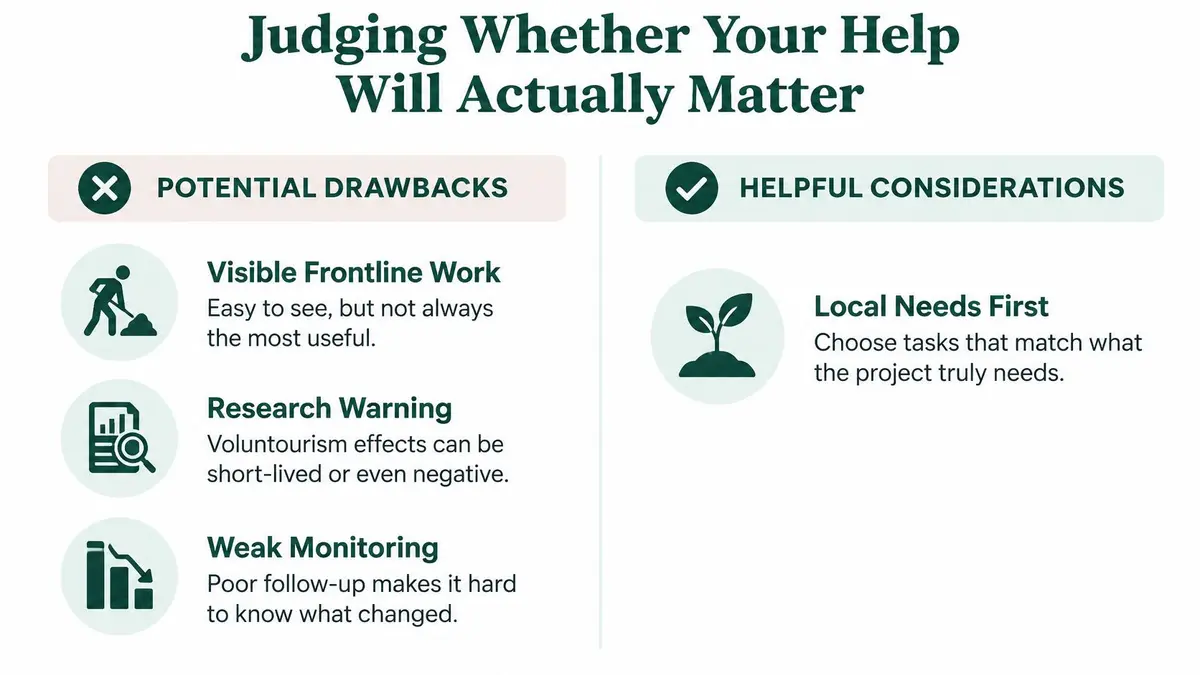
The most visible frontline work is not always the best contribution a short-stay visitor can make. Indirect support, such as funding, translation, preparing classroom materials, logging environmental data or backing locally led activities, often carries lower risk and leaves behind tools the team keeps using. Read the project page for signs that this support has an owner after you leave. A lesson pack with no staff member assigned to use it is a weak sign. A data log that a coordinator checks each week is stronger.
| Contribution type | Continuity after departure | Load on local capacity | | --- | --- | --- | | Visible frontline work | Ends when the volunteer leaves | High: orientation and supervision use local time | | Funding | Continues after departure | Low | | Translation or lesson preparation | Materials stay with local staff | Low if handed over properly | | Environmental monitoring | Data continues if handed over | Moderate: needs supervision | | Support for locally led activities | Follows the local plan | Low |
How Hosting Costs and Continuity Fit Together
Supporting visitors properly costs money and staff time. The fee helps cover the costs of hosting volunteers, including accommodation, meals, organising activities and the people who support volunteers while they are there. Arrangements vary by destination because each local organisation hosts volunteers according to its resources and the project's needs. Seeing those costs in plain language makes it easier to judge whether a project has planned for continuity. Our guide to ethical volunteering abroad looks at how to spot responsible partnerships.
Before committing to any placement, look past the highlight reel and test the listing against four continuity questions:
Project ownership: Who owns, funds and directs this initiative when no international visitors are present?
Baseline work: What would local staff be doing next Tuesday if no foreign volunteers signed up this month?
Handover method: How are your lesson materials, notes or survey records passed to permanent staff before you leave?
Post-departure tracking: What concrete outcomes are monitored after short-term volunteers return home?
A project with honest, specific answers welcomes informed volunteers rather than rushing you to book.
How to Make a Short Placement Useful
Once you land, your daily habits determine whether you lighten the local workload or add to it. Volunteers join activities that already exist and help where it's useful with what they can offer, while local coordinators look after volunteers while they are on their project and act as your first point of contact.
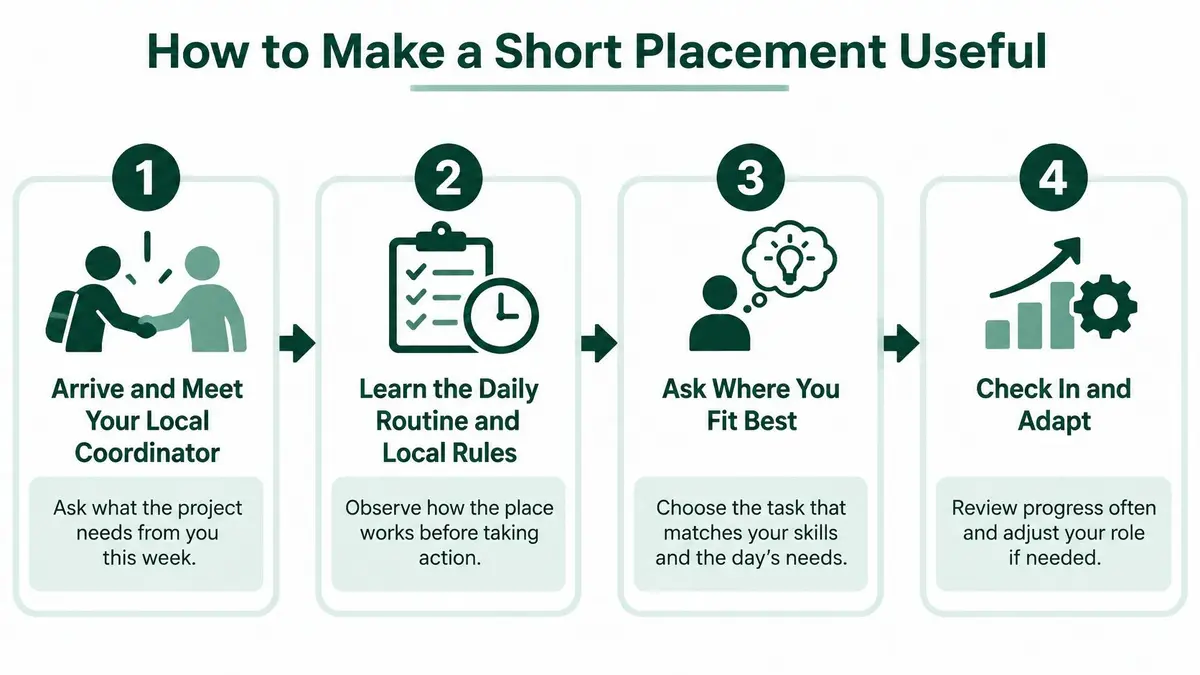
Follow this seven-step routine from your first morning to your final afternoon:
Meet your local coordinator first and ask what the project needs this week. Priorities shift with weather, school calendars, and staffing, so starting with an open question aligns your energy with today's reality. The common slip is assuming the summary paragraph you read two months ago reflects this week's exact timetable.
Learn the daily routine and local rules before suggesting changes. Watching how staff greet elders, manage tools, or pace a class keeps you from stepping on unwritten norms. Too many short-term visitors arrive with a fixed plan in a notebook and ask the host team to rebuild its schedule around their ideas.
Stick to existing tasks and state your limits plainly. Telling a coordinator early that you're comfortable preparing worksheets but not leading a room of thirty students protects everyone's time. Saying yes to everything out of politeness creates avoidable supervision headaches.
Prepare materials ahead of time. Drafting vocabulary cards, translating basic instructions, or sorting supplies in the evening means local staff aren't pulled away from their work to babysit your prep the next morning. Even half an hour of independent prep turns a passive shift into a productive one.
Keep a simple handover note as you go. Jot down three lines at the end of each day: what you finished, what remains open, and what local staff or the next volunteer should pick up. Without a written trace, half-finished folders usually get shelved the day you depart.
Raise any concern the same day. If something worries you regarding a child, an animal, or a colleague, take it straight to your local coordinator rather than waiting for a post-trip survey. Prompt reporting gives local leaders a chance to act while details are fresh.
Share constructive feedback before leaving and ask what would help the next arrival. Your fresh eyes on packing lists, commuting tips, or tricky briefing points can smooth the path for the next volunteer without adding work for local staff.
On-site habit: Treat your first two days as observation time rather than performance time; listening early saves local staff hours of corrective work later.
Confirm These Points Before You Book
Before paying a deposit, bring your project details and travel arrangements together. A promising description still needs to translate into a clear agreement about your role, support and costs. Get unclear answers confirmed in writing before committing.
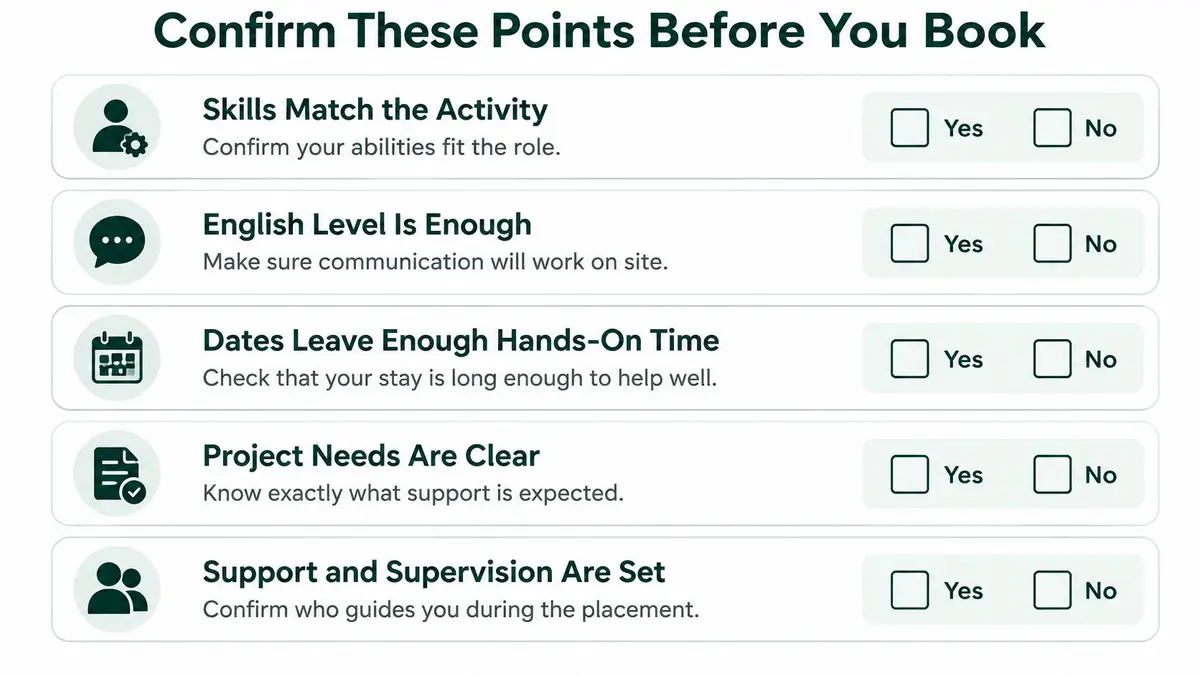
Use this checklist as a final cross-check against the earlier sections:
Skill and English alignment: Revisit the matching guidance in section 2 against your confirmed duties.
Sufficient hands-on days: Check that the dates agreed with the project reflect the working time discussed in section 2.
Child-safe structure: Confirm that the safeguards from section 3 apply to your actual placement.
Health and policy cover: Complete the health, insurance and paperwork checks in section 4.
Documented continuity: Ask who directs your work, receives your handover and continues activities after you leave.
Destination-specific inclusions: Request a written breakdown of included arrangements and separate expenses.
Read those answers together. Supervision is part of the impact question: your role should fit the support local staff can provide while keeping ongoing activities in their hands. A clear handover connects your short stay to work that continues.
Arrangements included in the fee vary by destination, because each local organisation hosts volunteers according to its resources and the project's needs. Compare that breakdown with separate costs such as visas and flights. For onward travel, review round trip vs one-way tickets when considering airfare options, and confirm entry requirements separately before booking.
HeyLocals supports volunteers before, during and after their trip. Use that preparation support to resolve outstanding questions about your shortlisted placement.
Choose the placement whose duties, safeguards and arrangements you understand, even if another listing looks more dramatic on screen.
In this article
- Table of Contents
- What Short-Term Volunteering Abroad Really Means
- Matching Your Skills and Dates to the Right Placement
- Spotting Safe Child-Contact Placements
- Health, Paperwork and Your Pre-Departure Timeline
- Judging Whether Your Help Will Actually Matter
- How to Make a Short Placement Useful
- Confirm These Points Before You Book