
Volunteering vs Internship: Which Builds Your Career?
Volunteering vs internship compared by duties, eligibility, costs and learning outcomes, with a clear verdict for each situation.
The standard advice is that an internship beats volunteering every time because it looks better on a CV. I'd stop taking that advice. The label on your placement tells you almost nothing about what you'll learn, who'll supervise you, or what the whole thing costs you once flights and lost wages are counted. A well-run volunteer role with a named supervisor, real tasks and documented outputs will teach you more than an unpaid internship where you fetch coffee and nobody reviews your work.
That's the argument I'll make throughout this guide to volunteering vs internship: judge the structure, the supervision and the total cost, not the name. Both routes can work. Both can waste a summer. The difference sits in details you can check before you pay a deposit, and most of those details are things a host will put in writing if you ask.
Table of Contents
Volunteering and Internships Side by Side
Both look like unpaid experience, so which one will help a career? That's the question most students bring to me, and it's the wrong first question. Start with what each thing is. Volunteering is unpaid contribution to a cause, a community or the environment. An internship is supervised workplace learning organised around a career goal. One is built around contribution, the other around occupational exposure.
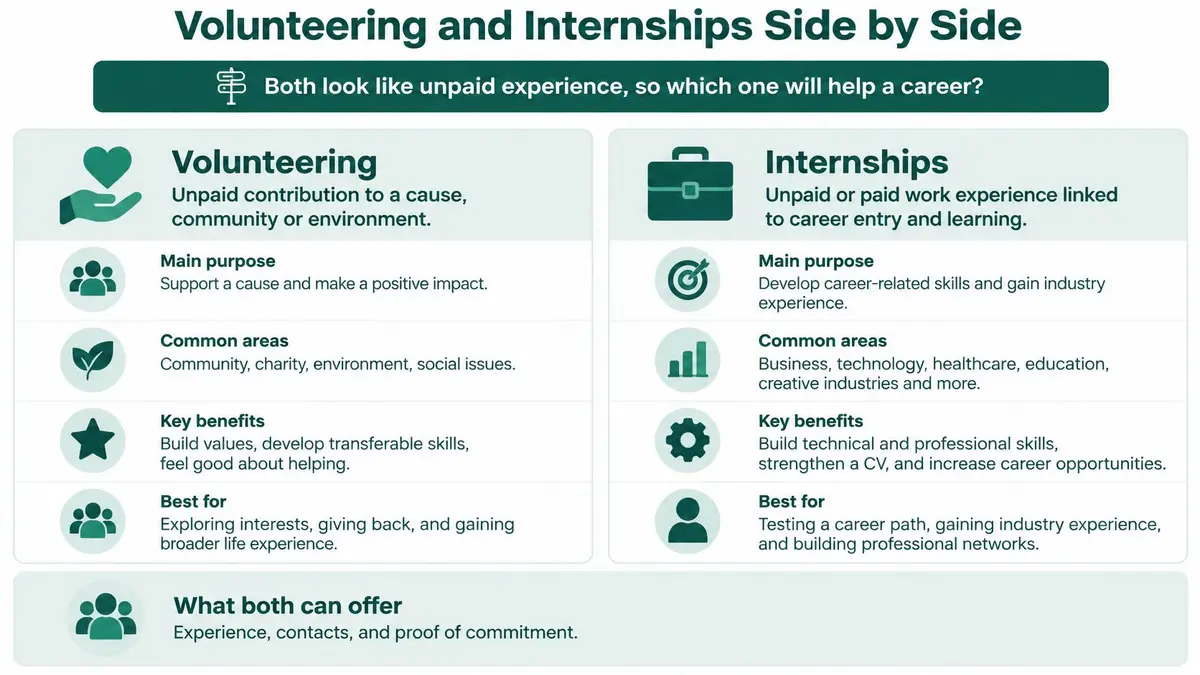
Volunteering and internships compared
| Criterion | Volunteering | Internship | | --- | --- | --- | | Main purpose | Contribution to a cause, community or environment | Supervised workplace and career learning | | Pay | Usually unpaid; some programmes charge fees | Paid, stipended or unpaid, depending on the host | | Structure | Role set by the host organisation, often flexible | Defined responsibilities, supervision and feedback | | Setting | Community projects, often abroad | Employer, company, clinic or school | | Evidence for employers | Transferable skills and initiative | Role-specific deliverables and references |
How to read those rows
Every row describes a typical pattern, not a promise. The structure row is the one that decides your outcome, and it's the row most likely to be wrong in practice. I've read internship descriptions that promised defined responsibilities and delivered photocopying. I've read volunteer role descriptions that looked vague and turned out to include a weekly review with a project coordinator and a folder of lesson plans at the end.
Practical rule: the strongest placement is the one that can show you a sample week, a supervisor's name and a list of things you'll have produced by the end.
The pay row deserves a second look too. "Unpaid" isn't a neutral category. An unpaid internship in an expensive city and a fee-paying volunteer placement abroad both move money out of your account, just under different headings. One costs you rent and forgone wages, the other costs you a programme fee plus flights.
Before you read further, pick the two or three criteria that matter most to you. If you need a reference from a specific industry, weight the evidence row. If you're funding this yourself, weight pay and total cost. If you're 16 and travelling with a guardian's involvement, weight structure and setting. Your weighting decides the answer, not the word on the certificate.
What Each Role Asks You to Do Day to Day
International Labour Organization statistics on volunteer work report that approximately 2.1 billion people volunteer each month worldwide, with the estimate placed on that sentence. Volunteering is mass unpaid work, so the scale says nothing about whether one role builds career skills. Judge the day to day structure instead.
Two calendars for the same fortnight in July show the practical difference.
The volunteer's week: morning reading circles in a preschool, an afternoon of preparing materials with a local educator, a conservation survey transect walked twice, a community health session where you handle registration and logistics. You join activities that already exist and help where your time and skills are useful.
The intern's week: a Monday team stand-up, a draft report due Thursday, two client calls you sit in on and take notes for, a dataset you clean and chart for a manager who reviews it and sends it back with comments.
Take childcare volunteering in Nosy Be. Local educators lead preschool activities where learning can begin with a shared story, a song or a game. Volunteers support that rhythm. They do not become clinicians, occupational therapists or substitute teachers. That distinction matters if you want childcare experience but expect professional training. Ask what tasks sit inside the project and who remains responsible for care.
Two mismatches waste most of the time people give these roles. A volunteer placement can become observation only: you watch a teacher for three weeks and come home with photographs, no prepared materials and no clear account of what you contributed. An internship can become administrative filler: you file, book rooms and reformat slides, while nobody assesses the work against a professional standard.
Both failures share a cause. Nobody designed the learning. Ask for a written task list, a named supervisor and a sample week of activities before you commit. If a host cannot produce a sample week, they have not planned one. If the supervisor exists only as a signature on a form, skip the role.
Duration and intensity
Volunteer placements commonly start from a single week and involve a fixed number of hours on site, with the rest of the day free. Internships follow a term agreed with the employer or your course, often full-time across a summer or a semester. That difference matters more than the total length, because a part-time placement leaves room for paid work and a full-time one usually does not.
Put four questions to any host, in writing:
How many weeks in total, with fixed start and end dates?
How many hours per week on site, and on which days?
Are there evening, weekend or on-call duties?
Can the role run alongside a paid job, and will the schedule flex for shifts?
Keep the written time commitment with your cost notes. A vague schedule can cost you shifts, rent and travel plans. It also hides the workload. Treat those answers as documents you keep, not reassurance you remember.
Who Qualifies for Each Path
Eligibility tells you whether you can join a placement, not whether it will teach you anything. Check the entry requirements, then ask how your experience affects the responsibilities you'll receive. Structure and supervision matter more than the label.
Getting onto a volunteer placement
Use this checklist to assess your eligibility:
Experience: usually, no prior volunteering experience is needed to join a project.
Age and language: volunteers can join from the age of 16 with a basic level of English that lets them manage everyday conversations and understand instructions.
Under 18: a parent or guardian must be involved in the arrangements.
Criminal records: participants declare any criminal records, and we require an ICPC issued within the last 6 months from UK-resident participants on placements of 4 weeks or longer involving direct contact with children.
Healthcare projects: some need relevant studies or skills, because you're supporting qualified staff rather than replacing them.
For medical volunteering in San José, check how the placement's requirements match your healthcare studies or experience before committing. Ask which activities suit your training and which remain the responsibility of qualified staff. A first-year student and a final-year nursing student shouldn't automatically receive the same tasks.
An accessible entry requirement is no reason to relax professional boundaries. Short-term volunteers do not replace professional care.
Getting onto an internship
Check the advertised requirements before spending time on an application: a CV, interview, relevant course enrolment, minimum study level, permission to work, references, or a portfolio or short task. Establish which are required and which are preferences.
Prioritise roles whose criteria you meet and whose responsibilities match what you need to learn. A selective application process alone doesn't make an internship worthwhile.
Ask the host which tasks your qualifications allow you to do and who will supervise them.
Prepare these this month
Update your CV. Ask potential referees for permission before naming them, and check how many references the placement requires. Describe your working languages accurately, including whether you can follow instructions and manage everyday conversations.
Request the placement's certificate and screening requirements before booking travel. Arrange any required criminal-records checks and vaccination appointments early enough to have them completed before departure. Keep eligibility paperwork separate from your assessment of the role: being accepted is only useful if the placement offers appropriate responsibilities and supervision.
What Each Path Costs and Who Can Afford It
Here are our published starting fees, so you can see real numbers rather than a vague warning about cost. These are starting prices for one organisation, not a market average.
Published starting fees for volunteering placements
| Destination | City or placement | Starting fee (US$) | | --- | --- | --- | | Vietnam | Ho Chi Minh | 860 | | Nepal | Kathmandu | 830 | | Kenya | Ahero | 620 | | Tanzania | Dar es Salaam | 860 | | Tanzania | Stone Town, childcare | 920 | | Tanzania | Stone Town, teaching | 970 | | Philippines | Palawan | 860 | | Sri Lanka | Kandy | 830 |
The fee helps cover the costs of hosting volunteers, including accommodation, meals, organising activities and the people who support volunteers while they're there. Arrangements included in the fee vary by destination, because each local organisation hosts volunteers according to its resources and the project's needs. Read the destination guide rather than assuming two placements include the same things.
What the fee doesn't cover
Our packages don't include international flights, travel insurance, visas, entry fees, departure taxes, vaccinations, or the cost of a criminal-records check. Budget each of those separately, and get quotes before you commit, because flight prices move and visa rules change.
Internships shift the arithmetic rather than removing it. A paid role offsets your living costs. An unpaid role moves rent, travel and forgone wages onto you, which is a transfer of training costs from the organisation to the student. If you're comparing routes, our guide to paid internship opportunities is the more useful starting point than any list of prestigious unpaid placements.
Who gets excluded
The 2025 Sutton Trust report on unpaid and underpaid internships found that people from working-class backgrounds were 20 percentage points less likely to have completed an internship than middle-class participants, 36% compared with 55%. The same report concludes that unpaid placements can exclude people who can't rely on savings or family support. That's not a motivation gap. It's a funding gap.
Now the returns side, because it changes the calculation. A 2025 study of work experience and graduate earnings found that career-related unpaid work, internships and volunteering included, produced no earnings advantage, and that combining unpaid work with casual paid employment could reduce earnings, particularly for women. Paying twice, once in fees or rent and again in lost wages, isn't a reliable investment.
Run the total-cost sum
Add every line, then add the wages you give up. Take the Ahero placement at its published starting fee and plug in your own quotes. Here's the shape of an illustrative four-week budget, with every non-fee line left for your own quotes rather than prices anyone can promise you:
Placement fee: US$620
Return flights: your airline quote for the actual dates
Travel insurance: your insurer's quote covering the full stay
Visa: the fee published for your nationality and entry type
Vaccinations: what your travel clinic quotes for the destination
Criminal-records check: the price of the check your placement requires
Wages given up: your weekly take-home pay multiplied by the weeks you're away
Total: the fee plus every quote above, plus the pay you give up
Then ask who that total excludes: women, disabled participants, carers, first-generation students, anyone without family financial support. If the number rules you out, the answer isn't a bigger loan. It's a local paid role, a shorter placement, or a part-time job run alongside fewer weeks on site.
Which Skills and Proof Each Path Builds
Labels are the least useful part of this comparison. A structured volunteer placement with clear tasks, feedback and outputs can teach more than an internship where you shadow people and fill gaps. Judge the role by structure, supervision and the evidence you can carry away.
Both paths build overlapping capabilities. The OECD review of voluntary work in the community identifies volunteering, internships and part-time employment as authentic work-context experiences that can build technical skills, social-emotional skills, professional networks and confidence in navigating work cultures. The overlap is real. The difference is how tightly the experience is designed and how well it is evidenced.
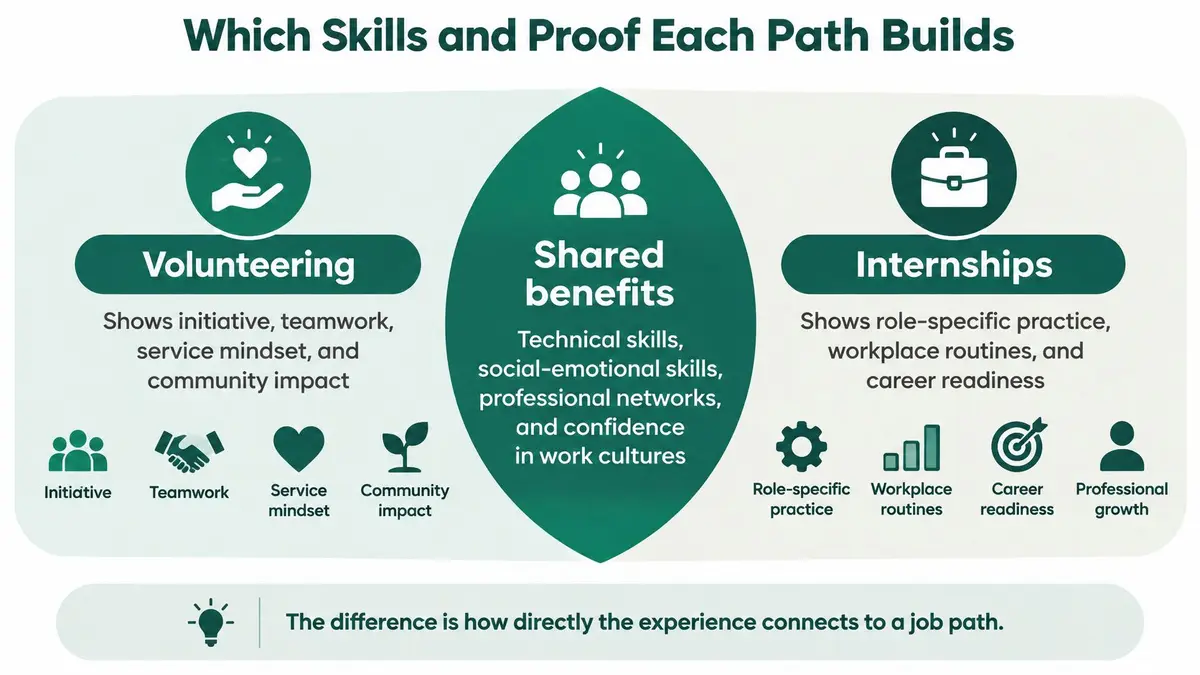
Where the structural difference bites
Volunteering is usually non-contractual, so what you learn depends heavily on role design, supervision, task continuity and skill alignment. An internship normally provides more explicit occupational exposure, defined responsibilities and closer observation of your performance. That is the honest case for internships: someone watches you work against a job-related standard and can describe it afterwards.
Notice the word "normally". A volunteer role with continuity, a supervisor who gives feedback and outputs you can point to closes most of that gap. A poorly supervised internship opens it again from the other side.
What the volunteering evidence says
The OECD review of voluntary work in the community reviewed eight longitudinal studies across Australia, Canada, Germany, the United Kingdom and the United States, and seven found statistically significant associations between adolescent volunteering and improved later employment outcomes, including reported adult earnings advantages of approximately 4% to 8% in some studies.
Those are associations, not causal estimates. The students who volunteer differ from the students who don't, in ways researchers can't fully control for. Don't let anyone sell you a placement on the strength of that number.
What the internship evidence says
Weigh the other path on the same terms. OECD analysis of internships for secondary school students using 2022 data found that 30.8% of students in general education had undertaken an internship by the time they completed the relevant PISA survey, compared with 42.4% of vocational-education students in countries where pathways had diverged. OECD analysis of internships for secondary school students also found that teenagers who completed an internship lasting several days in a company were about 24% less likely to be not in employment, education or training at age 23 to 25 than comparable peers without that experience.
Set that beside the 4% to 8% earnings associations reported for volunteering and the honest conclusion is narrow: neither body of evidence is causal, and neither path is proven to beat the other. Anyone who tells you the science settles the volunteering versus internship debate is overselling it.
Keep a skills log from day one
Hours served prove attendance. Outputs prove capability. Build the record yourself:
Pre and post self-assessments: rate your communication, adaptability and confidence in week one and again in your final week, using the same scale.
Supervisor ratings: ask your supervisor to rate the same items, so you have an outside view rather than only your own.
Output counts: lesson plans delivered, conservation surveys completed, community sessions supported, languages used, reports drafted.
Artefacts you can show: a redacted lesson plan, a survey sheet, a chart, a piece of code, with a sentence on what you did and what changed.
Then translate the log into interview answers. If you're heading towards technical-commercial roles, Eztrackr's guide to preparing for sales engineer interviews shows how to turn project work into evidence an interviewer can probe. For phrasing that reads well on a CV, our volunteer experience examples give you concrete wording to adapt rather than the usual "passionate team player" filler.
Check Quality Before You Commit
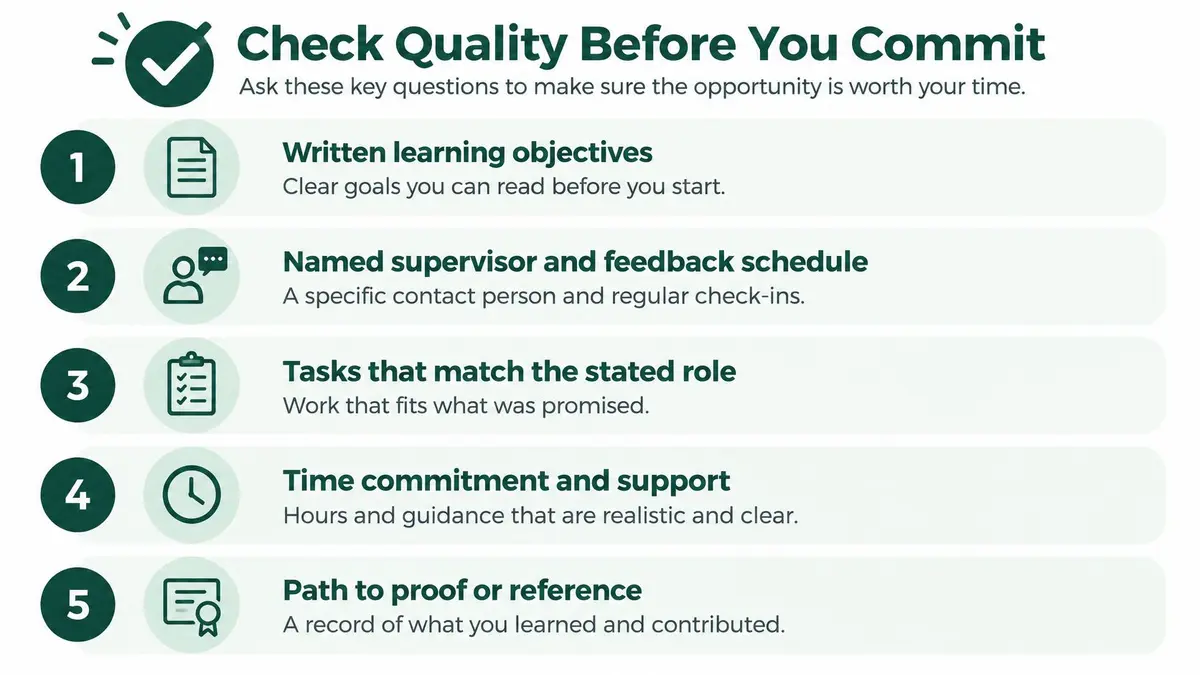
A well-supervised volunteer role can teach you more than a weak internship, and an unpaid internship can exclude anyone without savings. The label decides nothing. Run these eight checks on any placement; each is a question you can email today.
Written learning objectives you can read before you start.
A named supervisor and a feedback schedule, not "the team will support you".
Tasks that match the stated role, shown as a sample week.
Training before the work starts, including any safety or classroom basics.
Safeguarding and child-protection policies wherever children or adults at risk are involved.
Outputs you can document, such as lesson plans, surveys or reports.
A local organisation leading the work, with a genuine need for your help.
The total time commitment and total cost in writing, exclusions included.
HeyLocals projects are community-led, and some include contact with children and adults at risk, so item five applies: participants are asked to declare criminal records, and a parent or guardian is involved for under-18s. On item seven, you join a project already running rather than one built around your visit; on a school volunteering placement, that means stepping into activities the school runs and helping where the team finds it useful.
The limits matter too: short-term volunteering doesn't replace professional care, and participants never act as substitute parents, primary teachers or sole care-givers. A host implying otherwise fails item five. Item eight is the total-cost sum. On a HeyLocals trip, the fee covers the placement, accommodation for the specified period, meals as described in the destination guide and airport transfers, while flights, insurance, visas and vaccinations sit outside it. Arrangements vary by destination, so get yours in writing. Our volunteer selection criteria explain how we match people to roles, and we support volunteers before, during and after the trip.
Ask for the eight answers in writing before you pay. A host that can't answer has already answered.
Choosing the Right Path for Your Situation
The default assumption says an internship always wins. The earnings evidence and the access data say otherwise. The question that survives is simpler: which option gives you supervised, documentable work at a total cost you can carry? Answer it against your own situation, and let the label take care of itself.
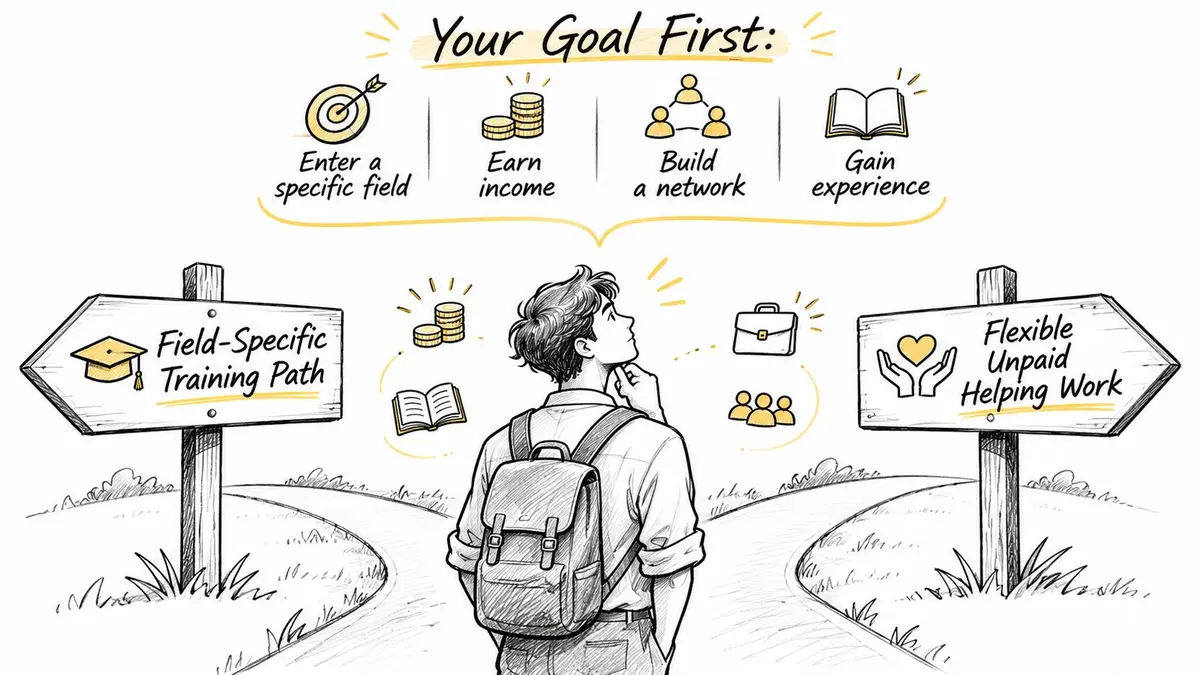
Best-fit path by situation
| Your situation | Better fit | Why | | --- | --- | --- | | Entering a specific career field | Internship | Supervised occupational exposure and references | | Building cross-cultural and teamwork skills | Volunteering | Broad soft-skill development in a new setting | | Needing income during the placement | Paid internship or local paid role | Unpaid placements can exclude people without savings | | Healthcare or teaching student wanting hands-on work | Structured placement with supervision | Clinical and teaching roles need relevant studies or skills | | Aged 16 or 17, travelling with guardian involvement | Volunteer placement with a named supervisor | A named supervisor must be assigned before you commit |
Two scenarios, worked through
Take a nursing student who wants clinical exposure abroad. A structured hospital internship is the right shape of opportunity, though the label guarantees nothing on its own. Check who supervises you, which tasks you're permitted to perform, and whether a qualified clinician signs off your work. If the honest answer is "you'll observe", you're paying for a shadowing week, not a placement.
Now take a teaching student who wants classroom time abroad. A community school that already runs, with a real timetable, a real class and a teacher who can describe your contribution afterwards, delivers more than an internship title on a programme with no classes of its own. HeyLocals runs trips for family volunteering, couples, university students, students and minors, and teachers and educators, and local coordinators look after volunteers while they're on their project.
The combined route
You don't have to pick a side for the next three years.
A student who volunteers for two weeks in a February break and takes a paid internship the following summer holds two different kinds of proof, and neither cost them a term of wages. Volunteering broadens your civic and practical experience. An internship gives direct evidence of employability and familiarity with professional environments.
Sequence them deliberately. Use the volunteer placement to build communication, adaptability and accounts of real work you can defend in an interview. Use the internship to convert that into role-specific deliverables and a reference from someone in your target field. If you can only afford one, pick whichever has the stronger supervision and the lower total cost, whatever it calls itself.
We organise international volunteering trips with local organisations across Asia, Africa and Latin America, on projects that are already running and led by the people who live there. Starting fees are published and exclusions are listed, so you can run your own total-cost sum before you commit. If a supervised volunteer role with documented outputs fits your goal better than an unpaid internship, browse our projects and tell us your dates, your studies and your budget. Visit HeyLocals to compare placements and get individual guidance.