
Costa Rica Solo Travel: A Practical Planning Guide
Plan Costa Rica Solo Travel with routes by trip length, safety by situation, transport options, realistic budgets and ways to meet people.
You've saved a volcano hike, a cloud-forest walk and a beach stay, and the map makes them look easy to connect. Then you start checking transfers and realise the cheapest room might leave you paying for taxis, while the cheapest bus could use up the daylight you wanted for exploring. Good Costa Rica solo travel planning starts with that trade-off: what each choice costs in money, usable time and exposure to risk.
Table of Contents
Build a Solo Route Around Your Trip Length
Say you've got ten days for your first solo trip and want Arenal, Monteverde and the Pacific coast. It's tempting to turn those pins into a loop before checking how you'll move between them. The better approach is to choose your overnight bases first, then make every additional stop justify its transfer.
Costa Rica has an established leisure-travel market: the Costa Rican Tourism Board reports more than 2 million international visits annually, with 75% of visitors travelling for vacation, pleasure or leisure. That supports a practical advantage for independent travellers: you can build a trip around accommodation, excursions and transfers rather than organising every experience from scratch.
Solo route options by trip length
| Trip length | Practical route | Pace | Best for | |---|---|---|---| | 1 week | Central Valley base with one Pacific or Arenal day trip | Slow, one major transfer | First-time solo travellers testing the country | | 2 weeks | Arenal, then Pacific coast with one shared shuttle between bases | Moderate | Most first-time solo visitors | | 3–4 weeks | Full loop through Central Valley, Arenal, Pacific coast and a southern or Caribbean stop | Relaxed, with rest days | Travellers who want nature and time to meet others |
These are planning templates, not promises about journey times. For the shortest route, choose the day trip only after checking the complete outward and return schedule. An excursion that technically returns the same day can still be a poor use of your holiday.
Choose bases before attractions
A Central Valley base reduces packing and check-in decisions, but it isn't a shortcut to every destination. If Arenal is your priority and the return journey looks exhausting, move your overnight base there instead of forcing a long excursion.
For a longer trip, pairing Arenal with a Pacific base gives each place enough attention without making transport the main activity. Pick the actual coastal town before booking the shuttle. “Pacific coast” is a region, not a useful destination to enter on a transfer request.
Use the Costa Rica destination guide to narrow your interests before adding stops. On a fuller loop, choose either a southern extension or a Caribbean stop rather than automatically adding both.
If Tortuguero makes your shortlist, browse Tortuguero lagoon lodge options through Lodging Nearby, then establish how arrival transfers connect with the property. Treat access as part of the accommodation decision.
Give nature days their own space
Plan protected-area visits as dedicated outings. Check each park's booking arrangements, entry window and closing time rather than assuming you can arrive whenever your bus does.
Route test: Add door-to-door travel, waiting and check-in time, not just the driving estimate. I'd use about three road hours as a personal planning trigger: beyond that, question whether to cut a stop or move the night.
That's a comfort threshold, not an official limit. The point is to notice an overloaded day before you pay for it.
Getting Around Alone by Bus, Shuttle, Taxi or Car
Transport options for solo travellers
| Option | Best for | Main solo risk | Practical control | |---|---|---|---| | Rental car | Remote areas and flexible routing | Crashes, theft from vehicles, night driving | Daylight driving only, no valuables left in the car | | Shared shuttle | Fixed routes between tourist bases | Waiting time and fixed departures | Book the seat in advance with a verified operator | | Licensed taxi or ride service | Airport and short city legs | Unlicensed drivers | Confirm the licence or booking identity and establish the fare basis before getting in | | Public bus | Budget travel on main roads | Pickpocketing, long transfers, unclear stops | Keep your day bag in front, travel by day, confirm the stop | | Domestic flight | Long distances or short trips | Limited routes and cancellations | Build a spare day into the plan |
Compare complete journeys, not ticket prices. Ask where the service collects you, where it drops you and what happens to your luggage. A shuttle to your accommodation and a bus to an outlying terminal aren't equivalent purchases.
Why driving takes more attention
The CDC's Costa Rica traveller guidance identifies motor-vehicle crashes as the leading cause of death for healthy U.S. citizens abroad and recommends seat belts, avoiding impaired drivers and avoiding nighttime driving in Costa Rica.
Don't interpret a short-looking map connection as an easy drive. Allow room for variable surfaces, awkward junctions and slower progress than your navigation app suggests. When you're alone, you're also the person checking directions, finding parking and deciding whether to continue when conditions deteriorate.
A rental car makes sense when you'll repeatedly use its flexibility. It makes less sense if it will sit outside your accommodation while you take organised excursions. Before collecting it, save the assistance number, inspect the vehicle and establish what the insurance excludes.
Match the vehicle to the difficult part
For buses, verify the departure terminal and final stop with your accommodation before leaving. Keep your passport, phone and payment methods in your day bag rather than in luggage you can't reach. Don't accept an uncertain connection because someone says another bus will probably come.
For taxis, ask whether the journey uses a meter or an agreed fare; don't insist on a fixed price where a meter is appropriate. With a booked ride, match the driver and vehicle details before loading your bag.
Carry practical backups:
Offline maps: Save accommodation pins and the surrounding streets, not just the national map.
Charged backup phone: Keep essential contact details accessible if your main handset fails.
Emergency cover: Select travel insurance that explicitly addresses emergency medical evacuation and your planned activities.
Written arrival instructions: Save the operator's contact and the accommodation's check-in procedure outside your messaging apps.
Use daylight for self-driving. After dark, take licensed transport rather than improvising an unfamiliar road journey.
How Safe Costa Rica Is for Solo Travelers
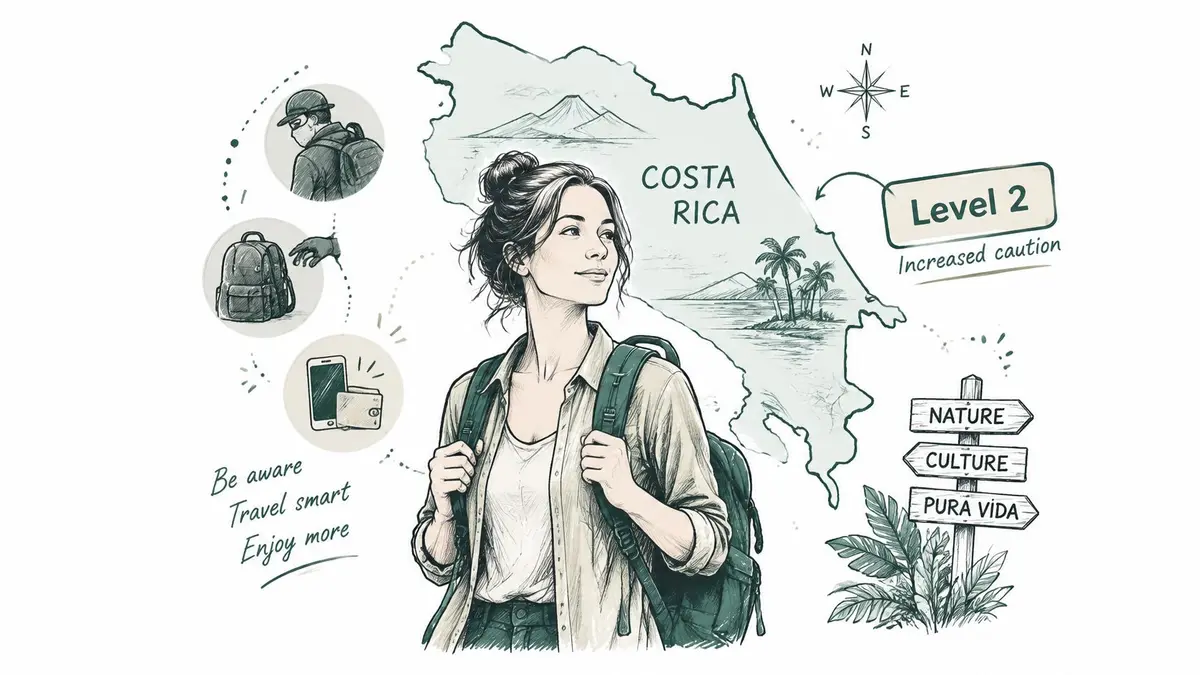
Costa Rica isn't a destination where a reassuring countrywide verdict replaces judgement. The U.S. State Department classifies it as Level 2, exercise increased caution, citing widespread petty theft and violent crime, including armed robbery and sexual assault, that also affects tourists.
The useful question is what you'll be doing, where and with what backup. Walking to a staffed reception in daylight isn't the same exposure as arriving alone at an isolated rental after a late connection.
Adjust the plan to the traveller
Australia's Smartraveller advice for Costa Rica warns that women travelling alone may experience sexual harassment and verbal abuse, particularly on beaches, in taxis and on public transport. That calls for prepared exits, not an expectation that you should politely manage someone else's behaviour.
A short refusal is enough. Move towards staff or other people, change seats or leave the setting when you can do so safely. You don't owe a stranger your accommodation name, onward itinerary or an explanation for ending a conversation.
Keep your day's spending accessible without displaying everything you carry. If you're comparing document organisers, CITYSHEEP's minimalist passport wallet for travelers is an option to assess for size and organisation, not a substitute for secure storage. Don't keep your passport, backup card and all your cash together merely because they fit.
Make the decision before the vulnerable moment
A beach-town night out. Decide your return transport before drinking, and carry only the valuables you need for that evening. Don't make a quiet beach your shortcut home or accept an unverified lift because your phone battery is low.
A first-time visitor landing late. Prearrange collection and obtain written meeting instructions. Choose staffed accommodation that has confirmed your arrival time, and establish what to do if the flight is delayed.
An older traveller using inland roads. Build the day around your own tolerance for fatigue, luggage handling and unfamiliar driving, not someone else's itinerary. A transfer that removes navigation and parking may be worth more than the nominal saving from driving yourself.
Share your daily destination and expected return with a trusted contact. Make the message useful: include the accommodation name or excursion operator rather than saying you're going hiking.
Don't let money already spent turn an uncomfortable situation into an obligation to continue.
Keep these off your solo after-dark plan:
Isolated beaches and access tracks: Arrange collection from a staffed, identifiable meeting point.
Remote hiking routes: Don't start an outing that could finish without a reliable return arrangement.
Unfamiliar rural approaches: Move the arrival earlier or stay somewhere accessible before continuing.
Empty streets around terminals: Use verified onward transport rather than searching on foot with luggage.
These are exposure-based decisions, not a claim that every busy place is safe or every quiet place is dangerous.
Where Solo Costa Rica Money Goes
Consider a hypothetical bus itinerary with several connections and a late arrival. Its fare may beat a shuttle, but add taxis at either end, a meal while waiting and an activity you can no longer reach. The shuttle hasn't necessarily become cheaper in cash, but it may deliver a better trip for the total amount you spend.
TechSci Research's Costa Rica tourism market coverage identifies poor rural roads, unreliable public transportation, limited domestic-flight options and dependence on private vehicles as cost pressures. A room-and-food allowance alone won't capture those logistics.
Cost lines solo travellers underestimate
| Cost line | What it covers | Easy to underestimate | |---|---|---| | Accommodation | Private room or dorm bed, with breakfast where included | Single-occupancy pricing and possible supplements | | Transfers | Airport and intercity shuttles, licensed taxis | Several short hops adding up | | Rental car | Vehicle, insurance, deposit, fuel, parking | Insurance excess and additional rental days | | Domestic flights | Limited routes, booked ahead | Replacement arrangements and lost travel days after cancellation | | Tours and activities | Guided park visits and excursions | Minimum charges or solo supplements where applicable | | Medical and evacuation cover | Emergency care and evacuation | Cover that isn't included in the basic policy |
Price the route, not an imaginary average day
Use current quotes for your actual dates. Check whether accommodation is priced per room or per person, whether breakfast is included and whether the advertised transfer reaches your address.
For car hire, distinguish the deposit, which affects available funds, from the insurance excess, which describes potential liability. Neither should disappear from your planning because it isn't part of the headline daily rate.
For activities, request the complete payable amount, including entry, equipment and collection where relevant. Don't assume a group excursion will operate at the advertised per-person price when you're the only booking.
Know when paying more improves value
A fixed-base stay can reduce paid transfers, repeated check-ins and the temptation to buy convenience meals while moving. Shared excursions can make an outing workable without funding a private driver alone.
Travelling with a partner can be financially more efficient when you split a room, taxi or vehicle. As a solo traveller, you need to decide which private costs buy something useful and which duplicate a service you could share.
Budget method: List every overnight stop and every transfer before setting your daily spending allowance.
Add a buffer day before a consequential departure, then price where you'd sleep and how you'd reach the airport. Don't count lost holiday time as a literal cash saving, but don't pretend it has no value either.
How to Plan Your First Solo Week Step by Step
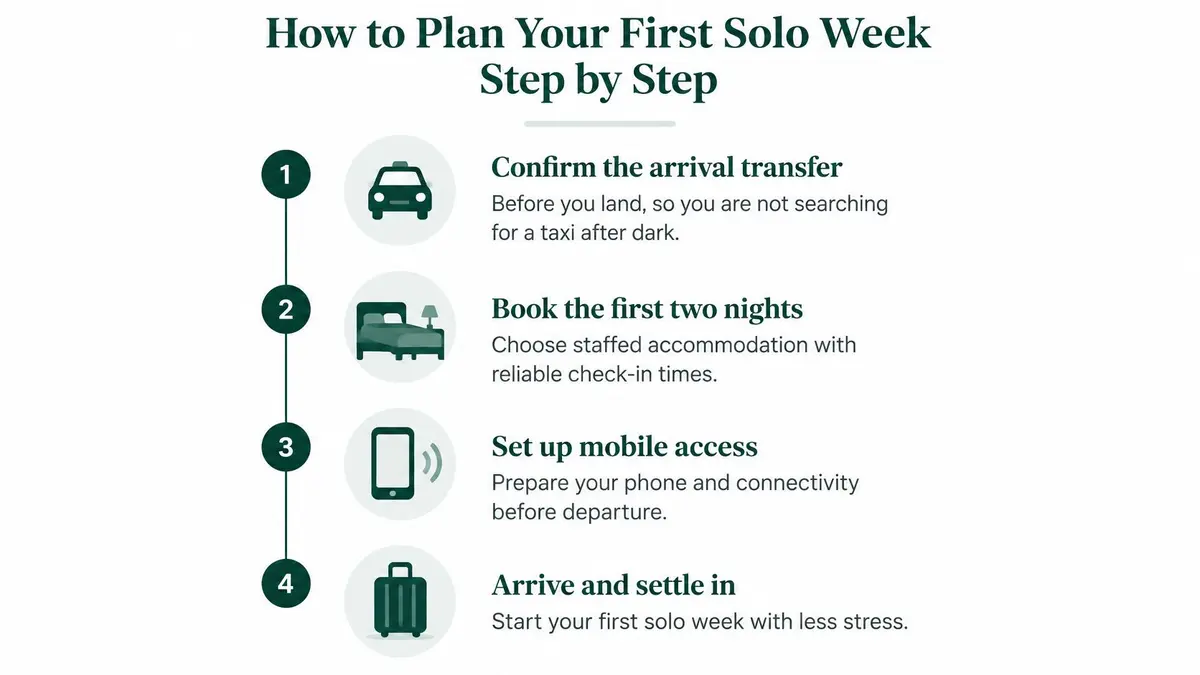
Your flight lands hours late. The property has already treated you as a no-show, the transfer desk is shut, and the cheap bus you liked for the next morning leaves before you have slept. A low fare that cannot survive a delay is often the expensive choice: you pay the lost night, a last-minute ride, and whatever you forfeit the next day.
Prepare the arrival before the adventure
Staffed lodging and the ride from the airport belong in the earlier decisions. This order is for what a slip can still break.
Price a late landing against the cheap transfer. A pickup that waits costs more than the last public bus. Missing that bus at night can cost the room and the next morning. Save the meeting point, the operator's number, and the rule if the flight slips. A booking email does not tell you where the driver stands.
Split days 1 and 2 into refundable and forfeit bookings. If the flight can erase the first morning, a non-refundable tour is costly even when the sticker price looks low. I would rather hold a flexible activity than protect a bargain I cannot use.
Keep one arrival note you can open without email. Address, booking code, insurer assistance line, and emergency contact. Leave it where a dead inbox or a weak signal does not hide it.
Match cover to the week you will travel. Check medical evacuation, the activity, and rental-car terms if you might drive. A general travel policy often leaves one of those out.
Leave one unpaid recovery window. A half-day with nothing sold is cheaper than moving a tour because you arrived exhausted. That spare time is part of the budget, not a gap in the plan.
Choose a first daylight outing with a fixed return and a door-to-door time you have added up. Do not test the longest route on the morning after a night arrival.
Check official entry and health guidance for your passport before you fly. Use current destination-health advice. An old trip report is not a list of documents or medicines.
Keep preparation useful rather than endless
Use a travelling abroad checklist to catch omissions, then stop adding tasks that do not change the first 48 hours. For the confidence side of preparation, LuminAID's tips for first-time solo adventurers offer another perspective. Treat other travellers' advice as ideas to weigh against your flight time, your refund rules, and what a delay would cost you.
Fix the night you might lose, the ride that still runs if you land late, and one block of time you have not sold. The rest of the week can move.
Meet Other Travellers and Book Your First Leg
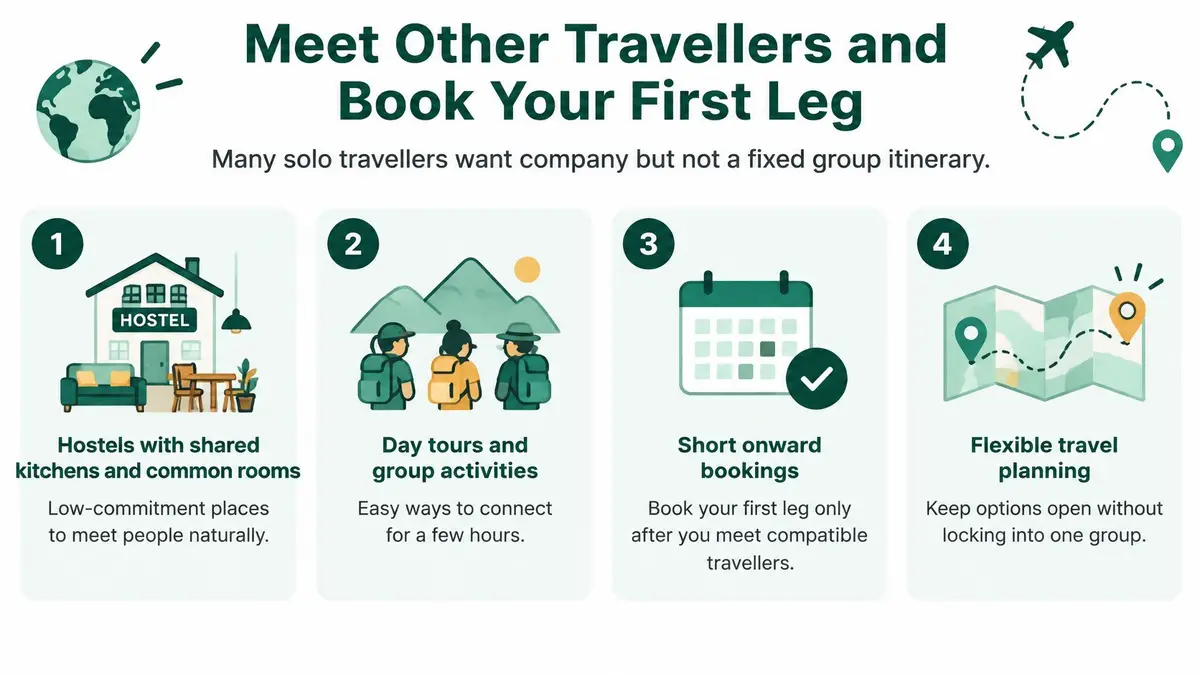
You can want company without wanting a fixed group itinerary. The practical solution is to choose how much shared structure you need, rather than treating solo travel and organised travel as opposites.
Start with the smallest commitment that meets your needs. If casual conversations are enough, a social place to stay may work; if arriving alone feels daunting, recurring activities or a supported placement can provide a more dependable routine. The trade-off is real: more structure costs money and flexibility, while less structure costs you time spent engineering the contact yourself.
Choose company without giving away your itinerary
Shared kitchens and common rooms: These offer low-commitment contact around ordinary routines. Choose accommodation with somewhere people can comfortably sit, rather than a dorm full of beds; a private room with shared spaces can serve the same purpose. The cost is noise and waiting for the stove at dinner hour.
Lessons and guided activities: Surf lessons, cooking classes and guided hikes give you a reason to talk without having to invent an introduction. Repeating an activity can be more useful than constantly switching venues, because a second surf lesson with the same group produces conversation a new venue every day never will.
Shared shuttles and group day tours: These offer a bounded stretch of company. Enjoy the conversation without assuming that a pleasant fellow passenger should become your onward travel partner. A few hours together tells you almost nothing about how someone handles budgets, early starts or a delayed bus.
Volunteering with a local organisation: An ongoing role offers more structure and responsibilities than a social excursion. Choose it because the work fits your interests and abilities; treating a placement as a social club is unfair to the project and leaves you committed to weeks of work you never wanted.
For that last format, HeyLocals offers projects in Costa Rica where solo travellers can join others and meet volunteers from around the world. One option is Childcare in Esparza; check the placement page for the daily activities, since tasks vary by project.
Our solo travellers receive practical help, logistical support and people to turn to throughout their stay. Where a project isn't part of an international network welcoming travellers from different countries, we organise group trips for people with the same motivation. Confirm the placement's terms, responsibilities and inclusions before booking.
Keep new connections compatible with your plans
Company is useful when your expectations match. Before sharing onward arrangements, discuss spending preferences, departure times, room choices and whether either person expects to split up during the day. A traveller who budgets for shared shuttles and one who plans around public buses will struggle within a day, and neither is wrong; they are just paying in different currencies.
Ask the awkward questions early. Who books the room and in whose name? What happens if one of you wants to stay longer in a town? Does either of you snore, work online in the mornings, or need quiet evenings? An honest answer to any of these is cheap. A discovery three days into shared bookings is expensive.
The guide to finding a companion for travel can help you think through that decision. Agree as well on how either person can leave the arrangement without drama, because a clean exit clause is what makes the experiment low-risk.
I'd begin with a group day rather than committing the whole trip to strangers. You can always arrange another outing; unwinding shared accommodation and transport bookings is harder.
Treat each format as the same calculation you apply to transport: what it costs in money, what it costs in time, and what risk it removes or adds. Shared kitchens cost little and deliver casual contact. Lessons cost more and deliver repeat contact. A placement costs the most commitment and delivers a fixed routine, a role and people expecting you. Pick the cheapest structure that solves your loneliness, and keep the rest of the trip free to change.
HeyLocals offers volunteering projects in Costa Rica with preparation, local coordination and support for travellers going alone. Visit HeyLocals to explore placements and check how the responsibilities, included arrangements and separate expenses fit your solo route before committing.