Medical Volunteers Overseas: What They Can Do Safely
Learn which medical volunteers overseas roles are allowed, what qualifications they need, the ethical limits and how to prepare safely.
How much a placement costs, how long it runs and what you'll see on your days off: search for ten minutes and you'll find answers to all three. Now ask what you're legally allowed to do with a patient on your first morning, and most placement pages go quiet.
That silence is the gap. Generic listings sell destinations and personal growth. They rarely tell you whether a role counts as observation or clinical care, who supervises you by name, what you're forbidden to do, who you call when a patient deteriorates, and who takes over your work when you leave.
Below is the version a field coordinator would give you. It starts from your role, not your itinerary, and it treats limits as practical information rather than a warning label. Risk exists on any placement. Clear boundaries are how you keep it small.
Table of Contents
Medical Volunteer Roles at a Glance
Most overseas medical placements are non-clinical, and the clinical ones rest on two conditions: your credentials and the host's written approval. Destination, cost and duration are details stacked on top of those two.
Here is how the common roles split.
| Role | Typical qualification | Permitted activities | Supervision | |---|---|---|---| | Health education or community outreach | No clinical credential needed | Hygiene talks, awareness sessions, supervised outreach | Local team lead | | Translation, logistics or admin support | No clinical credential needed | Interpreting, record keeping, stock and transport | Project coordinator | | Nursing or medical student | Enrolled in a recognised course | Observation and tasks assigned under supervision only | Named licensed clinician on site | | Qualified nurse or allied health professional | Current licence in home country; host registration where required | Tasks within the licence once the host recognises it | Host facility clinical lead | | Licensed doctor | Current registration and indemnity cover | Clinical work only after host registration is verified | Host hospital clinical governance |
Who decides what you may do
The host country does. Observation, health education, translation, logistics and clinical care are five different activities, and the authority to diagnose, prescribe, treat or perform a procedure sits with whoever the local regulator licenses. Your home licence travels as a document, not as a permission.
That distinction matters more than most placement pages admit. A recent review of short-term health volunteering in low- and middle-income countries identified violations of clinical scope of practice and inconsistent regulatory oversight as recurring problems, and linked poorly supervised programmes to risks for patient safety, local expertise and health-system integrity.
Three rules that cover almost every case
No credentials, no independent clinical care. Without a recognised licence you can teach, translate, carry stock and observe. You don't assess, diagnose, prescribe or treat, and you don't advise a patient to change a prescription.
Students work under defined supervision. "Supervised" means a named licensed clinician on site who knows what you're doing that day. A rota pinned to a wall isn't supervision.
Licensed professionals verify before departure. Confirm registration status in the host country, indemnity cover, patient-consent standards, infection-control procedure and the referral pathway while you're still at home.
A placement that can't answer all three for your specific role is unfinished, however good the beach photos are.
Pre-med and pre-health students ask most often what counts as legitimate exposure. The Ace Med Boards volunteering guide is a sensible starting point for comparing options, and it's worth reading beside the table above. Choose placements that put you next to a licensed clinician rather than in front of a patient on your own.
The test to apply: if you can't name the person who supervises you and the person you report an incident to, you don't yet have a role. You have a plane ticket.
Find your row in the table, then note the supervisor that row requires. Everything later in a placement flows from those two facts.
Why the Health Worker Shortage Shapes Every Placement
Medical volunteering is a workforce question before it is a travel one.
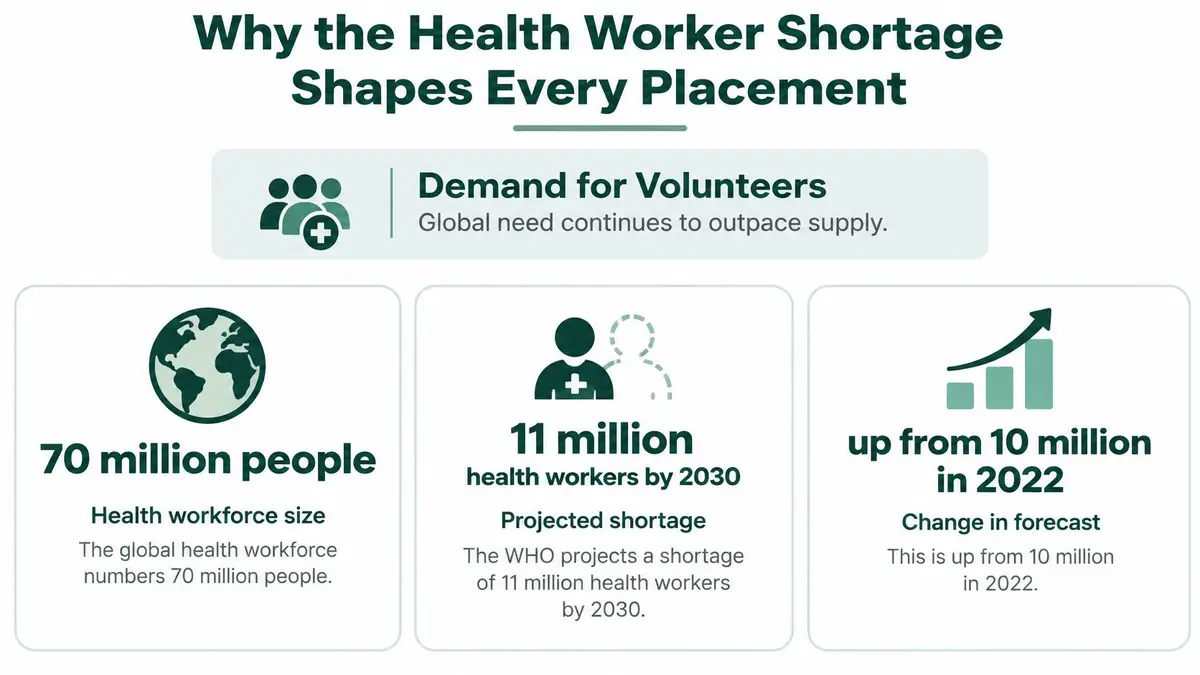
The WHO health workforce team reports that the global health workforce now exceeds 70 million people, yet projects a worldwide shortage of approximately 11 million health workers by 2030, a revision upward from the 10 million the organisation forecast in 2022. The higher figure means the gap is closing more slowly than that earlier forecast assumed.
The gap concentrates in the African and Eastern Mediterranean regions. Limited training capacity, migration, population growth and an uneven spread of professionals all restrict access to care. Those causes sit at system level. A four-week placement does not train a new cohort of nurses, and it does not stop a clinician from leaving.
What a volunteer can add
A ward already short one nurse on every shift cannot hand that post to a visitor. The useful work is the set of tasks the team has already designed and has no spare hands for: supervised health education, support inside existing clinical services, and community outreach a stretched team has no time to run. Those WHO figures describe a system-sized gap, so the safe tasks sit inside work the local service already owns. Short sessions on a topic the ward already teaches. Discharge instructions in a patient's own language. Stock that finally gets counted. A referral that reaches the district hospital.
It works like an extra pair of hands on a line that is missing a trained operator. You can pass tools and follow the checklist that operator wrote. You do not take their station for a month and then leave it empty.
You also cannot stand in for a local professional, or repair a health system in a few weeks. The size of the deficit needs long-term investment in locally trained staff and in the institutions that employ them. Sound programmes therefore place volunteers beside local services, not in their place.
A volunteer who teaches hand hygiene to a ward team leaves something behind. A volunteer who runs a clinic alone takes something away from the people who staff it every other week of the year.
Before you commit, ask two questions the shortage makes concrete. Does the local team want this specific help? Will the service still run after your flight leaves? If either answer is no, the placement is about your experience, not their health outcomes. The person who owns the work after you go is the local clinician or coordinator already on the rota.
Qualifications and Documents Hosts Will Ask For
A host asks for documents because the file sets the limit on what you may do. A student file keeps you in a learning role. A licensed file shows a supervisor which tasks already sit inside the local service. Match the pack to your category and send it before a place is confirmed.
Age and language come first. You can join from 16 with English strong enough for everyday conversation and for understanding instructions. Nurse volunteering abroad describes how that starting point applies across healthcare and non-clinical projects. You will also be asked to declare any criminal record, for safety reasons, and a parent or guardian must be involved for anyone under 18.
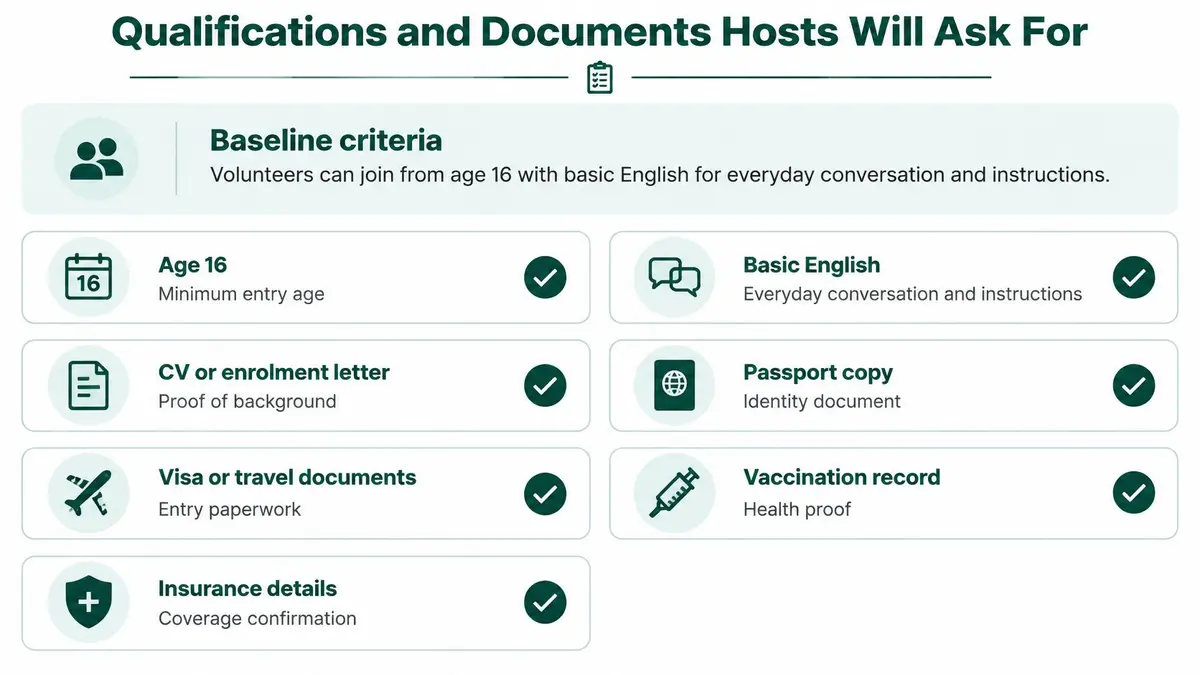
Passport copy, visa or entry paperwork, vaccination record and insurance details come next. Most general placements need no previous volunteering experience. Healthcare projects usually ask for relevant studies or practical skills, because those papers are what a supervisor uses to decide which tasks stay closed to you.
Students
Bring an enrolment letter or student ID from a recognised course so the host can see what stage you are at. Add a letter from your tutor or course supervisor that states what you are competent to do and what you are not. That letter is the boundary the placement should not cross.
Keep a current first aid certificate in the same pack. Check the expiry against your return date. A certificate that lapses mid-placement leaves you unable to assist in the one situation where that skill is the task you were cleared for. The HLTAID011 renewal requirements explained guide covers how long a certificate stays valid in the Australian system, which is useful if you are training there.
Licensed professionals
Send a copy of your professional registration or licence, evidence of indemnity insurance, and references.
HeyLocals requires staff and in-house volunteers in roles involving contact with children to provide criminal-records certificates covering each country where they lived for six months or more in the previous five years. That certificate rule applies to staff and in-house volunteers, not to every person who joins a placement. Projects are community-led, and in some cases they include contact with children and adults at risk.
Send the full set before the placement is confirmed, not after you have paid. A host that asks for credentials only late is usually a host that never uses them to fix your limits.
How to Prepare Before You Leave Home
Preparation is the part of a placement you fully control. Work through these eight steps in order and you'll arrive with fewer surprises than most volunteers.
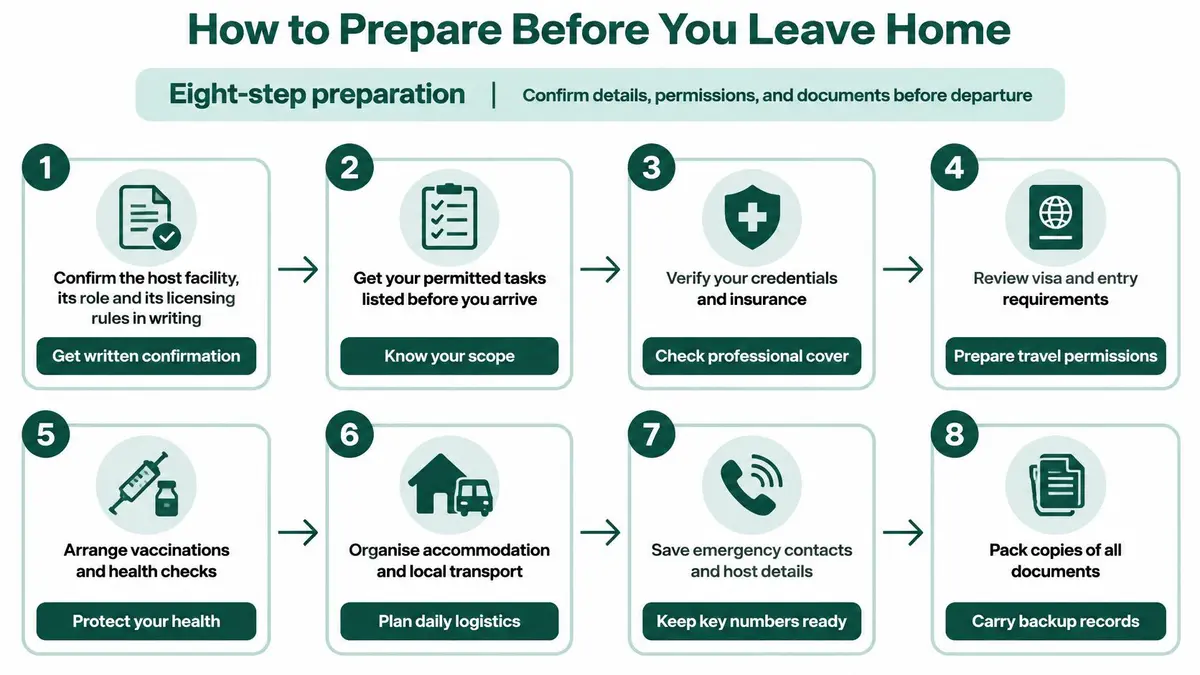
Confirm the host facility, its role and its licensing rules in writing. You need the name of the hospital or clinic, not just the country. The common mistake is accepting a confirmation email that lists a start date and nothing else.
Get your permitted tasks listed before you arrive. Ask for the sentence that says what you may do and the sentence that says what you may not. If the answer is "whatever comes up", you've found the first warning sign.
Verify your credentials and insurance cover against the destination's rules. Home indemnity often stops at the border, and host registration is a separate process from your own licence. Confirm both before you fly.
Check visa and entry requirements. Volunteer work and tourist entry aren't the same permission, and a host facility can't fix a visa problem once you're standing at arrivals.
Book a travel-health assessment and start vaccinations early. Some courses need weeks to complete, and a last-minute appointment is the one that gets missed when a placement date moves.
Arrange accommodation, local transport and insurance that includes emergency evacuation. Read the exclusion list. Cover that excludes your region is cover you don't have.
Learn the escalation chain, then take the briefing. Write down three contacts: the named in-country coordinator, the medical referral route and your consular contact. Our duty of care includes emergency response, medical assistance referral and consular liaison for participants, and local coordinators look after volunteers while they're on project. The briefing itself should cover cultural communication, vulnerable populations, infection prevention and psychological load, because CDC guidance for humanitarian aid workers notes higher risks from infectious disease, security threats and mental-health challenges for long-term overseas workers.
Plan the handover. Note what you'll leave behind, who continues it and how follow-up gets recorded. Placements that end in silence undo most of the good they did.
Two mistakes cost volunteers the most: buying evacuation cover that excludes the destination, and treating the pre-departure briefing as a formality. Neither is recoverable once you're on the ground.
Placement Examples and What Changes by Setting
The room you walk into sets the limits of your day more than the country on the ticket. A licence that lets you suture at home does not travel with you. What you may do is the task the host has already assigned, under a named person who stays after you leave.
Structured programmes show the pattern. In 2024, Health Volunteers Overseas facilitated more than 300 volunteer assignments and trained thousands of healthcare providers. That scale works like a teaching-hospital rotation: supervision, repeat relationships and teaching, rather than a visitor-run clinic that closes when the plane leaves.
A rural clinic in Palawan
On Medical support in rural Palawan, you support community health through village visits, health education and practical tasks alongside the local team. Your role matches your training and is supervised by local staff. The named supervisor is the clinician or community health lead running that day's visit.
You may take histories the team has asked for, help with health talks they have written, and handle stock or records. You may not start a procedure the clinic cannot finish or follow up. Equipment is limited and referral distances are long, so the useful work is often the routine a stretched team cannot reach. The warning sign is a placement that promises procedures the clinic has no equipment or follow-up to support. A concern goes first to that local supervisor, then to the named in-country coordinator. The handover owner is the host clinician who will still be in the village next week.
A city facility in San José
If you have a healthcare background, medical volunteering in San José lets you get to know a local facility and support its staff. Studies, experience and the activities that suit your role are discussed before you confirm. Daily tasks sit inside the staff's workflow: preparation, observation, patient communication, stock and records.
You may not take an unsupervised caseload or change a treatment plan. The named supervisor is the facility staff member assigned to you. A placement that cannot name that person, or cannot describe those tasks until you arrive, is one to decline. Report a concern through the facility's own route the same day, and tell the in-country coordinator. Handover belongs to the ward or clinic lead who owns the patient list.
A student observing and teaching
A student in a supervised clinic or a community school runs a narrower day: watching a licensed clinician, then delivering health education the local team has already approved. Health education work in Kathmandu is the model to study, because the lesson plan belongs to the local organisation, not to the volunteer.
You may observe, and you may teach only the session that was approved. You may not examine patients, give clinical advice, or rewrite the curriculum on the spot. If nobody can tell you which clinician is in the room and which classroom is yours, that is the warning sign. The classroom teacher or clinician is the supervisor. A safeguarding or clinical concern goes to that person and the in-country coordinator the same day. The handover owner is whoever continues the class after you fly home.
Ask one question of every placement: who is the named clinician in the room while I work? You'll learn in thirty seconds whether the answer was prepared in advance or invented in the moment.
When Something Goes Wrong on Placement
Something will go wrong. A patient deteriorates, a child discloses harm, a volunteer's own health fails. The procedure matters more than the intention.
A medical error or near miss. Stop and make the patient safe. Tell your named clinical supervisor immediately, record what happened and who was informed, and follow the host facility's incident-reporting procedure rather than your home organisation's alone.
A safeguarding concern about a child or adult at risk. Report it to the in-country coordinator and the host's designated safeguarding lead the same day, write a short factual note, and don't investigate it yourself.
A personal emergency. Use the chain you wrote down before departure: the named coordinator, the medical referral route, your consular contact. Check again that evacuation cover includes where you are.
The reporting rule: report early and report to the host first. A volunteer who reports late, or only upward to their own organisation, removes the people who can actually act.
There's a scope reason behind all three. Short-term visitors may be unable to interpret delayed test results, manage complications, or provide follow-up after departure, so any concern about a patient you've seen goes to the clinician who will still be there next week. That's continuity, not hierarchy.
Before you leave, settle one question: who owns the follow-up, and how is it recorded? A concern handed to a person without a note attached usually disappears.
Confirm Your Role Before You Book
What may you do once you arrive, and who says so? A ward handover works the same way: the next person can act only on what is written down. Record the role in writing before you pay. Match your credentials to a row in the table at the top of this page, then ask any provider, ours or otherwise, to put the answers on paper.
The written description should name the role, the permitted tasks, and the prohibited activities. Clinical work needs a supervisor with a job title and, ideally, a name. Who is the named in-country coordinator, and what happens in the first hour of an incident? Ask what the host requires for licensing before you are near a patient. If a provider cannot answer that, the placement sits in a system nobody has checked. Ask for the safeguarding and incident-reporting procedure, including who receives the first report. Ask who owns unfinished work when you leave, and where that handover is recorded. A placement without a named successor leaves patients with an unfinished story.
Read the ethics of volunteering abroad before you sign anything. A provider's answers tend to show how it treats local partners. A consensus-based framework for short-term global health work sets out similar requirements: recruitment and preparation done properly, continuity, compliance with legal and ethical standards, routine evaluation of impact, and mutual learning with local professionals. If a placement cannot describe its handover, it fails most of those at once.
Travellers can find a suitable HeyLocals volunteer project with the 'Find my project' tool, which matches placements to interests and dates. People with a healthcare background who want to compare options should look at the medical and healthcare projects, where the activities that suit your role are discussed before you confirm.
If your credentials do not match the role, choose a non-clinical placement or wait until you are licensed. Accept only a clinical task that has been assigned to you. Host staff trust a volunteer who stays inside that scope with more of the work that fits it.
HeyLocals arranges medical and healthcare placements with local partner organisations across Asia, Africa and Latin America, and it confirms the activities that suit your training before a booking is made. If you want the details settled before you pay, its team will talk through your studies and experience, the named coordinator on the ground, and the handover arrangements at the end of your stay. Start with HeyLocals to find a placement that matches what you're licensed and prepared to do.
In this article
- Table of Contents
- Medical Volunteer Roles at a Glance
- Why the Health Worker Shortage Shapes Every Placement
- Qualifications and Documents Hosts Will Ask For
- How to Prepare Before You Leave Home
- Placement Examples and What Changes by Setting
- When Something Goes Wrong on Placement
- Confirm Your Role Before You Book