Vietnam One Week: A Practical Route and Planning Guide
Plan a Vietnam One Week trip with realistic routes, travel times, entry checks and a volunteer week in Ho Chi Minh City.
You have seven nights, a return flight half chosen, and a saved list with Hanoi, Ha Long Bay, Hoi An, Ho Chi Minh City and the Mekong Delta on it. The list is the problem. Every long leg on it spends a day you don't get back, and the week disappears into airports, check-ins and road transfers. For Vietnam one week, the map is the trap.
I plan short itineraries by counting transfer days first and attractions second. Seven nights buys one region done well, or two regions with a single flight, or a lot of waiting around with a suitcase. The routes below are ranked by what they cost in travel time, not by how many sights they tick off. The right question isn't "What can I see?" It's "What am I willing to sacrifice?"
Table of Contents
Compare One-Week Routes by Travel Time
| Route | Structure | Main travel time | Best for | |---|---|---|---| | Hanoi, Ninh Binh and Ha Long Bay | Hanoi base with one cruise night | Short road transfers only | Northern culture and scenery | | Hanoi and Hoi An | One domestic flight | About 1 hour 15 minutes (Hanoi to Da Nang) | Culture with coast | | Ho Chi Minh City base | One base with day trips | Day trips only, no long transfer | Volunteer placement or slow pace | | Hanoi to Ho Chi Minh City by rail | Overland north to south | 32 hours 45 minutes to 38 hours 26 minutes | Not advised for one week | | Hanoi to Ho Chi Minh City by air | Two cities, one flight | About 2 hours plus airport time | Contrast between two cities |
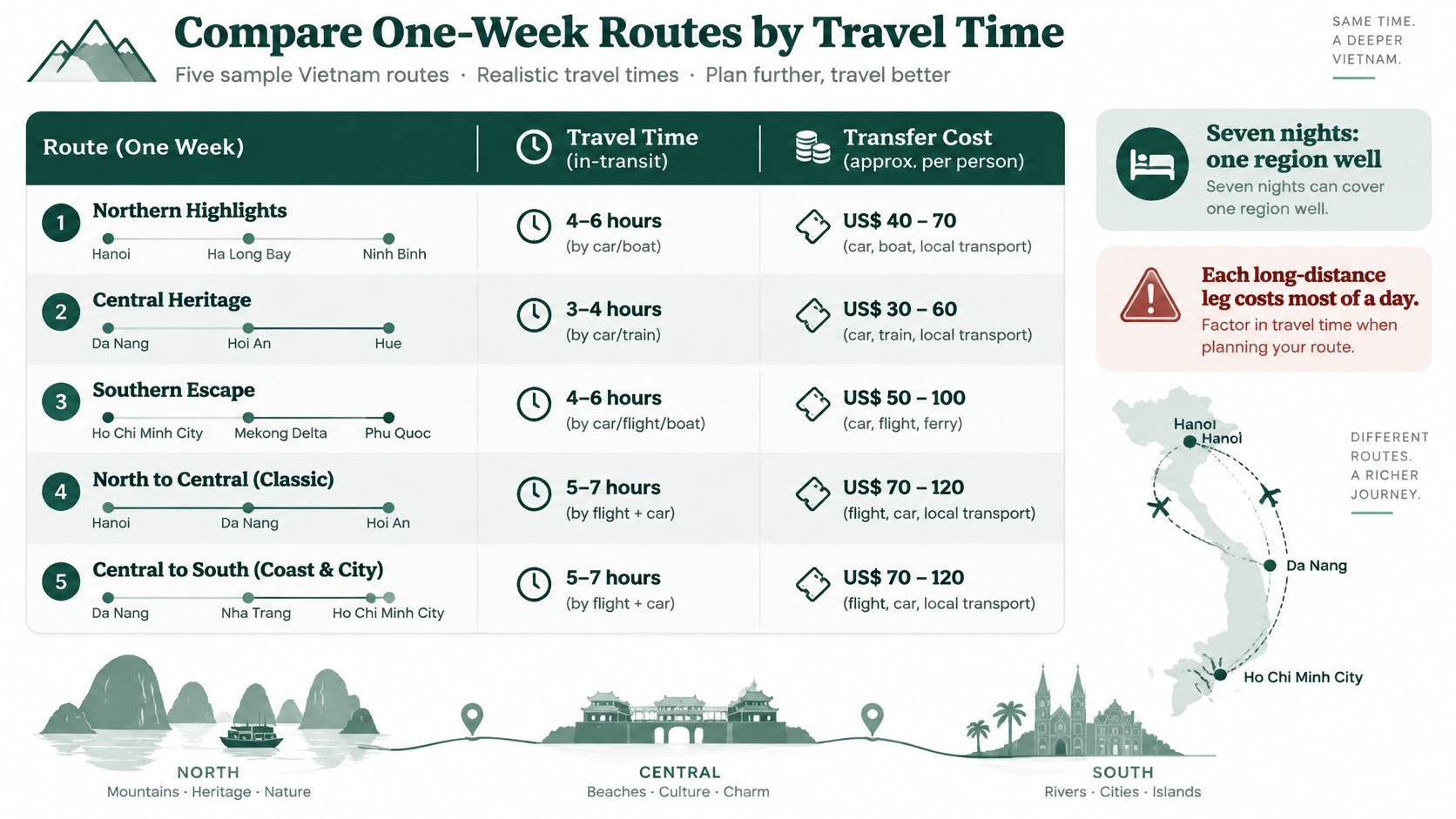
The rail row is the one to read twice. The Asia Vela guide to a first Vietnam trip gives the north-south train as 32 hours 45 minutes to 38 hours 26 minutes, against about 1 hour 15 minutes for Hanoi to Da Nang by air. If you're going all the way to Ho Chi Minh City, Vietnam Authentique's one-week route notes put the flight at about two hours before you count airport transfers and check-in. That gap explains most failed itineraries.
Why the northern loop works
Hanoi, Ninh Binh and Ha Long Bay is the route I'd give most first-timers. You sleep in Hanoi or nearby, take short road transfers to Ninh Binh, and spend one night on a bay cruise. No domestic flight, no second hotel every night, and the culture and scenery are both in the north. The trade-off is obvious: you see one region, not the country.
Hanoi plus Hoi An is the compromise for travellers who want coast with their culture. One flight does the work. Anything more than that and you're buying a second transfer day, which is where the week starts to feel like a logistics exercise.
Ho Chi Minh City as a base is the right shape for a volunteer placement or a slow city week. Day trips to the Cu Chi Tunnels or the Mekong Delta fit around fixed activity days. You don't need a long transfer at all, and you get to know one city instead of photographing four.
Hanoi to Ho Chi Minh City by air is a contrast trip. Two hours in the air looks cheap until you add the transfer to the airport, the check-in buffer, the arrival transfer and the fatigue. It works when comparing the two cities is the point, not when you're trying to "see Vietnam".
If you're adding this week to a work trip, the guide to planning business trips faster is worth reading before you book the internal flight. It treats transit as work, not recovery, which is how a one-week route should be costed.
Decide what you want from the week: nights in one place, minimal travel time, or contrast between cities. Choose the row that matches. If no row matches, the plan is too big for seven nights.
How to Pick One Base and Limit Transfers
A one-week itinerary fails when it has more bases than rest days. The fix is mechanical: one anchor, one long transfer, buffer time, fewer hotel changes. I use four steps with every short trip, and they work whether you're volunteering, travelling as a family or carrying a laptop.
Choose one geographic anchor. Pick the region where most of your nights will fall, usually Hanoi for the north or Ho Chi Minh City for the south. Treat that city as home base, not as a place you pass through. Book accommodation there for the majority of the week.
Allow one long transfer, not two. A seven-day trip can absorb one domestic flight. A second long leg eats a sightseeing day and a rest day. It also doubles the chance of a delay that ruins the next booking.
Reserve buffer time around flights, cruises and weather-sensitive trips. Leave a spare half day before the flight home. Never book a boat trip on your only free afternoon. Weather, traffic and check-in queues don't negotiate.
Limit base changes to two or three. Switching accommodation every night costs more energy than the extra stops return. Every check-in is a bag repack, a key handover and a new set of directions.
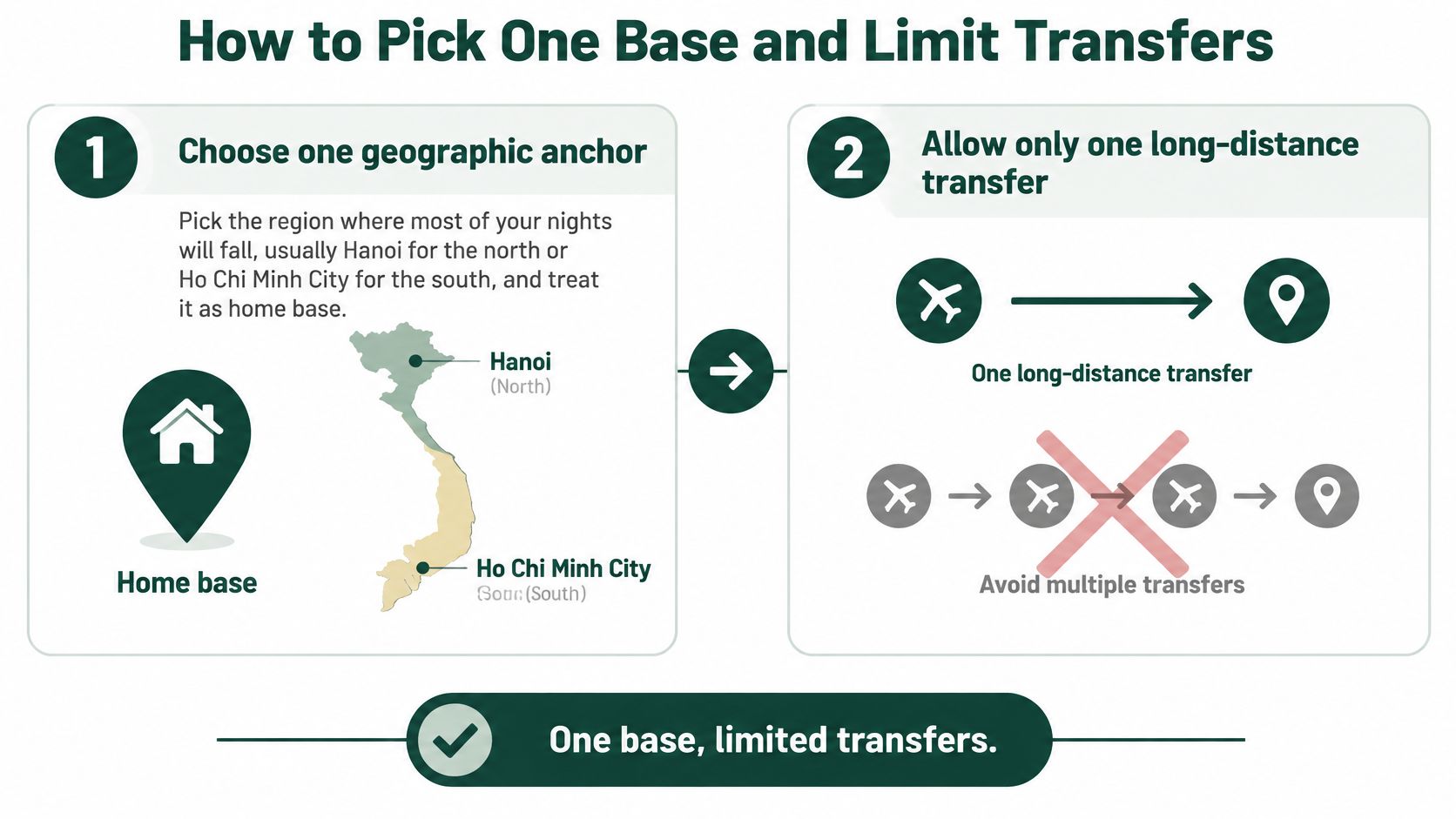
Then apply the rules that follow from the choice. One region suits slow travel. North and central Vietnam works only with one flight, as in Hanoi plus Hoi An. North and south makes sense only when contrasting two cities matters more than settling in anywhere. If you need a flight to make the route work, count the airport hours as a half day, not a line on a map.
The cut-a-stop test: if the route needs more than one transfer day, remove a stop before you book anything. A shorter route you can enjoy beats a complete route you survive.
Packing lighter makes the base-change rule easier. How to pack lighter for flights is the practical version: one bag you can carry up three flights of stairs, not a suitcase you negotiate with at every check-in.
Weather and Crowds Across the Regions
Weather is regional, so the forecast that matters is the one for your base. A week that's pleasant in Hanoi and Ninh Binh can be wet or storm-affected in central Vietnam or the south. That's why a fixed seven-day route shouldn't be treated as universally suitable.
The Vietnam National Authority of Tourism reports that arrivals reached 21.2 million in 2025, 20.4% higher than in 2024, that accommodation-search interest rose 49% for Phu Quoc, 26% for Ho Chi Minh City, 25% for Da Nang and 23% for Hanoi, and that 55% of travellers choosing quieter destinations want to avoid contributing to overtourism, while 63% of those travelling outside peak season want to reduce pressure on destinations.
Check the seven-day forecast for each base in the week before departure, not only the monthly average. Keep one indoor option per base: a museum, a cooking class, a market walk. Schedule the weather-sensitive outing mid-week, so a washed-out Tuesday still leaves a backup day. Ha Long Bay cruises, trekking, cycling and beach time are the first activities to be disrupted by heavy rain, flooding, landslides or typhoons.
Busy stops fill fast. Moving dates by a few days or swapping a crowded stop for a quieter one can reduce pressure without losing cultural value. That's the practical response to growth, not another list of the same five attractions.
The substitution rule: if rain would cancel your main outdoor activity, which stop can become an indoor one without losing the reason you came? If there's no answer, you've built a weather-dependent week.
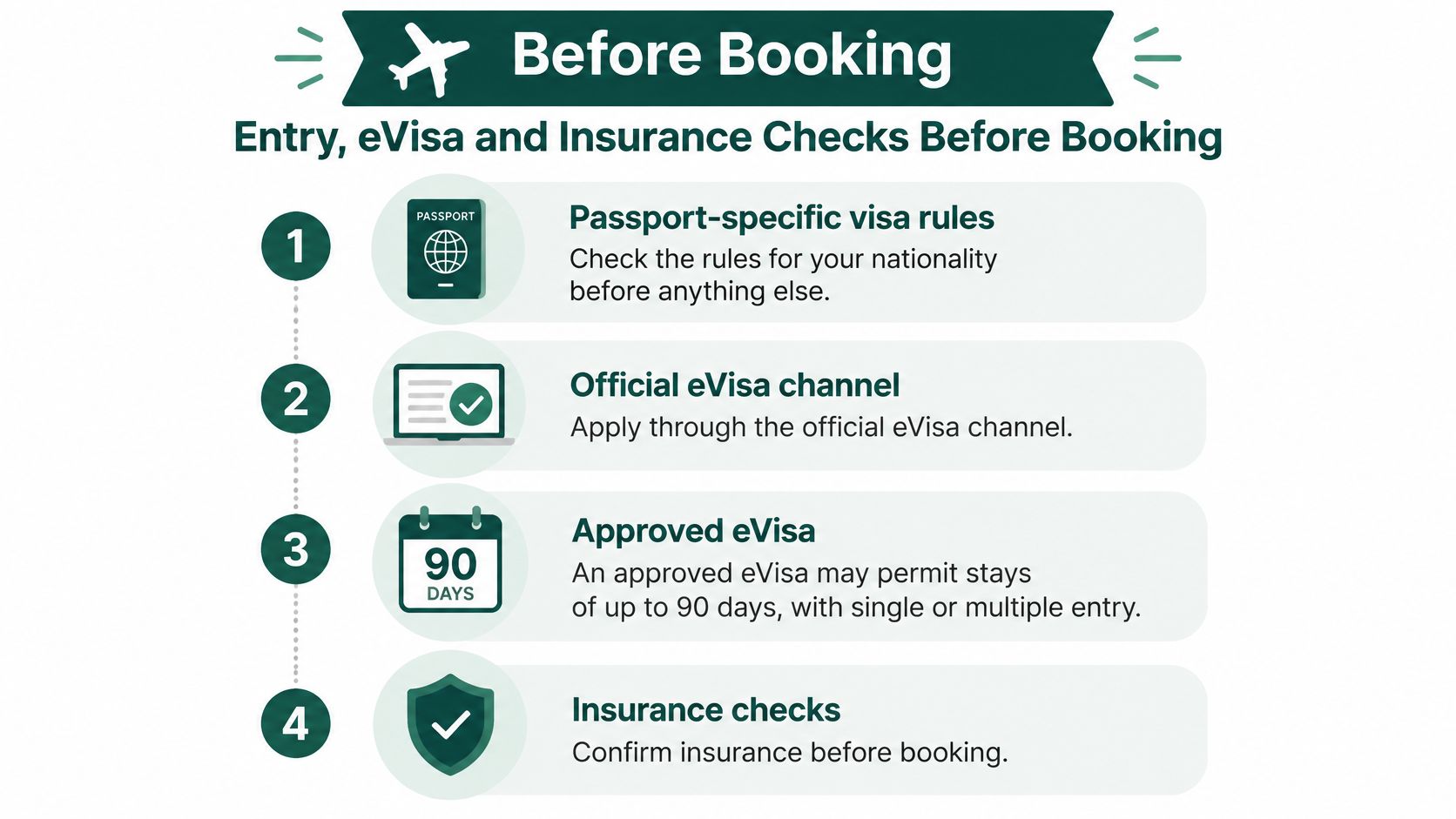
Entry, eVisa and Insurance Checks Before Booking
Paperwork is part of the route. A visa error, an uninsured clinic visit or a missed declaration can wipe out the week faster than a delayed train. Start with Smartraveller's Vietnam travel advice, which sets out that an approved eVisa may permit stays of up to 90 days, with single or multiple entry depending on the authorization, and that air arrivals may need a digital pre-arrival declaration within a three-day window.
The seven checks
Verify passport-specific visa rules first. Nationality, passport validity and entry point all matter. Don't book flights until you know which visa you need.
Apply through the official eVisa channel. Third-party sites add fees and introduce errors. The approved document tells you whether entry is single or multiple.
Check every field and carry a printed copy. A misspelt name or wrong passport number can cause problems at airline check-in or at the border. Save a PDF offline as well.
Complete the pre-arrival declaration if it applies. Do it inside the permitted window, not at the airport on unreliable wifi. Rules depend on current entry requirements and your nationality.
Build a weather contingency into the booking. Heavy rain, flooding, landslides and typhoons can disrupt flights, roads, phone service and excursions. Keep one flexible day and know your cancellation terms.
Buy travel insurance for medical treatment and evacuation. Lost luggage cover is not the point. If you're volunteering, volunteer abroad insurance explains the cover to check before you commit.
For adventure activities, verify the operator. Confirm licensing, equipment, safety briefings and route markings. Inspections and staff certification are not consistently assured.
The failure mode
The common failure is planning only the itinerary and ignoring the administrative and weather dependencies. That turns a short trip into a schedule disruption. Check the official entry rules on the day you book, since requirements change between planning and packing.
How a Volunteer Week in Ho Chi Minh City Runs
A volunteer week isn't a sightseeing week with a morning of charity attached. In Ho Chi Minh City, the published kindergarten schedule is the clearest example of how the seven days run. The kindergarten-support project accepts stays from 1 week and runs departures every week throughout the year, except during holiday closures, as HeyLocals's Vietnam destination guide sets out.
Monday is orientation and settling in. You cover culture, safety, house rules, local transport and daily life, and you meet the coordinators. Project work begins on Tuesday. From Tuesday to Friday, you support kindergarten educators through games, songs, first English words, lunchtime assistance, childcare routines, storytelling, creative workshops and sport.
The daily shape
| Time | Activity on each project day | |---|---| | 07:30 | Breakfast and coordinator meetings | | 09:00 | Morning kindergarten activities | | 11:30 | Lunch and childcare support | | 14:30 | Afternoon activities | | 17:30 | Preparation with local coordinators |
A one-week stay includes induction plus four scheduled project days, not five full days of placement work. Count the travel and induction in the schedule from the start. Weekends have no set activities, so use them to explore the city or take a short trip. Food distribution follows a similar pattern: Monday induction, Tuesday to Friday project work, weekend personal time.
This is a labelled sample week, not a testimonial. No documented host assessment of a particular one-week stay was available, so use the schedule to plan, not to assume an outcome.
What the local team needs from you
Arrive in the agreed window, attend orientation, join the regular task on each activity day, and hand over before you leave. That's the arrangement that lets a short placement be useful rather than disruptive. Before departure, you complete our online pre-departure safeguarding module, a briefing call with an in-country coordinator, and a written acknowledgement of the Code of Conduct. Our local team members are listed in Cambodia, Vietnam, Bali and Arusha, and the Vietnam coordinator is the person who confirms activity days.
If you'd rather work with older learners, English teaching in Ho Chi Minh places you alongside local teachers helping young adults practise English for tourism and hospitality. Hospital and disability placements have separate role and eligibility checks, so don't treat them as interchangeable with the kindergarten or food-distribution week.
Confirm Activity Days and Dates Before You Book
Before you pay for a bus, a flight or a cooking class, ask the coordinator one question: which days are activity days for my week? Get the answer in writing, then check the live offer for minimum duration, age, role, language requirements and inclusions. These details change, and the live listing is the source of truth, not a price you saw somewhere else.
Volunteering in Vietnam, in Ho Chi Minh, costs from US$860. Confirm what the current offer includes, such as placement, accommodation, meals and airport transfers, before you compare it with a DIY week. Our packages combine the placement, accommodation, in-country coordination and transfers, with meals as described in the destination guide.
Don't assume a disability or hospital placement follows the kindergarten or food-distribution schedule. A Hospital placement in Ho Chi Minh is a separate clinical placement: you see the Vietnamese health system up close, work alongside professionals on the wards and follow its own role and eligibility checks. The published kindergarten schedule confirms fixed weekday morning and afternoon duties, with weekends left free.
For the participant check, complete the self-declaration in your personal area. Keep parental consent and professional qualifications separate, because they're different checks, not one combined permission slip. If you're under 18, a parent or guardian is involved. If you're applying for a clinical role, qualifications are assessed separately.
Write down your dates, activity days and travel time. Compare them with the route you chose. Keep sightseeing close to the base and around the agreed activity times. If you're adding sightseeing, volunteer on vacation is the right planning mindset: the placement sets the timetable, not the other way round.
The one next step: ask the coordinator for the activity days for your chosen week before booking anything.
If you want a week that gives you a real role instead of a series of transfers, HeyLocals arranges volunteer placements in Ho Chi Minh with accommodation, meals as described, airport transfers and local coordination. You can compare projects, check what each week includes and confirm the activity days before you commit to flights. Visit HeyLocals to find the placement that fits your dates and skills.