Volunteer on Vacation: Plan Project Hours and Free Time
Learn how to plan a volunteer on vacation trip around project hours, travel time and free time, with clear inclusion checks.
You have two weeks that finally line up, a destination you keep picturing, and a project that sounds like it would use the days well. You want a temple morning, a market, or time by the water. You also do not want to discover, after you land, that the hours you agreed to give were treated as optional.
That is the practical problem of a volunteer on vacation. Plan the fixed project time first. Free time is whatever remains after the activity hours, the preparation, the journey to the site, and the return time in the house rules. Some afternoons open up. Some do not. A night shift can take the next morning with it.
There is room to enjoy the place without dropping the work. The point of travelling with HeyLocals is a chance to join work that local organisations already run, with practical support around the placement, and still meet everyday life where you are staying. The holiday sits in the time left.
Table of Contents
Set Boundaries That Keep Your Trip Purposeful
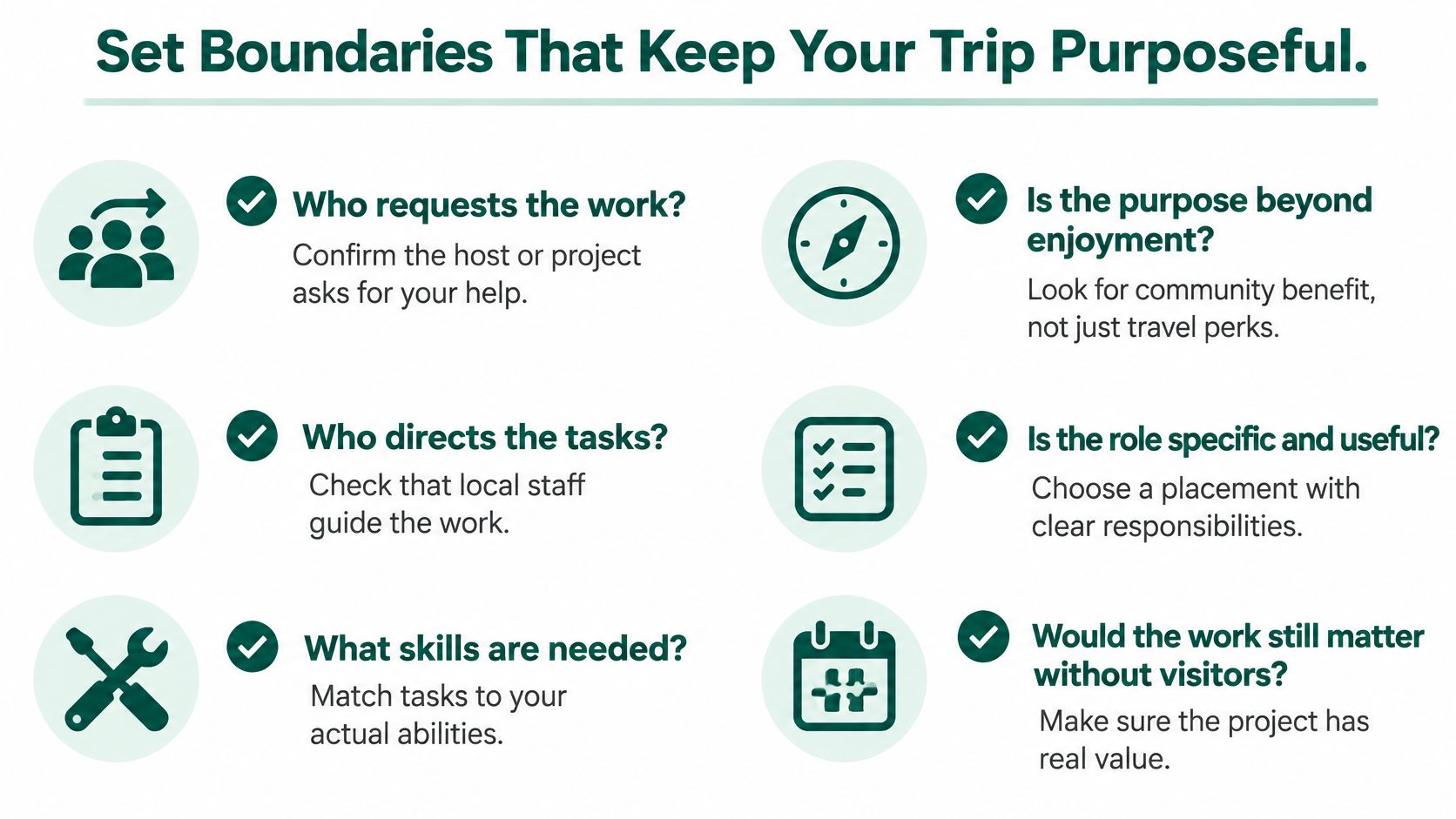
Test a warm description against the role it gives you. Before you look at beaches or day trips, ask four things. Who requests the work? Who directs the tasks? What skills are needed? How does a short-term participant fit a programme that is already going?
You join a project that is already running rather than one built around your visit. Local people set the problem, the timetable and the standards, and you help where that help is useful, with what you can offer. A realistic contribution is preparing materials, completing an assigned care routine, or helping staff with a practical task they have defined. That is the shape a useful week takes.
What a short stay can do
Short-term volunteering does not replace professional care, and participants never act as substitute parents, primary teachers or sole care-givers. Childcare and education placements, where they exist, keep qualified local staff in charge. You do not take a class alone, and you do not become the person a child relies on for the week.
Wildlife placements follow the site's rules on distance, feeding and handling. A well-run project builds the day around the animal's routine, and holding one for a photograph has no place in it. Safeguarding works the same way. Supervision stays in place, consent and photography have rules, and unsupervised contact with children or adults at risk is prevented, because some HeyLocals projects involve that kind of contact. For safety reasons, you must declare any criminal record. That declaration is a required step, and on its own it does not make a child-focused role suitable for you.
Attendance is part of the agreement. If you cannot make a shift, tell the local coordinator who looks after you on the project before the day, and the host already knows who covers the task. The work should still matter on a week when no visitor arrives.
Ask this before you pay:
Request: Who asked for this help, and would the activity continue without visitors?
Direction: Who assigns today's tasks, and who stays with you while you do them?
Skills: Which abilities does the role need, and which tasks are closed to short stays?
Limits: What are the rules on children, animals, photos and time alone with either?
Absence: What happens if you miss a shift, and who covers it?
A useful pause: If the listing leads with how close you will get to a child or an animal, the purpose is the visitor's experience. Choose a different project.
Choose a Placement That Leaves Room to Explore
A placement in a city gives you one kind of free afternoon. A placement on an island gives you another. Before you compare what you could visit, compare what the calendar leaves open, because the same week can hold very different amounts of usable time depending on where you sleep and what the work asks.
Most projects do not ask for prior volunteering experience. You can join from the age of 16, and a basic level of English is enough to manage everyday conversations and understand instructions. Those are entry conditions. The hours you will have depend on the setting itself.
Use the same three checks everywhere: the project calendar, the house rules, and the return times. Then add one question that belongs to that particular place.
| Setting | Free-time pattern | What to check | | --- | --- | --- | | Kandy | Temples, markets and nearby hills can fill time outside project commitments | Project calendar and return times before planning day trips. Ask whether this afternoon's return still leaves a local outing. | | Bali sea turtle conservation | Conservation routines alternate with island downtime | Shift pattern, night duties and transport time to other parts of the island. Ask whether tomorrow morning is a recovery block. | | Palawan | Local daily life close to the placement; island trips need a boat and time | Transport options and whether the calendar's days off allow the trip. Ask if the journey fits inside the confirmed days off. | | Zanzibar | Beaches and historic towns draw visitors, but distances on the island add up | Whether the specific site runs weekend or night shifts. Ask for that month's shift list, not a typical week. |
Kandy puts temples, markets and the nearby hills within reach, so a short outing can sit beside the day's commitment once the return time is confirmed. The Bali sea turtle work follows the animals, and the animals keep their own schedule. A beach on the far side of that island takes real travel time. Palawan works the same way on a smaller scale: the village next to your accommodation is a walk, and anything further is a boat and a plan. In Zanzibar the coastline looks close on the map, yet distance there is measured in hours.
Weekends are free on many programmes, though a conservation shift can still fall at night or run across Saturday. Read the shift list for your actual dates first, then let the holiday grow inside the gaps the project has already confirmed. If the calendar does not show the afternoon clear, that outing waits for a day that does.
Map Your Project Hours Before You Book
Start with the project calendar. Every other part of the trip hangs on it, including the afternoons you hope to keep.
Work through the dates in this order.
Write your travel window, including any day you cannot commit because of a flight, a family plan or a late arrival.
Ask for the activity hours, the preparation expected, and the return times for those exact dates.
Add the journey from where you sleep to the site and back, then block rest, especially after an early start or a night duty.
Build a total budget that keeps project inclusions apart from excursions, entry fees and recreational transport.
Confirm accommodation, meals and transfers in writing before you choose any outing.
Agreed activity hours are the set project time on that calendar. Preparation covers materials, briefings and handover, and it may sit outside the hours you first pictured. Travel to the placement is part of the working day even when nobody calls it a shift. A house rule can end the evening early on a day that looked open. Rest is a planned block, not a leftover you hope appears.
| Time block | What it covers | What to confirm before booking | | --- | --- | --- | | Agreed activity hours | Set project hours on the placement calendar | Exact start and end times, and whether they change by day | | Preparation | Time for materials, briefings and handover before a task | Whether preparation counts within activity hours | | Travel to the placement | Journey from accommodation to the project site and back | Travel time and any transport the programme provides | | Required return times | Evening return or curfew set by house rules | Return times written in the house rules | | Rest | Recovery after early starts or night duties | Rest days built into the calendar | | Free time | Hours outside project commitments | Which afternoons and weekends are free in your chosen month |
Add the hours that are easy to forget
Write the weekly committed hours, then add preparation and the return journey. Only then look at what is left. A short day disappears quickly when the site is forty minutes away and the briefing starts before the task. The other common slip is assuming a paid excursion is covered because it appeared in a photo.
If an answer is vague, ask for the calendar rather than a summary. Local coordinators look after you while you are on the project, and it helps to know what volunteer coordinators do before you arrive. They are the people who walk you through the day's tasks, the boundaries and the time you are expected back.
If the free-time answer is "you'll have plenty," ask which afternoons in your month are actually unassigned.
After you describe who is travelling and what you need, HeyLocals and the local organisation check whether the project is a good fit and arrange your trip. That check comes before you lock excursions around a timetable you have not seen.
Sort Included Activities From Paid Excursions
A temple tour appears in a project photo, a boat ride gets mentioned in a welcome email, and both land in your plans as though the programme were paying. That assumption is where trip costs unravel. Before money moves, split every item into three piles: included project activities, included support, and separate costs.
A typical package covers the volunteer placement with its assigned activities, accommodation for the period you booked, meals as described in the destination guide, and airport transfers on the start and end days. What sits inside that frame changes from one destination to the next, because each local organisation hosts volunteers according to its resources and the project's needs. The page for your placement is the reference that counts.
Paid excursions deserve a second look. A tour runs on its own schedule, and a full-day trip booked midweek can collide with your activity hours or the evening return set by house rules. Ask for a written inclusion list and check each line against it before you commit.
Questions worth asking before you pay:
Which dates do the accommodation and meals cover, and which meals are included on working days?
Are airport pickups and drop-offs confirmed against my flight times, or only available within certain hours?
Who runs each excursion, and is it part of the programme or sold separately?
If an organised visit is included, are entry fees for temples, parks or beaches part of it?
Is transport to other areas provided for project purposes, or priced per trip?
On a placement such as Volunteering at a soup kitchen in Seoul, the included work is the shift with the team: prepare ingredients, help with service and clear up afterwards. Time in the city afterwards is free time, and a booked tour is a separate purchase. Travellers weighing alternative spring breaks need the same discipline, because a short trip still carries fixed project hours.
Treat silence as an answer. Anything the inclusion list does not name belongs in the extra column of your budget, and if the page stays quiet about an item, price it yourself before you book.
A Sample Week That Balances Work and Rest
Sample rhythm, not a timetable. Use it as a shape to test against your project calendar, not as a promise of free afternoons. The pattern only works because the fixed hours are placed first.
Say you have already agreed a weekday role. You leave one preparation session in the week rather than hoping briefing time appears. You take one nearby free outing. You plan a larger trip only on days the programme has confirmed as off.
A typical weekday runs like this. Breakfast at the accommodation. A morning activity block of about four hours, where you prepare materials or complete an assigned care routine alongside staff. A midday break. A free afternoon for a nearby walk or a market, only if that afternoon is unassigned. An evening cut short by the return time in the house rules. The outing stays close because you have not been promised a long gap.
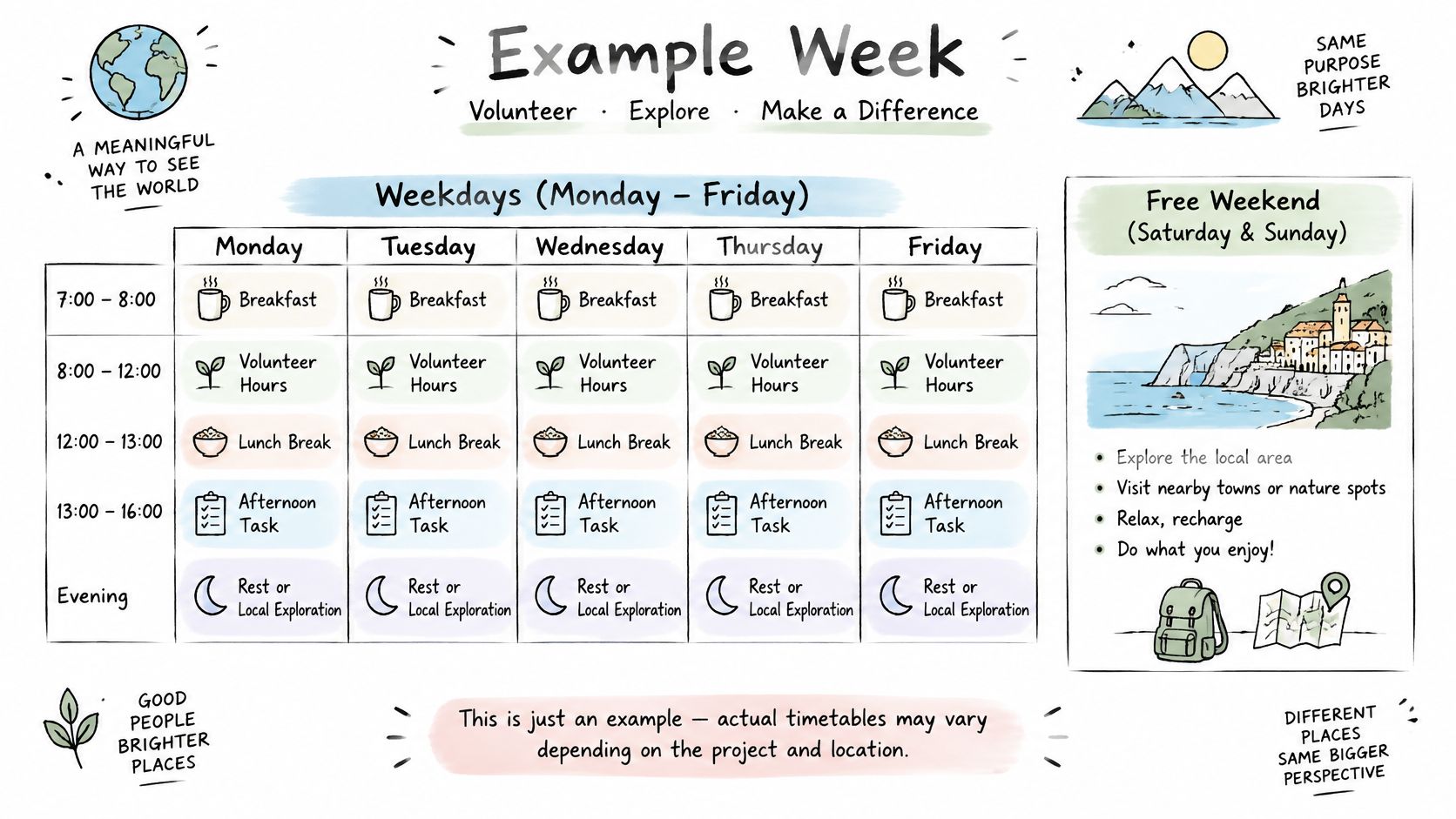
Monday to Friday keep that shape, with the preparation session sitting on one morning before the task. One afternoon holds the nearby outing. Saturday and Sunday are the only days you consider a longer trip, and only after you have seen those days marked free on the project calendar. If Sunday night has an early return because Monday starts early, you come back in daylight. That is the whole trick: the holiday fills the gaps the schedule leaves, never the other way round.
When the shift runs at night
Conservation work often refuses that daytime picture. The marine turtle community monitoring guidelines say night patrols are most effective, particularly during peak nesting seasons, and recommend that patrols begin about two hours after sunset and continue until early morning. On a turtle placement in Indonesia, such as Bali, the work is seasonal and shift-based, so a realistic variant is a scheduled night patrol, a recovery morning, and local downtime on a non-patrol day. Sleep becomes a fixed duty too, and the day trips shrink accordingly.
The same habit you use to build a healthier work-life balance applies on the trip. Fixed duties go on the calendar first, and rest is scheduled, not squeezed into whatever is left. This sample assumes a weekday role, one preparation session, one nearby outing, and a weekend the programme has already marked free. Your own week starts from whatever the project calendar confirms, so check it before you book.
Choose the Routine You Will Follow
Bring one list to every project page you open. Dates. Real activity hours. Travel time to the site and back. Total budget, with extras in their own column. Accommodation. What is included, and the dates that inclusion covers. The list works like a filter: if the free time left is too thin for the holiday you want, choose a different week or a different placement rather than trimming project hours to make a tour fit.
HeyLocals supports volunteers before, during and after their trip, and the Find my project tool matches what you care about to dates that work. Once you have a shortlist, read each project's calendar, inclusions and return times on its own page instead of copying them from another destination. Students weighing a term away from campus can browse gap semester ideas and then come back to the same list, because a longer stay still needs fixed hours and a clear inclusion line.
Pick a routine you would enjoy following. A morning task, a quiet afternoon nearby, and one bigger outing on a confirmed day off is an honest week. A timetable that puts the project first and the sights second is the one to keep, because the hours you protect are the reason the trip exists.
HeyLocals arranges volunteer trips with local organisations so you can join work that is already running, with support before you go and while you are there. If you want project hours and real free time in the same fortnight, open a live placement on HeyLocals and confirm what its days look like before you commit.