Travel for a Purpose: How to Choose Meaningful Projects
Learn how travel for a purpose works in practice, from everyday tasks and project types to the questions that show whether your help is useful.
You've probably got a few tabs open right now. One is a school that runs afternoon English clubs. One is a coastline with a turtle hatchery. One mentions "medical support" in a way that's either exciting or alarming, and you can't tell which from the photos. The question you want answered isn't which one looks best. It's whether showing up for two or three weeks would help anyone other than you.
That question deserves a slower answer than most volunteering pages give it. Interest in purposeful travel is widespread, but intention and action don't line up neatly. In a Trip.com Group survey of 9,867 travelers across 109 countries and regions, 92% said they were interested in sustainable travel while 56.9% said they had actively practiced it, as TravelPulse's summary of the Trip.com Group sustainable travel report sets out.
The gap isn't hypocrisy. It's a design problem, and it's solvable with better questions before you book. What follows is how purpose looks once you're on the ground, the five checks that separate useful work from a meaningful feeling, how the main project types differ in daily tasks, where expectations drift, and how to handle child-facing work without adding to the risks.
Table of Contents
What Purpose Looks Like Once You Arrive
Say you join a school that already runs an afternoon English club. That's an illustrative scenario rather than a report of one particular trip, but it's the shape most placements take. Your first morning isn't a welcome ceremony. You sit at the back, watch how the teacher moves between tables, learn where the materials live, and discover the club has thirty children, two staff and a cupboard door that everyone works around. Nobody hands you a curriculum. You're asked to prepare a vocabulary game for Thursday and to help two children who get stuck on the same words every week.
The classroom is a working environment, not a backdrop, and fitting into it is the job.
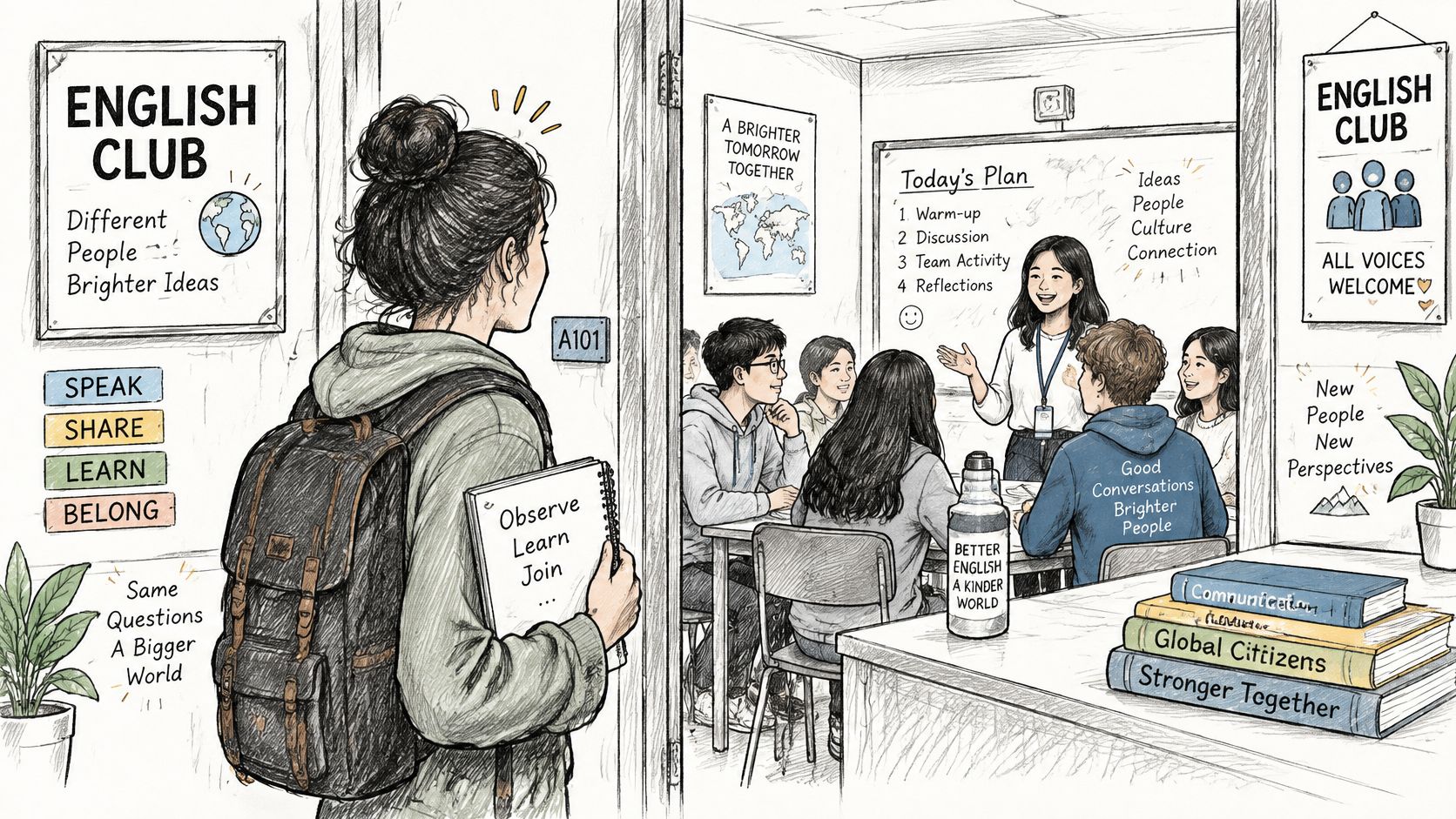
Keep both sides of that exchange visible. The host organisation asks for a contribution, and you learn from the people welcoming you. Every HeyLocals placement is a project that's already running, not one built around your visit. You're not there to rescue a community, and you're not there to design a new programme from a kitchen table at home.
Most of the sector works this way already. The UN Volunteers programme mobilized 14,631 volunteers in 2024, and 10,150 of them were national volunteers serving in their own countries, against 3,175 international volunteers serving abroad, supporting 59 UN partners across 169 countries and territories (UNV annual report 2024). The people who know the routine are local. You're the extra pair of hands.
Two everyday pictures show what that means. In education, you prepare materials and practise language while host teachers lead the session. In conservation, you work through a staff briefing, whether the task is monitoring, cleaning or recording.
The work is often repetitive. Its value shows in reliability, not drama: the same task, done properly, on the days you said you'd do it. A short stay does not by itself prove measurable social impact, and treating your presence as proof is where purpose starts drifting into performance.
The next check is narrower. Who defines the task, and can you do it well in the dates and hours you have?
Five Questions That Show Whether Your Work Is Useful
Feeling moved and being useful are different outcomes, and only one of them belongs to the host organisation. The United Nations' work on volunteerism frames it plainly: sustainable volunteerism strengthens trust, fosters cooperation and enables communities to participate actively in shaping their own development pathways. The same body of work argues that meaningful collaboration needs participatory approaches, not merely activities pushed down to a local level, and that priorities identified on the ground should connect to wider efforts while resources are decentralised to match local responsibilities.
That standard translates into five questions you can put to any placement, including ours.
| Question | Convincing answer | Weak answer | |---|---|---| | Who defines the need? | The local organisation names the task and keeps delivery | You arrive with a project you designed yourself | | Does your help complement local people? | You support paid or qualified staff who still do the skilled work | You replace a teacher, clinician or other paid worker | | Who supervises the day? | Named local staff assign and brief each task | Nobody briefs you, or you work alone | | What continues after you leave? | Staff or the next participant keep the same routine | The activity stops when you fly home | | How is feedback given? | Staff can say what helped and what to change | The only record is your feelings or a count of hours |
Keep these checks in view while you compare placements.
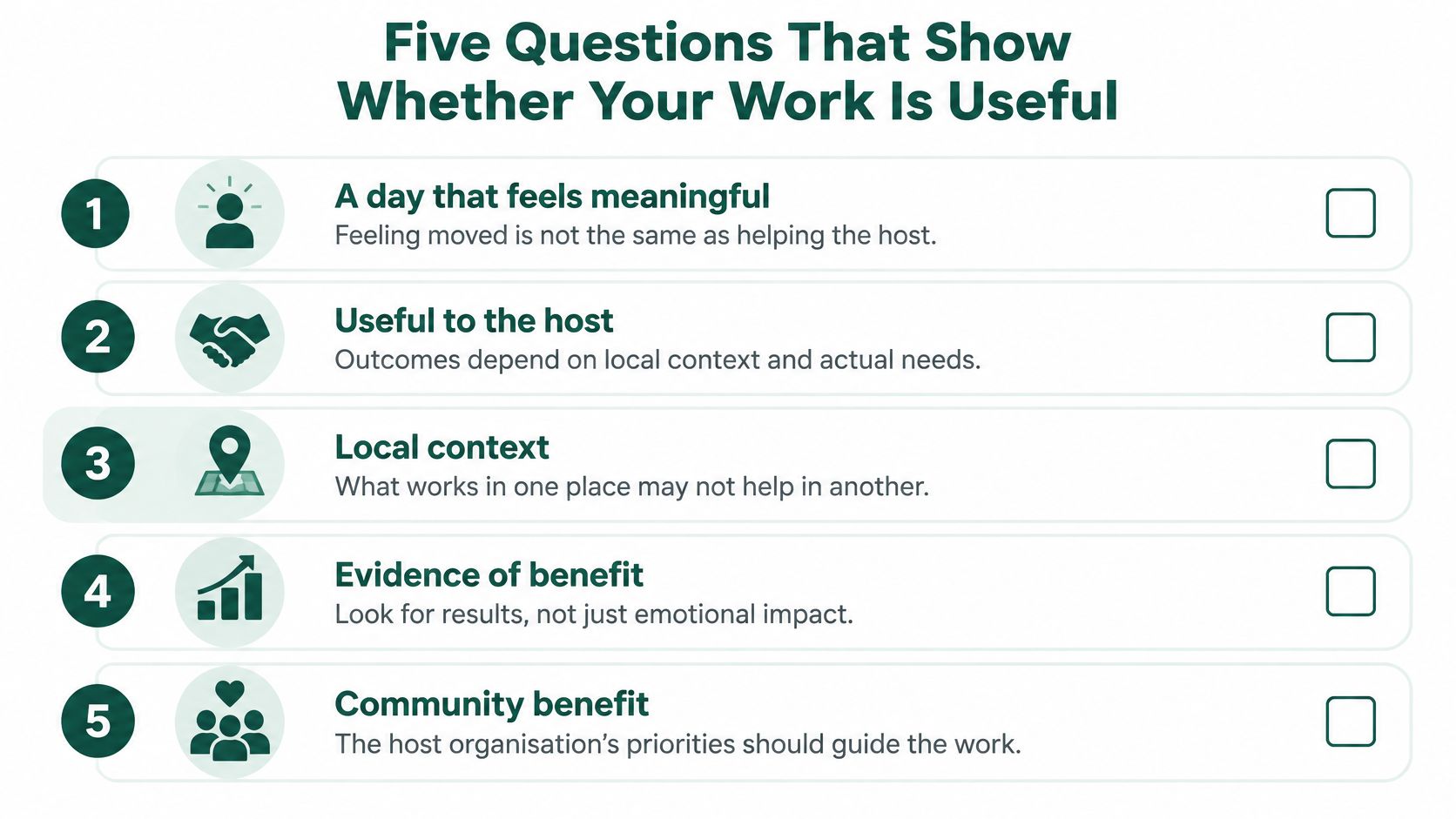
The first two questions carry most of the weight. If staff name the task, the project stays one project. If you bring your own programme, the host now has to manage two, and yours has no local history behind it. The second question is where most harm hides: preparing materials while a teacher leads is help, while taking the class because a teacher is absent is replacement, even when the class is grateful.
Supervision is the third test, and it's concrete rather than cultural. A named staff member briefs you each morning, checks the task midweek, and tells you what to adjust. Choosing your own tasks feels autonomous and removes the local judgement that makes a placement worth having.
Practical rule: if nobody at the project can tell you what they'd repeat and what they'd change after your stay, the placement has no feedback loop.
Outputs are where evaluation usually goes wrong. A two-year action-research project across Kenya, Mozambique, Nepal and the Philippines found that volunteering can build trust, confidence, agency, leadership and networks that help communities own and sustain solutions, and it treats partner-reported capacity gains and continuity after departure as more meaningful than activity counts (VSO and IDS report on volunteering in sustainable development). Lessons delivered, trees planted and clinic hours are easy to report and easy to overstate.
Once you describe who is travelling and what you need, HeyLocals and the local organisation check whether the project is a good fit and arrange the trip. Our guide to how we select projects sets out what we look at before a placement goes live.
Project Types Compared by Role and Preparation
No ranking of education, conservation, community work and healthcare by meaningfulness will survive contact with a real placement. What you can compare is the work itself, the preparation it demands and who holds authority over it. All four share one feature: you join a project that is already running, and local staff set its priorities.
| Project type | Typical everyday task | Preparation needed | Who supervises | |---|---|---|---| | Education | Classroom support, lesson preparation and language practice | Lesson planning and basic language readiness | Host teachers, who lead lessons | | Conservation | Repeated tasks such as cleaning, monitoring and data recording | Physical readiness and a briefing on local protocols | Local staff, who brief and direct daily work | | Community work | Tasks assigned by staff, such as routines, events or administration | Willingness to follow local routines and the language the role needs | Local staff, who set priorities and direct the work | | Healthcare | Approved support or observation only where lawful | Relevant studies or skills, permissions and eligibility checks | Qualified local clinical staff, for all contact |
Education placements reward preparation more than enthusiasm. If you will be supporting an English club, the useful groundwork is lesson planning and enough language practice to follow the teacher's pace. Host teachers lead because they hold the relationship with the children and the continuity between visitors.
Conservation is the most reliably misunderstood of the four. On a project like Coastal conservation in Palawan, the listed activities translate into routine field days: cleaning, monitoring and recording on a schedule set by local staff. You need the physical readiness for full days outdoors and a briefing on local protocols before you handle anything.
Community work is broader and harder to describe in advance, which is why the brief matters. Staff assign what is needed that week, whether a routine, an event or administration, and they set the order. Your preparation is mostly attitudinal: follow the local rhythm and bring the language level the role requires. Basic English covers most roles, with higher proficiency needed for some activities.
Healthcare has the narrowest scope of the four. UNICEF treats roles involving direct contact with children or identifiable children's data as high-risk positions, applies additional vetting and assessment, and verifies academic credentials and employment history for selected candidates, as its published requirements for an elevated-risk safeguarding role show. That is the level of accountability appropriate when your actions could affect vulnerable people.
Interest in medicine is not a clinical qualification, and a short stay is no reason to diagnose, treat or perform procedures. A responsible healthcare placement defines eligibility, verifies professional status, limits you to approved support or observation where lawful, and keeps qualified local clinicians supervising every contact. HeyLocals healthcare projects ask for relevant studies or skills for the same reason.
Choose the row whose preparation column you can already meet. The project was running before you arrived, and it will run after you leave.
Matching Your Expectations to the Placement on Offer
Most mismatches are ordinary expectation gaps. Someone pictures holding a sea turtle and arrives to a morning of tank cleaning and log sheets. Someone imagines standing in front of a class and discovers the children are taught in a language they can't yet follow. Both are fixable, usually before booking rather than after arrival.
| Expectation | Realistic placement | Question to ask before booking | |---|---|---| | Close contact with animals | Mainly cleaning, feeding routines and monitoring | What share of my day is hands-on with animals? | | Leading lessons | Supporting an existing teacher, with language preparation first | Who plans and leads the lessons, and what language level is needed? | | Hospital procedures | Only approved professional roles | Which tasks is my role permitted to do, and who supervises them? | | An excursion every day | Fixed project days, with excursions as optional extras | Which days are project days, and what is included in the fee? |
The animal gap is the most common. Conservation and wildlife placements run on husbandry and data: enclosures cleaned, behaviour recorded, feeds prepared to a schedule. Close contact, where it exists at all, is usually a brief and supervised part of a much longer day, and it's often restricted for the animals' sake rather than yours.
The lesson gap is quieter. Wanting to lead a lesson without language preparation is an untested assumption. Ask who plans and delivers the sessions, and what level of the local teaching language you'd need to be useful rather than decorative.
Healthcare expectations need the firmest reset. The evidence base for international volunteering in low-resource health settings is wide rather than tidy. A systematic review of 55 papers identified 133 distinct outcomes and 34 potential influencing variables, with expert stakeholders selecting 116 statements as core outcomes spanning skills, knowledge, attitudes and effects on health organisations (Cambridge review of international volunteering outcomes). Benefits and risks sit in the same placement, separated by role boundaries and supervision.
Intensity is not the same as value. A packed day of unskilled activity can create more disruption than a modest, well-scoped task done under local direction.
If you're travelling on your own, that's the norm rather than the exception: around 80% of the people who join HeyLocals projects travel alone, and solo travellers get practical help, logistical support and people to turn to throughout the stay. Reading up on what volunteer coordinators do on a placement shows you who to raise a problem with on day three.
A different programme, a different duration or a later departure often suits a stated purpose better than the first option you looked at. Before you commit, write down three things: your ideal day, your actual skills and languages, and the dates you can travel. Then compare them with the role listed for the project.
Protecting Children in Child-Facing Projects
Childcare, a school visit or time in a residential care setting is not automatically safe or meaningful because the intentions behind it are kind. A 2023 review in Frontiers in Sustainable Tourism concluded that the limited benefits associated with orphanage tourism are outweighed by child-protection concerns and negative effects on children's agency, rights and development, and it names unfettered visitor access as a potential route to sexual exploitation (Frontiers in Sustainable Tourism review of orphanage tourism). The same review notes that repeated cycles of forming and breaking attachments with short-term volunteers carry substantial psychological risks for young children.
Use this evidence to choose a different kind of participation.
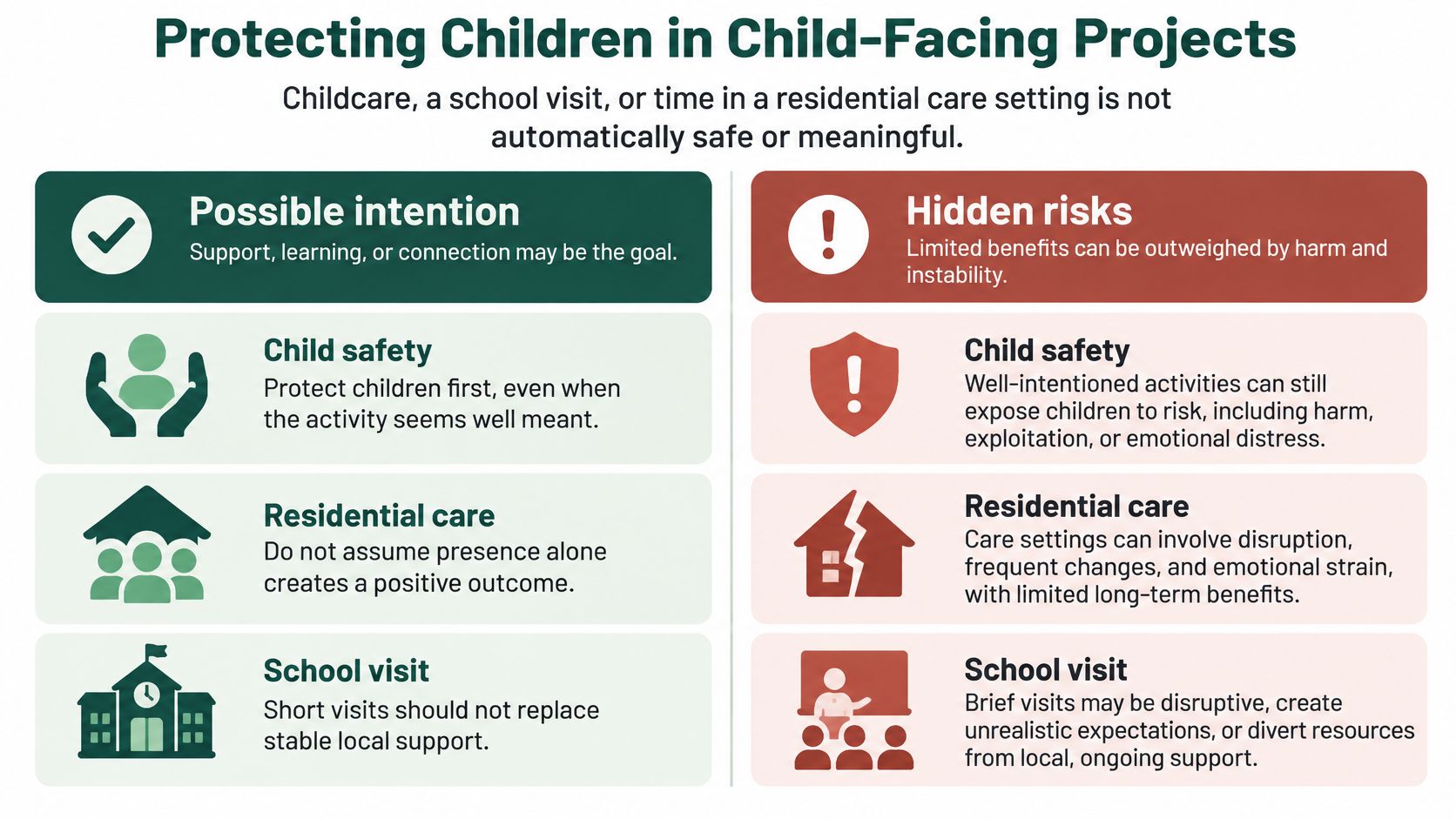
The dividing line is formal safeguarding. UNICEF South Africa's volunteer handbook states that screening is compulsory for every prospective volunteer who may work with minors, and can include a face-to-face interview, identity documentation, reference checks and police clearance, alongside an AFIS criminal-record check and a sexual-offences check form (UNICEF South Africa volunteering handbook). HeyLocals follows the same logic: participants declare criminal records as part of a pre-travel file, a designated safeguarding lead reviews the completed file and can approve it, decline it or request further information, and travel cannot proceed without that file.
Six checks tell you whether a child-facing project has real controls:
The task is defined without private access. The host names work that doesn't depend on being alone with a child.
Contact happens in a group, with local staff present and visible.
Nobody asks for one-to-one time with a child, whatever the justification.
You are not asked to photograph identifiable children for a project's marketing.
The activity isn't rebuilt around a new visitor every few days, which is the attachment cycle the evidence warns about.
Staff can explain who supervises the day and exactly what happens when someone raises a concern.
Participants must be at least 18 to book, and anyone under 18 travels only with written consent from a parent or legal guardian, and only on placements designated suitable for under-18s. Age rules set the floor. Screening and supervision do the protecting.
If you hoped to work with children, keep the aim and change the form: prepare materials, support a class the teacher leads, or take a conservation or community task that staff assign. Good intentions do not assign you a role. If a daycare setting is what you're considering, read what volunteering at a daycare involves before you weigh the options.
Three questions to hold on to: who is in the room, what task is assigned, and what continues when this group of visitors leaves?
Making the Trip Count After You Return
You can't audit a placement from the airport lounge, and you don't need to. What you can do is separate two things that get mixed together in the retelling: what the trip gave you, and what it gave the host.
A trip can feel worthwhile for entirely legitimate reasons. You learned a practical task and can now do it reliably. Local staff showed you how their routine works and corrected you twice before you got it right. That's personal value, and it's real. It isn't evidence of a community outcome, and the two shouldn't be swapped for each other when you describe the trip to family or in a university application.
Four questions are worth sitting with on the flight home.
What work were you asked to help with? Name the task, not the cause.
Who guided you, and how did they correct or confirm it? A supervisor who adjusted your work is a good sign.
What do you understand differently about that routine now? The learning sits here.
What would the next volunteer need to continue the same task? Your answer is useful handover information.
Read the answers plainly. If you can name the task and the staff member who directs it, the placement probably fitted you. If you can describe only how you felt, keep that as personal value and don't dress it up as impact.
A small habit that pays off: keep a two-line log during the stay. Date, task, who supervised, one thing you learned. Specific notes make your feedback to the host worth reading.
Photographs need the same discipline. Don't publish images of children or identifiable community members without consent, and don't treat a smiling picture as permission after the fact.
Feedback is the part often skipped. Tell the organisation what worked, what you were unprepared for and what you'd tell the next person taking the same role. That note is the handover, and it's the most durable thing a short stay can leave behind.
Confirm Your Fit Before You Book a Placement
Before you book travel for a purpose, write the fit down as a practical match: your available days against a defined task, your skills against the role's eligibility, your expectations against a project that is already running. More browsing will not answer that.
Write your reality down. Your ideal day, the skills and languages you have, and the dates you can stay. Include the hours you can manage in heat or at altitude.
Shortlist a project that is already running, where a local organisation defines the role. Compare it against the five questions and the expectation table before you fall for the photos.
Open the live project page and read the details for that programme only. Dates, inclusions, separate costs and eligibility vary by destination, so nothing carries across from one placement to another. A page such as Support for children with disabilities in Ho Chi Minh sets its own requirements and daily routine; judge that programme from its page, not from another placement.
Check eligibility before you imagine the week. You must be at least 18 to book, and under-18s may travel only with written consent from a parent or legal guardian and only on placements designated suitable for under-18s. Healthcare roles may ask for relevant studies or skills, keep the work to approved support or observation, and require local clinical supervision. Basic English is generally required, with higher proficiency for some activities.
Book a call with the HeyLocals team from the website. Describe who is travelling and what you need, bring your notes and the five questions, and ask us to check the match with the local organisation before you commit.
Two practical items belong in the same week as your decision. Travel insurance is compulsory for every participant on every HeyLocals Package, without exception, and it must cover at minimum cancellation and curtailment, medical expenses and emergency repatriation, personal accident, personal liability, loss of luggage and personal effects, the included activities, and the full duration of travel. Where checks apply, the completed file is reviewed before travel and the trip cannot proceed without it. You will also receive a Pre-Departure Pack, which carries the practical preparation and project-specific detail.
The concrete test is this: the project was running before you arrived, it will keep running after you leave, and your days slot into a task the people who live there decided needed doing.
HeyLocals arranges international volunteering trips with local organisations across Asia, Africa and Latin America, matching you to a project that is already running and supporting you from first question to final day. If you've written down your ideal day, your skills and your dates, we can check the fit with a local partner and tell you whether the role suits you. Start by visiting HeyLocals and booking a call with our team.
In this article
- Table of Contents
- What Purpose Looks Like Once You Arrive
- Five Questions That Show Whether Your Work Is Useful
- Project Types Compared by Role and Preparation
- Matching Your Expectations to the Placement on Offer
- Protecting Children in Child-Facing Projects
- Making the Trip Count After You Return
- Confirm Your Fit Before You Book a Placement